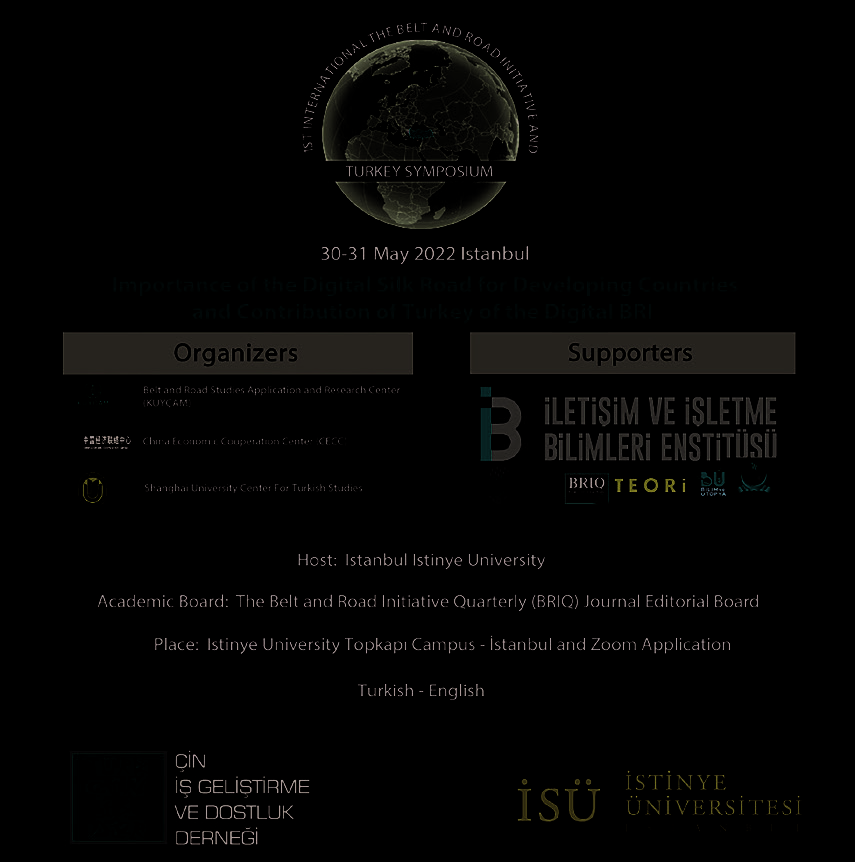
The 1st international belt and road Initiative and Turkey Symposium was held on May 30-31, 2022 in cooperation with the Turkish-Chinese Business Development and Friendship Association and the Istinye University Center for Belt and Road Studies (CBRS). The main theme of this symposium was the “Importance of the Digital Silk Road for Developing Countries and Contribution of Turkey to the Digital BRI”, which was discussed by distinguished business people, academics, and diplomats from different countries.
The opening session included Mustafa Varank (the Minister of Industry and Technology of the Republic of Turkey), Lin Songtian (President of the Chinese People’s Association for Friendship with Foreign Countries), Liu Shaobin (Ambassador of the People’s Republic of China to Ankara), Prof. Dr. Erkan İbiş (Rector of Istinye University), Lin Songtian (Chairman of the China Association of Friendship with Foreign Countries), Prof. Dr. Guo Changgang (Shanghai University Center for Turkish Studies), and Assoc. Prof. Efe Can Gürcan, Director of the CBRS. A total of 11 sessions were held over two days, where many topics were discussed, ranging from agriculture, education, transportation and logistics to finance, tourism, and development.
Organizers
Turkish-Chinese Business Development and Friendship Association, Istinye University Center for Belt and Road Studies (CBRS), China Economic Cooperation Center (CECC), Shanghai University Center for Turkish Studies.
Supporters
National Strategy Center (USMER), Belt and Road Initiative Quarterly (BRIQ), Institute of Communication and Business Sciences, Journal of Theory, Journal of Science and Utopia, Turkish Student Union in China.
The world of the oppressed will humanize digitalization
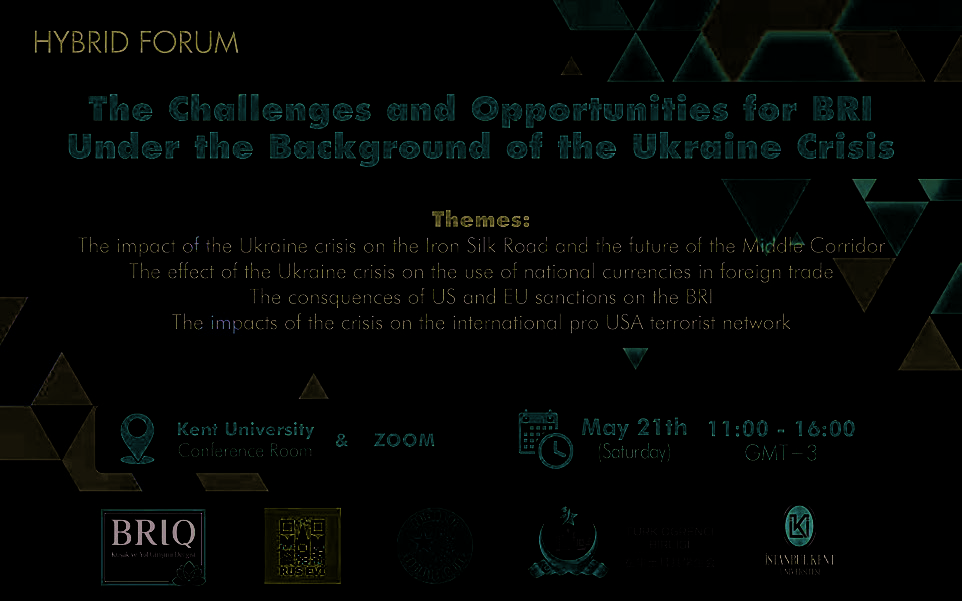
In his opening speech, Adnan Akfırat, President of the Turkish-Chinese Business Development and Friendship Association, said that “digitalization in the 20th century was developed and exploited by global capitalism to eliminate national borders, but in the 21st century, the initiative in digitalization has passed to developing countries”. Pointing out that the World of the Oppressed in the Asian Century has made digitalization one of the tools to get rid of the hegemony of US imperialism, Akfırat emphasized the involvement of the People’s Republic of China for digitalization as a leading state in this area. Akfırat observed that advanced capitalist BRIQ was the main organizer of “The Ukrainian crisis and the BRI: Challenges and opportunities", a hybrid forum that discussed the implications of NATO’s Eastward expansion and the challenges and opportunities brought by the Ukraine operation to the BRI.
The co-organizers of this forum, held on May 21, 2022, included the Russian Centre of Science and Culture, Friends of Socialist China Platform, Turkish Student Union in China, and Istanbul Kent University. Distinguished speakers from 4 continents and 10 different countries took part in the forum. Adnan Akfırat, President of the Turkish-Chinese Business Development and Friendship Association and Chairman of the BRIQ, made the opening speech and moderated the forum discussions.
In his speech, Akfirat said that the unipolar world, led by the United States and institutionalized by hegemonic tools such as the NATO and the EU, has collapsed, and now the initiative has passed to developing countries. He noted that a new international order is rapidly emerging, which is more egalitarian, fairer, more people-centered, and environmentally friendly. Stating that 87 percent of the world’s population do not agree with the USA and the EU regarding the sanctions against Russia, Akfırat concluded his speech by saying, “every step taken by NATO on the way to expand Eastward brings itself closer to its grave”. In this environment, Turkey should develop its relations with Asia, Africa, and Latin America within the framework of the Belt and Road Initiative in order to resist the pressures of Western countries.
Professor Ma Xiaolin, from Zhejiang University International Studies University, said in his speech that over the past 8 years, the Belt and Road Initiative has expanded the foreign trade volume of participating countries by 3 to 10 percent, while 7.6 million people have been lifted out of extreme poverty and 32 million people have been lifted out of poverty. He mentioned that the BRI greatly contributes to the construction of infrastructures such as railways and highways. Prof. Ma pointed out that after the Ukraine crisis, the West’s unilateral sanctions has negatively affected the global financial system. He went on to add that the United States has been conducting a demonization campaign to break the influence of the Belt and Road Initiative, which offers a better alternative to the whole world.
Other participants included Mushahid Hussain, Pakistan Senator and Chairman of the Defense Committee, Dr. Darya Platonova from Moscow University, Dr. Rajiv Ranjan from Shanghai University, Dr. Governor Kaleji from Tehran University, Keith Bennett, Editor of the Friends of Socialist China Platform, and Dr. Ahmed Shahidov, President of Azerbaijan Democracy and Human Rights Institute. The speakers concurred that the unipolar order has come to an end and unilateral sanctions by Western countries have only served to intensify the global problems. countries have transformed digitalization into an enemy of humanity that propagates individualism and intensifies exploitation. According to him, the main purpose of this symposium is to encourage Turkey to become a vanguard in the construction of the Digital Silk Road based on its young, dynamic, and qualified labor force as well as its talented and bold entrepreneurs. Akfırat also asserted that the BRI is driven by the principle of shared development and Turkey is one of the countries that benefit most from this collective initiative.