Introduction
The focus of this article is on the organization of Buddhist painting, which is an important feature of the art of the Northern Wei Dynasty (Yuan Wei), founded by the Toba Turks (Touba Wei). In this context, the organization of the composition will be examined through some sample wall paintings of this period, which are considered as examples. There are two elements that influence Buddhist art in China: the art of sculpture in India and Central Asia (especially in Gandhara). Buddhist sculptural iconography originating from Gandhara and Central Asia was under a strong Hellenistic influence, described as “Greco-Buddhist”. As for the Buddhist sculptural art of India, the effects of Indian mythology are clearly visible. Before the Northern Wei period, the depiction of Buddhist stories, both in Central Asia and in India, was mostly created with the art of sculpting. Buddhist iconographies made in
sculpture schools in these regions were depicted as simple story-painting strings. The sculptural art of Northern Wei was also influenced by early Buddhist art, which developed from these prototypes. The lack of a specific premise in Buddhist painting of this period pushed the Northern Wei artist to various pursuits for compositional patterns and opened the door to new compositional solutions.
The History of the Toba Turks, Who Founded the Northern Wei
Toba is a community that took over and united the north of China and remained in power for 150 years as a minority. It is generally accepted that the ethnological foundations of the Toba community, which founded the Northern Wei Dynasty (386- 535), the most powerful state of the Northern Dynasties period in China, were Turkish (el-Kaşgari 1074/2007; Lezina & Superanskaya, 2019Lezina & Superanskaya (2019). The source article does not provide a separate full bibliographic entry for this citation.; Zekiyev, 2007:130). “The word Tobas comes from Tabgac,
which is mentioned in the old Orhon inscriptions. By this name, the Toba state, which dominates Northern China, and in later period, the whole of China, was also meant“ (Eberhard, 1987:166). Muhammed el-Kâşgarî defines it (1074/2007:547) as: ”The name given to a Turkish people residing in the Tawgach region." The division of the Huns (Xiongnu State), the ancestors of the Toba, into the Chinese region and the migration of the “Five Nomadic Societies that Complicate China” later had led to the event known as the social and cultural change. “T'o-pa people were living as nomads in the southern parts of the Baikal region in the 1st century BC. They were found in the mixture of Baikal peoples who were included in the Hsiungnu State during 1st and 2nd centuries" (Gumilev, 2002:107). In 87 AD, the remnants of the Northern Huns, who were forced to leave Mongolia as a result of the cooperation of the Southern Hun State with China, joined the Xian Bei. The Toba tribe is a Toba Xianbei community consisting of Xianbei father and Hun (Xiong Nu) mother within the western region organization of the Xian Bei confederation, a Turkic-Mongolian union” (Utkan, 2018:55). When the western organization disintegrates, the Toba migrate from north to south and spread towards the Central Region. In these regions, the Toba who have become stronger form a union. “Tabgach State is known as T'o-pa because it was founded by the T'o-pa people or Northern Wei State because they were founded in the Wei region” (Balcı, 2010:18Ağaçlar, Kayalar, Av Partileri, “Vısual Versıon Of The Story”, Online Konferans. Balcı, T. G. (2010). Tabgaç Devleti (386-550) siyasi ve kültürel tarihi hakkında Çin Halk Cumhuriyeti’nde yapılan araştırma eserleri değerlendirmeli bibliyografyası. Yayınlanmamış Yüksek Lisans Tezi, Trakya Üniversitesi, Sosyal Bilimler Enstitüsü. Bao, M. (2021). Discussion on the Painting in Cave 254 of Mogao Grottoes.).
Toba Turks Entered Gansu and Founded the Northern Wei Dynasty
During their expansion, the Toba created a caste system based on military rule, which included 119 tribes with pressure on the majority Chinese population, and they established the Northern Wei Dynasty. The rulers of the Toba,
who took control of all of Northern China in 440, defended the path of sinicization against nomadic life, adapting to Chinese culture and civilization. However, looking back at the history of the early Northern Wei, we can see that as a tribe of the ancient Turks, they inherited a number of state traditions from the past. As the sinicization of the Northern Wei state progressed, the old customs and traditions were gradually abandoned.
Tobalar ve Budizm
After the 3rd century AD, China acquired a new religion through the Silk Road. “Although the name of Buddhism in China was mentioned during the Han Dynasty, its widespread adoption and acquisition as a true religion coincides with the Sixteen-State Period" (Utkan, 2018:50). Buddhism was not the local religion of China; through the Buddhist missionaries traveling through India and Central Asia, and through the original texts and Buddhist pilgrims, it began to spread from the Xinjiang region of present-day China to the central parts of it. The rulers of the Turkic and Mongolian communities adopted Buddhism and invited Buddhist monks and artists. Thus, new styles of Buddhist architecture such as stupas , monasteries and cave temples developed and many structures were built to meet the requirements of the growing Buddhist community. One of the most important of
them was undoubtedly the Dunhuang cave temples, which was the entrance gate to China at that time of the Silk Road.
Buddhism in the Northern Wei Dynasty under Toba
When Buddhism first entered China, communities in China considered this system of beliefs of foreign origin to be nothing more than belief in exaggerating supernatural phenomena. During the Northern Wei period, “For those in power, it did not matter what was worshiped in a temple during the time when they themselves realized their political goals” (Karavit, 2015:36Mimar Sinan Güzel Sanatlar Üniversitesi Yayınları. Karavit, C. (2015). Ipek Yolu. Istanbul: Türk Kültürlerine Hizmet Vakfı. Kenneth K.S. (1973). Ch’en, Buddhısm in Chına: A Historical Survery.). In order to convince the authorities that their political views were made for the benefit of society, they had the Buddhist discourses they interpreted accepted by the public. In short, the tradition of China was gradually accepted by some circles and synthesized with the mainstream of Chinese culture. Buddhism was adopted by Toba Gui (386-409), the first ruler of the Northern Wei Dynasty. Toba Gui spread the orders of the central authority by sending the clergy to the areas that the Northern Wei armies had just taken. Thus, the Northern Wei administration gained control over the monastic community in the North of China. “In this regard, according to the state strategy of the government in Northern China, which is headed by the Toba community, the Buddhist community has never received such a free status as in southern China. We can define this as the Northern Buddhism of that era” (Karavit, 2015:36Mimar Sinan Güzel Sanatlar Üniversitesi Yayınları. Karavit, C. (2015). Ipek Yolu. Istanbul: Türk Kültürlerine Hizmet Vakfı. Kenneth K.S. (1973). Ch’en, Buddhısm in Chına: A Historical Survery.). Another important reason for the growth of Buddhism during this period is the increasing sinicization policies of the Toba emperors. “In the figures announced by the ‘Discussions on Toba Issues’ section of the Chinese annals, at least 60% of the population was Chinese and perhaps as many as 20% were Tabgach.” (Golden, 2020:87Retrieved from. Golden, P. B. (2020). Türk Halkları Tarihine Giriş. Istanbul: Ötüken Yayınevi. Gumilev, L. N. (2002). Hunlar (çev. D. Ahsen Batur). Istanbul: Selenge Yayınları. Guiraud, P. (1984). Anlambilim, Ankara: Kuzey Yayınları. Huo, X & Qi X. (2006). The Buddist Art in Xinjiang Along the Silk Road.).
In this direction, as the Northern Wei Dynasty conquered new lands, forced migrations took place between the Chinese peoples in accordance with their requirements. These forced migrations also accelerated the migrations of artists and craftsmen to the capitals of the Northern Wei Dynasty. “The Veys (Wei) play a culturally important role. After a long period of maintaining many nomadic traditions, they become Chinese... at least 1300 temples are established in Lo-yang; Jong-ti (471-499) achieves a rare success by building the famous Longmen caves.” (Roux , 2006:120). This situation has affected Buddhist art. The Toba rulers of Northern Wei provided great support for the production of Buddhist paintings and sculptures. The most important factor in the development of the art of the Northern Wei period is the translation of Buddhist sacred texts into Chinese. These translations were extremely important for the depiction of wall paintings, which were a means of visual propaganda of Buddhism.
Effects of Buddhist Administration and Art in the Northern Wei Period
Cave temples were the main architectural structure in China in terms of containing Buddhist art in its entirety. In essence, cave temples are an extension of the cave temples of India, but over time they have become blended and sinicization. The earliest Buddhist paintings are in Ajanta Cave (in India) which are dated in the first half of the 2nd century BC, and with the spread of Buddhism, its leading influence on Chinese works is visible. Just in 398, during the newly established years of the Northern Wei Empire, Emperor Toba Gui published: “...it is commanded that the capital of the statesman will be decorated with visual artifacts, and statues will be erected and Buddha's masters will be given places
of residence so that they will have a place to stay" (Kenneth, 1973Kenneth (1973). The source article does not provide a separate full bibliographic entry for this citation.). His proclamation was a definite order and an indication of the dynasty's investments in Buddhist art. During the Southern and Northern Dynasties (3.- 6. century), there was turmoil in the major cities of China. The most important area of the cave temples group, Dunhuang, was a relatively stable refuge center. This was the only connection place between China and the West, and also an important trade center. After the opening of this road, the culture of China and the cultures of India, West and Central Asia were fused here. In these cave temples in China, prototypes were needed for artists and craftsmen who produced Buddhist art. In the early stages of Buddhism, bronze and gold sculptures, which will serve as a prototype in the art of sculpture, first came to China from Northern India. “Many merchants and missionaries from India and Central Asia brought works of all kinds of descriptive art to China, and these sculptural, painting and illustrated manuscripts became models for the Chinese craftsman and artist who made the first local works (Van Alphen & Bisscop, 2001Van Alphen & Bisscop (2001). The source article does not provide a separate full bibliographic entry for this citation.).
Buddhist Painting Art of the Northern Wei Period
In the development of Buddhism in China, places of worship that lacked visual propaganda tools could not convey a strong enough message to believers. Therefore, during the development and spread of cave temples constructions, two arts developed together with architecture: painting and sculpture.
These two arts have created a visual narrative language through which believers and priests can communicate Buddhist teachings in temples. Buddhist sacred texts were translated on the one hand; on the other hand, they were interpreted with visual narratives. According to Pierre Guiraud: “... language serves to convey concepts by portraying images formed in our own moment in the memory of someone across us” (Guiraud , 1984:31). In this context, the artist's world of imagery has been important in the painting of Buddhist texts. Guiraud (1984) indicates that, to the context of the wordobject: "These are dry and abstract images of objects, ‘the word is not the object’; it portrays the object indirectly, as if from behind a curtain. However, only the very thing that wants to be animated can make us feel it." By making this determination, he references to the source of the “thing” that wants to be revived. Texts alone do not meet the source of what the Buddhist art of painting “wants to revive”. Because word is not a ”object". In this direction, two trigger elements have come into play for the visual narrative to come to life: Buddhist iconography and the artist's world of imagery. For this reason, the choice of types of stories in Buddhist texts played an important role in the design of paintings in caves. The stories of all the murals in the caves are Jataka stories written before BC and are divided into different genres: Tales of Buddhist Gods, Jataka Stories, Cause and effect stories, Buddhist History Stories, Story of Famous Buddhist Monks, Morality Stories, Buddhist Temple Stories, “Story of the Bodhi Tree” (Cheng, 2008:13-14).
A Formal Analysis of the Compositional Pattern of Northern Wei Painting
“The art of painting in Northern Wei is different from the art of sculpture and is not limited to strict religious rituals. Apart from what Buddhist
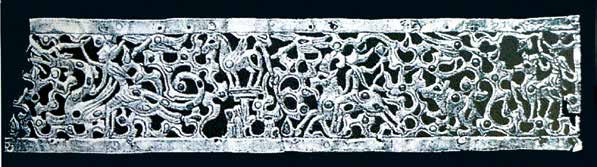
philosophy implied, they depicted the texts in a different visual framework. In this sense, painters were able to break the rules and use their own imagination when drawing such paintings.” (Bao, 2021Bao (2021). The source article does not provide a separate full bibliographic entry for this citation.). Were the imagistic worlds of the nomadic communities rich enough to be able to look at Buddhist art from such a diverse visual framework and design compositional patterns? Jean Paul Roux (2006:117) notes that for nomadic communities such as the Xiongnus (Huns) and their relatives, the Xianbei, “Like all steppe people, are real artisans; the large number of thimbles and plates found in Ordos prove their outstanding achievements in this regard. They have managed to interpret, reproduce and revive animal fighting figures and themes according to themselves, even if they are not the first to use high-relief technique, overflowing fantasy and vitality, and deer and ram figures." Before the nomads of the steppe settled down in the north of China and established an empire, the basic tools and equipment they used in their daily work were easy-to-install, detachable and durable items. This requirement played a role in the development of their technical and mathematical skills, as well as their craftsmanship. Items made with this crossing structure or jigsaw technique have improved their entertainment and educational skills. Today, the “International Museum of Intelligence and Puzzles” is located in Mongolia, which was once the dwelling of the ancient immigrant communities of the north.
According to the claim of the museum management and guides located in the capital Ulaanbaatar, this is the place of origin of intelligence games in the World: “Shatar, the Mongolian version of ancient Mongolian intelligence games and chess, historically dates back to the Middle Ages” (IQ Museum, t.y.IQ Museum (t.y.). The source article does not provide a separate full bibliographic entry for this citation.). The nomadic communities of the North have repeatedly combined multi-part puzzles to evaluate their leisure time, and have sought alternative solutions to Deconstruct and integrate them. "Wooden knots and solving puzzles have traditionally been popular” (Szynkiewicz, 1989Artibus Asiae, 53(1/2), 59-88. Szynkiewicz, S. (1989) Sport und Spiele. in Walther Heissig (editor), Die Mongolen (exhibition catalogue), Innsbruck 1989. Tamamushi Shrine (t.y.) Retrieved from. Utkan, P. (2018). Hunlar. Türkiye Iş Bankası Yayınları, Istanbul. Van Alphen, J., & Bisscop, N. D. (2001). The Buddha in the Dragon Gate). "After solving the problem of integrating these parts of the whole, they began to create their own puzzles” (IQ Museum, t.y.IQ Museum (t.y.). The source article does not provide a separate full bibliographic entry for this citation.). For these games, which are considered the predecessor of puzzle, they designed compositional patterns with transition systems from complex forms that they made with limited materials at their disposal. This understanding of composition is also seen in the motifs they process on items and clothing: “One of the most extraordinary art products of the steppe are the plates called ‘struggle scenes’. These plates are usually a pair of animals, their tails and horns are very closely intertwined the composition depicts leaves and birds gushing from their wings in a row, and their bodies are incredibly twisted and intertwined.” (Roux, 2006:54). (Pic. 1)
The second socio-cultural contribution of nomadic culture to Buddhist art is the strong visual memory of the nomadic society. Strong visual memory was
a necessity for these communities to survive in the huge steppe geography in which they lived. Philippe Dubois and Elise Rousseau say that the wealth of visual memories of nomadic communities continues even today: “...The Mongols find their place in the mountain shapes that escape the eyes of Europeans, in the subtle details of nature. Because here, in an area of tens of thousands of square meters ... everything is similar to each other, and the Western eye cannot place anything in its memory, it cannot detect anything to guide it” (Dubois & Rousseau, 2020:27-28Princeton Univ. Press. Dubois, P. & Rousseau, E. (2020). Kuşların Felsefesi. Istanbul: Domingo Yayınları, 27-28. Colors of Dunhuang (2012). The Gateway to the Silk Road: Colors of Dunhuang Exhibition. Video Presentation of the Exhibition Held as part of "Chinese Cultural Year in Turkey", MSGSÜ Tophane-I Amire Cultural Center Five Dome Hall, Istanbul. Eberhard, W. (1987). Çin Tarihi, Ankara: TTK Yayınları. el-Kaşgari, M. (1074/2007). Dîvânü Lugâti’t Türk. Istanbul: Kabalcı Yayınevi. Feng F. (2002) The Nude Art of the Quici Grottes. Beijing. Ganguly, B. (2017). Temptation of the Buddha with Mara's army fleeing.). Visual memory also means that the world of imagery is strong. In the Northern Wei painting art, we come across many common images that reflect the socio-cultural life of the nomadic society in the depiction of Buddhist texts: animal figures, hunting scenes, fighting scenes, etc. Whether religious or non-religious, the imagery worlds consisting of the visual memory archive of nomadic societies have contributed to Buddhist art. At the same time, this world of imagery was a common visual language for the illiterate society, which would transmit Buddhist texts. The third element that I think has an effect on the murals of the nomadic society is “storytelling”. Storytellers have spread narrative culture in history thanks to some social classes; farmers, monks of religious discourses, and travelers (nomadic storytellers, merchants, etc.). The most important means of mass entertainment of all nomadic communities in the north and west of China were storytellers, and it was thanks to them that the culture of oral storytelling was formed.
“We are aware that in the ancient Central Asian
Turkish culture, Shamanist Turks spent long nights evaluating their time with the stories told by shamans“ (Nutku, 1976Nutku (1976). The source article does not provide a separate full bibliographic entry for this citation.). In this way, oral storytelling has been developed by the storytellers of the nomadic culture and their ability to ”script" them into story painting. Buddhist sacred texts also have a rich storytelling. Buddhist texts, on the one hand, were interpreted in translations, and on the other hand, at Buddhist sites on the Silk Road, the artistic styles of Chinese, Western and nomadic culture were mixed, melting into each other. "Artists and craftmen of the period created a new visual framework for the art of Buddhist painting, different from the meanings implied by Buddhist philosophy. The pictorial compositions of the new visual culture, interpreted from Buddhist discourses, differed greatly, as did the synthesized cultures of the Silk Road” (Shih, 1993:59-88). In this context, we will focus on three sample paintings to examine the different compositional patterns of Northern Wei Buddhist painting art.
The Nine Colored Deer
Most of the wall paintings in Dunhuang describe Buddhist stories. These stories are called Jataka Tales and are about Buddha's life before being recognized as a Bodhisattva. This story is known as "Ruru Jataka" in Pali Buddhist rhetoric and Arya Sura's Jatakamala. The story of the Nine Colored Deer has been described on the middle section of the southern side of the western wall in the cave of Mogao no 257. The height of the painting is 58.5 centimeters, and the width of it is 588 centimeters. (Pic. 2)
This Jataka story is briefly as follows: "Once upon a time, a nine-colored deer lived on a mountain. It is known as the ‘Nine Colored Deer’ because it has different colors all over its body. One day, when the Nine Colored Deer comes to a river to drink water, he sees a man (Diao Da) fluttering in the water and saves the drowning man. The man thanks the deer by prostrating himself. Deer: 'There is nothing to thank, if you do not come out of where I live, it will be your gratitude to me.’ The man promises: 'If I betray you, I will have pus, pus-filled wounds all over my body!’ On the other hand, the queen of the country dreams of a nine-colored deer, so she asks the king for the skin of the 'Nine-colored Deer’. The King declares that the Nine-Colored Deer will be rewarded handsomely. The man rescued by the deer reports the deer's location in order to gain wealth. The surrounded Deer is led straight towards the king. The deer points to the man he saved and tells the king how he saved him. When everyone turns to the man, they see that he has pus and blood all over his body. The
whistleblower is punished by the king for his disbelief, and no one is allowed to harm the deer” (Ma, 2007马泰, 龟兹造像, 范书财编, 北京:文物出版社 Ma Q. & Fan S. (2007). Murals in Kucha,Beijing. Wenwu Chuban She. Nutku, Ö. (1976). Meddahlik ve meddah hikâyeleri. Ajans-Türk Matbaacılık Sanayii. Otkan, P. (2018). Tarihçinin kayıtları’na (Shi Ji) göre Hunlar Ankara: Türkiye Iş Bankası Kültür Yayınları. Pang X. (1982). Research on Chinese Ancient Decorative Painting, Shanghai People’s Fine Arts Publishing House, Shanghai. Roux, J. P. (2006). Orta Asya: Tarih ve uygarlık (Çev. L. Arslan Özcan, Ikinci basım). Istanbul: Kabalcı Yayıncılık. Shih, H. Y. (1993). Readings and re-readings of narrative in Dunhuang murals.).
The Plot and the Narrative Pattern
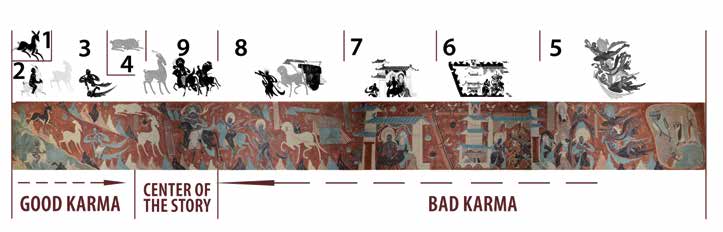
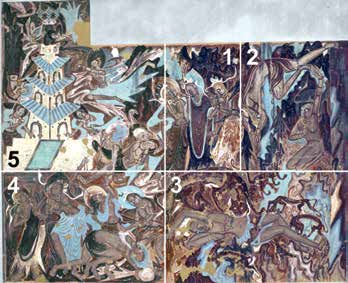
“The illustrated narration of the story "Nine Colored Deer" is depicted in nine scenes (Pic. 3).
“The episodes come from both sides towards the center where the climax of the story is depicted. The conversation between the king and the deer ends the story. This arrangement is an interesting example of showing that it is not necessary to depict a story in chronological order” (Karavit, 2012:71Karavit (2012). The source article does not provide a separate full bibliographic entry for this citation.).
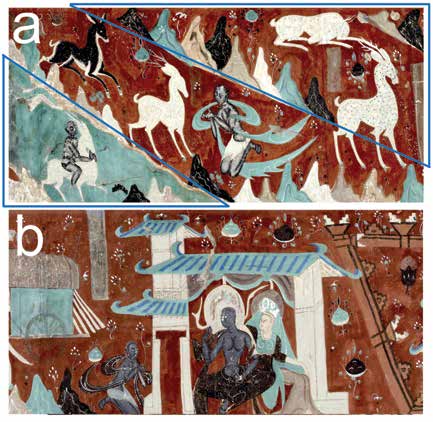
The first two scenes of the painting occupy a quarter of the available space, while an equal portion is devoted to each of the other three scenes. The narrative, which begins on the left side of the picture, begins with three consecutive chapters. The deer saves a drowning person, who then kneels down to thank him. The deer then rests above the picture. These successive sections, which form the first part of the picture, are separated from each other by the diagonal
partitions formed by the mountain ranges on the left side of the picture (Pic. 4). After this part, the direction of the narrative moves to the right side of the picture. The scenes progress towards the center of the picture, starting from the far right, with the palace life, the queen seeing the deer in her dream, and the man rescued by the deer informing the king and queen about the deer. In 3/4 of the scenes going from right to left, the last scene is followed by the whistleblower man guiding a carriage to find the deer and the deer confronting the king.
Linear Compositional Pattern through the Center
A linear reading of the painting's space cannot be made to equalize the diachrony in the narrative
because the scenes meet asymmetrically in the left center of the picture, arranging from left to right 1, 2, 3, 4 (covering 1/4 of the whole) and from right to left with a follow-up string of 5, 6, 7, 8, 9 (covering 3/4 of the whole). As in these scenes, the scenes of good and bad behavior (Karma) are depicted consecutively in the last two scenes. The trace order of the description also explains Jataka's "Karma" discourse. In the formal organization of the visual narrative, there is a balanced structural order between the good and bad "Karma" actions of the king who saves the deer and the man who betrays the deer (Pic. 3). Thus, the good "Karma" in the actions of the Deer and the King is highlighted by the direction signs. The deer always looks to the right, the king to the left. On other hand, the Chinese architectural structures depicted in the
right part of the painting make the organization of the composition a closed form. “Scenes on the right have a defined and stable starting point, accentuated by the straight lines of an architectural setting” (Shih, 1993:59-88). This region of the painting has a closed form, but continues with an open movement to the left and turns into an open-form composition. These architectural structures fulfill two important functions in the long linear follow-up of the story: frame and seperation. The first function frames two important scenes; the scene where the queen dreams of the "Nine Colored Deer" and the scene where the man denounces the deer to the king. "The brightest scenes in this mural are the scenes where the queen recounts her dream, the scene where her passion and restless inner world are reflected quite well in her body language, and the scene where the man sniffs the deer" (Zhang, 2002:60). The second important
function is that these places serve as a separator between the other scenes of the story.
Other Examples of the Illustration of the “Nine Colored Deer” Story
While there are many examples of the "Deer King", there are rare examples of the "Nine Colored Deer" story. The plot and compositional pattern of the painting "Nine Colored Deer" depicted in cave no. 257 in Mogao (North Wei Middle period 465- 500) is a rare example of this; because there is no other example of this story coming from the right and left with a linear follow-up and uniting it in the center. The rhombic framed pictures of the story “Nine Colored Deer” in the 11th framework of the Kizil Cave No. 38 are the compositional pattern classics of the Kizil caves. However, differently, the story is summarized in a single frame (Pic. 5).
The Defeat of Mara
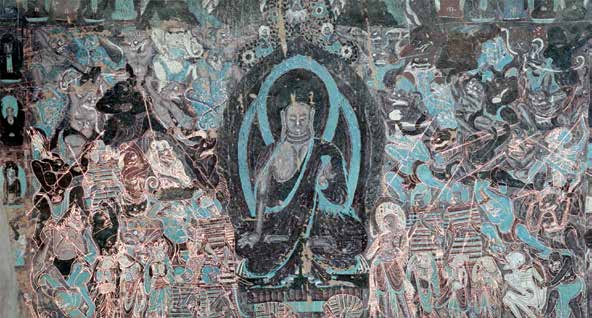
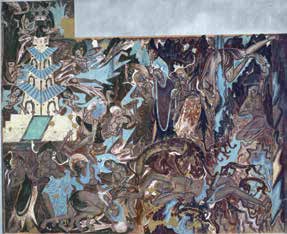
"The Defeat of Mara" is depicted on the south wall of cave 254 of the Mogao cave temples in the Buddhist historical site of Dunhuang in Gansu province, China (Pic. 6). "The Defeat of Mara" is a Jakata story. The height of the painting is 118 cm and its width is 229 cm. is Mara is the guardian of the lust that exists around the Buddha, the being of anxiety and fear. Among Buddhists, it is described as a demon that hinders meditation and delights in destruction. According to the scriptures, demons "bring an atmosphere of darkness" and depictions of demons are three poisons; It forms the unifying theme of greed, anger, and stupidity.
The "Defeat of Mara" mural tells the story of Prince Siddhartha before he attained enlightenment and became the "Historical
Buddha" . "While the prince is sitting under the bodhi tree in meditation, the demon Mara, the celestial being of desire, fears that his enlightenment will lead people out of the trap of lust, so she tries to harass him with her demons. Whether Mara's demon army uses temptation or power attacks, this battle is suppressed by Buddha's meditation, compassion, and wisdom. The demons fail and eventually surrender. Siddhartha also passes the test, conquers the spirit of the demon, and attains enlightenment" (Chen H. & Chen Q., 2020Chen H. & Chen Q. (2020) Subduing the Devil: Interpretation of Dunhuang Art Classics through Digital Media. Ars Orientalis, Volume 50, Smithsonian Institution, Washington, D.C. Chen H. & Chen Q. (2017).). In Buddhist texts, the demon king's daughters also participate in the act of seduction. However, in some texts, it is said that the demon Mara did not send his three daughters to seduce him, but instead they came of their own accord after Mara's failure in his effort to prevent Buddha's enlightenment (Keown, 2004: 171).
The Plot and the Narrative Pattern
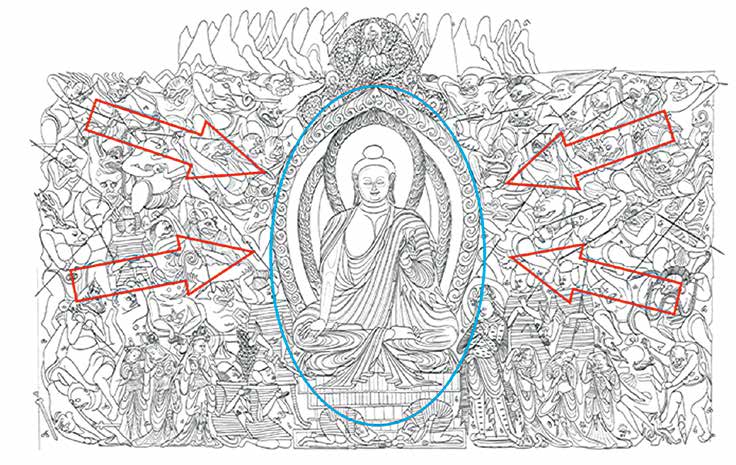
According to the narrative, Siddhartha, positioned at the very center of the composition, is always calm and unhurried. In the whole story, it is viewed as the last scene after overcoming events. However, this scene constitutes the beginning as well as the end of the follow-up sequence. The narration sequence of the story spreads from the figure of Siddhartha towards the environment (Pic. 7). Then, Siddhartha's central calm is followed by a powerful narrative depicting the demon horde's aggression towards him. The third part of the follow-up sequence
is the scene in the lower part where the Mara's daughters, whose gaze is directed towards Buddha, are depicted with different physical characteristics. In various legends, Mara's daughters try to seduce Prince Siddhartha with their beautiful female appearances. In this section, Mara's daughters to the left of the Buddha are depicted as old and ugly women, and those to his right as young and beautiful and seductive. In the end, the demons' anger and weapons are broken, all attacks are blocked, and bouquets of flowers bloom from the broken weapons. The environment of demons turns into a peaceful, stable, and beautiful environment.
Central Composition as a Classic Narration
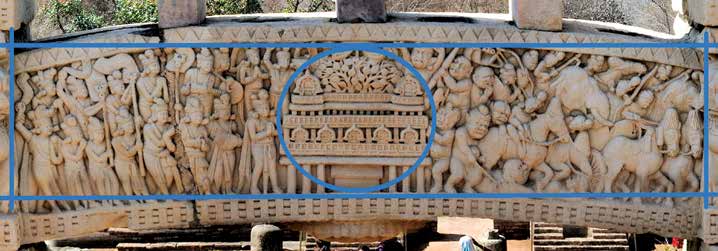
The artistic origins of the painting are rooted in the tradition of placing the demonsurrounded Buddha or Buddha symbols at the center of the composition. The stonecarved relief "Mara's Attempt to Seduce Buddha with her Daughters and the Flight of Mara's Demons’ is arranged by the principle of its central composition in Buddhist art, although it is not yet directly represented by the human figure but is symbolized by a stupa” (Chen H. & Chen Q., 2017:143Chen H. & Chen Q. (2020) Subduing the Devil: Interpretation of Dunhuang Art Classics through Digital Media. Ars Orientalis, Volume 50, Smithsonian Institution, Washington, D.C. Chen H. & Chen Q. (2017).). Almost all of these stories are symmetrical, central, closed-form. In this relief, the demon Mara is placed in the center of the composition (Pic. 8). The composition is linear but not sequential. With the spread of Indian Buddhist art, the depiction of demons confronting Buddha became common, and demon figures varied from region to region.
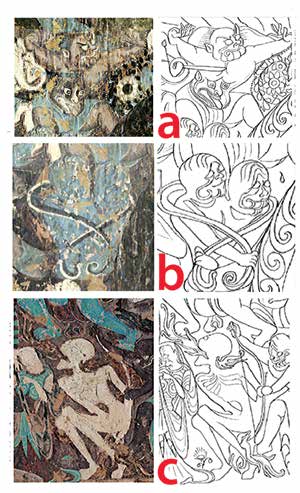
In the painting "The Defeat of Mara" in cave 254 of Mogao, the surreal images of demon figures represent an incitement to bad morals (Karma). For example, black smoke comes out of the bellies of demons, just like blind, ignorant people. In another “the head of a two-headed blue demon is constantly split in two or even up to ten” (Chen H. & Chen, Q., 2020Chen H. & Chen Q. (2020) Subduing the Devil: Interpretation of Dunhuang Art Classics through Digital Media. Ars Orientalis, Volume 50, Smithsonian Institution, Washington, D.C. Chen H. & Chen Q. (2017).). The ever-differentiating head is a symbol of greed. Another demon “has a skeletal body and filled with fire, spews fire from his mouth, nose, eyes, ears, and head” (Chen H. & Chen, Q., 2020Chen H. & Chen Q. (2020) Subduing the Devil: Interpretation of Dunhuang Art Classics through Digital Media. Ars Orientalis, Volume 50, Smithsonian Institution, Washington, D.C. Chen H. & Chen Q. (2017).). This defines anger (Pic. 9). While the traditional compositional understanding of Indian and Central Asian art is continued in this wall painting, the style of depicting the demons is in harmony with the art of the Han Dynasty (2nd century BC) of China. This combination illustrates the process of blending other Asian traditions and local
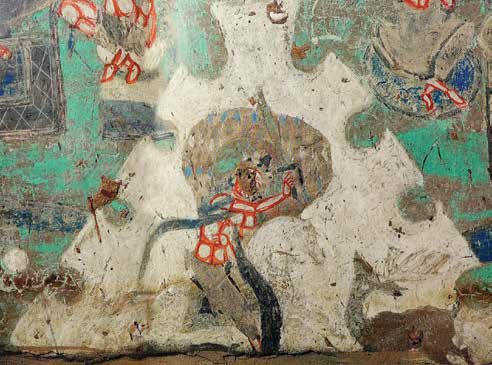
cultures with Buddhist art. "The body position of the Buddha who defies Mara is the common pose of Buddha statues on this subject" (Vogel & Barnouw, 1936, s. 70-71199). Etnografisch Museum. Vogel, J. P., & Barnouw, A. J. (1936). Buddhist Art in India, Ceylon, and Java.). The Buddha is shown with his left hand in his lap, palm facing up, and his right hand on his right knee. The bodies of Mara's daughters, who are depicted as old and ugly in the lower part of the painting, are depicted
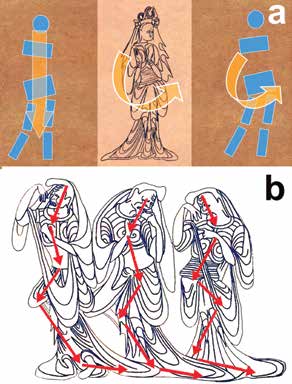
with tired, fragile body axes that can no longer resist gravity. The anatomy of those who want to seduce Buddha and those with beautiful bodies are depicted with a strong and dynamic axes (Pic. 10).
Other Examples of the Story of Mara's Defeat
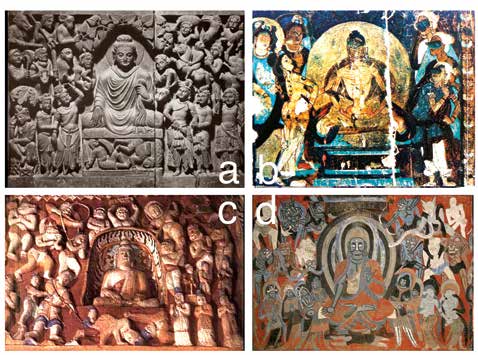
The painting "The Defeat of Mara" is depicted with similar compositions, starting from the earliest schools of Buddhist art and extending to the mural painting of the Mogao caves. Gandhara (3 AD), Kizil caves 76 (7 AD), Mogao 265 and 428 (North
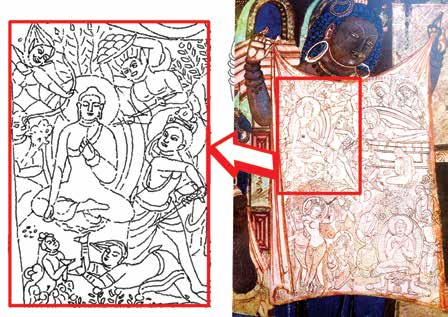
Liang), and Yungang cave no.5 (Northern Wei) (Pic. 11) wall paintings are examples of these. The difference is small, and the artist has given more importance to the moment of tense confrontation. The Kizil cave temples in the Xinjiang region of China are somewhat different from these examples. The stories of the Buddha in the Kizil Caves are generally depicted in single-scene, rhombic compositions. In the picture in the Kizil Cave no.205, the Buddha's life story in a single square composition has four scenes, and its upper left corner depicts "The Defeat of Mara" (Pic. 12). We cannot find such examples in the compositional pattern in Buddhist painting of the Northern Wei period.
The story of “Prince Sattva Sacrificing Himself to Feed Tigers”
In cave 254 of the Mogao caves, on the south wall of the main chamber, the Buddhist story "Prince Sattva Sacrificing Himself to Feed Tigers” (Mahasattva Jataka) was illustrated during the Northern Wei period (Pic. 13). Mahasattva Jataka is a Jakata story of prince Sattva's life before he became Gautama . The height of this mural is 125 cm and its Buddha width is 168 cm. is the depiction of "Prince Sattva Sacrificing Himself to Feed Tigers.” It consists of twenty human figures, eight tigers, five goats, two deer, a monkey, and randomly overlapping mountains. The prince Mahasattva, the protagonist of this story, will be briefly referred to as "Sattva" in the text (Karavit, 2012, s.108Karavit (2012). The source article does not provide a separate full bibliographic entry for this citation.).
"The description of the story begins with three princes standing on the mountainside. Prince Sattva
is in the middle of his brothers. The tiger and its cubs, found below the mountain, are starving. Sattva throws herself before the hungry tigers, but the tigress is too weak to bite her. Sattva climbs the cliffs, pierces his neck with a bamboo stick, bleeds, and jumps back down to the tigers. Hungry tigers head for her lying body on the ground and eat it. His family grieves deeply at Sattva's death. Later, they realize the virtue of Sattva's self-sacrifice. As depicted in the Sutras, Sattva sacrificed his body to attain enlightenment. "
The Plot and the Narrative Pattern
There are different follow-up interpretations of the description of this story. According to Mingjie Bao, the Mahasattva Jataka painting: "Scenes and sequences depicted in eight separate space-times are displayed in a spiral type composition. In this context, the story is arranged chronologically with
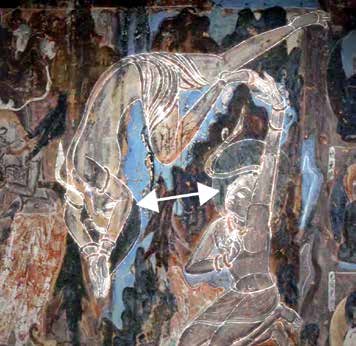
eight plots" (Bao scenes (Pic. 14). The first scene of the story begins with the three brothers watching the tigers on the mountain top and Prince Sattva, standing in the middle of them, raising his right hand for an offering. The viewer's attention is directed by the slanting stance of Satva's two older brothers and follows Sattva's robes to focus on the tiger cubs below. In the second scene, this shows Satva piercing his neck and jumping down, Sattva lies next to the tigers. However, tigers are so hungry and weak that they cannot bite him. Sattva climbs the cliffs again, pierces his neck with a bamboo, and jumps off the cliffs to the tigers. In this scene, two Sattva figures from different times facing each other are shown in the same frame (Pic. 15). One pierces his neck with a bamboo, while the other jumps off the cliffs. "It's as if one (right) said to the other: 'You've given your life as a sacrifice. Do you have any remorse?' The other seems to reply: 'Absolutely not. I am not a fan of fame and power.' He says, 'I just want to help all the sensitive ones to be freed from the, 2021). However, according to Dunhuang Academy, the plots of the story are divided into five painful
cycle of life'" (Karavit, 2012Karavit (2012). The source article does not provide a separate full bibliographic entry for this citation.). The third scene is the feeding of the tigers with Sattva. The attention of the audience is directed to the body lying on the ground surrounded by tigers, following the Sattva, who jumped down and stood up. Sattva helps the tigers to eat him. This sign depicts the interdependence of life and death. The viewer's attention follows her arms and is directed towards the next scene. In the fourth scene depicting mourning for Sattva, his family grieves after his death. A figure sprinkles water on them. In Buddhism, sprinkling water on someone means "awakening." His family awakens and realizes the virtue of Sattva. In the fifth scene, the White Stupa, representing the mercy of Sattva, is erected as an offering. Sattva did not want suffering behind him, nor did he want to attain Nirvana. Instead, he wanted to sacrifice himself again and again every time he came into the world.
Compositions that Breaks Old Artistic Concepts
In early depictions of the "Mahasattva Jataka" story, only one scene was usually chosen, which was the scene of Sattva throwing his body from a cliff to a tiger. This scene was the focus scene, expressing the whole story, and was popular. This scene became a dominant motif and has been depicted over and over for hundreds of years. In some areas, the choice of this single scene was “perhaps due to the very limited painting area, because the frames of such early paintings were limited to the lozenge-shaped grid pattern, as in the example of the Kizil caves” (Bao, 2021Bao (2021). The source article does not provide a separate full bibliographic entry for this citation.). The compositional pattern of the painting in Mogao Cave 254, on the other hand, shows an independence and integrity that is unmatched in the compositions of other paintings. Because the narrative of this painting is the synthesis of different compositional pattern. The mural in Cave 254 “combines the early stage single-scene image with the clearly depicted story from Cave 428, creating a complex image with a larger painting. Although this image presented some difficulties for the viewer in terms of viewing and identification, it was greatly improved on previous single-image examples and produced a composite image that was not as simple as the first images” (Bao , 2021Bao (2021). The source article does not provide a separate full bibliographic entry for this citation.). Pang Xunqin (1982Clarendon Press. Xunqin, P. (1982). Research on Chinese Ancient Decorative Painting. Shanghai People’s Fine Arts Publishing House, Shanghai, 38. Zekiyev, M. Z.(2019). Türklerin ve Tatarların Kökeni, Selenge Yayınları, Istanbul. Zhang, A. H. (2006), 克孜尔石窟壁画精选·佛传故事, 乌鲁木齐: 新疆人 民出版社, s.13-14. Zhang, W. (2002). Dunhuang, Beijing: Dunhuanh Research Institute, Morning Glory Publishers.)
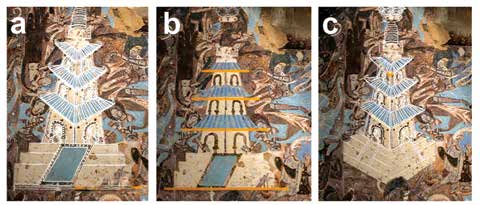
said for this understanding of composition: "The artistic understanding of this painting is breaking old habits. It organizes the whole story in one painting." In his painting in Cave 254, the artist used his creativity to show different times and scenes in a single image, similar to the montage technique. Thus, he not only reflected the plot of the story but also revealed its spiritual depth. When we look at the linear infrastructure of the composition, this spiritual depth emerges in vertical and horizontal lines. The artists performed this scene in an unusual way; they depicted the White Stupa from a bird's-eye view and its foundation at ground level. Such a perspective method is rare in Buddhist paintings. So why did the artist resort to it? "In the first option, if both the ground and upper floors of the stupa were flat, the whole picture would be very dull and uninspired, and the painting would not be a memorable scene despite the laborious sacrifice of Satva (the feeling of looking from above adds to the celestial effect). In the second option, "if the whole pagoda was drawn from a bird's eye view, this time the pagoda would damage the sense of balance (solidity) in the design and weaken the horizontal and vertical connections of the whole picture. In the third option, if we were looking at the stupa from below, the upward-facing roofs of the stupa would change its focal point and make it appear incoherent" (Karavit, 2012Karavit (2012). The source article does not provide a separate full bibliographic entry for this citation.) (Pic. 16).
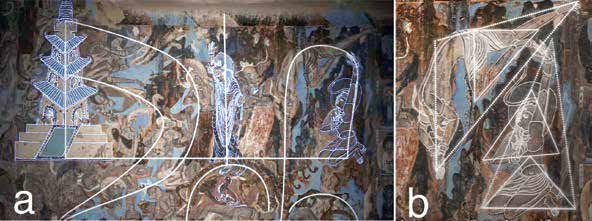
Thanks to this perspective depiction, the horizon line formed from the foundation of the Pagoda to the part where Sattva pierced his neck leads us to the starting point. Thus, by looking at the whole picture, viewers can perceive this spiritual depth along the lines of "votive" and "enlightenment" (vertical and horizontal) with two implicit references. "The first line draws a vertical line down his robe as he makes the Sattva offering towards the feeding tiger cubs" (Karavit, 2012Karavit (2012). The source article does not provide a separate full bibliographic entry for this citation.). This vertical line (votive) depicts the joy of the baby tigers being brought back to life by Sattva's self-sacrifice. The second horizontal line (The Enlightenment) extends from the White Stupa on the left, symbolizing the enlightenment of the Sattva, to the scene where he pierces his neck on the right. These two lines express the interrelationships of cause and effect (Pic. 17-a). The compositional pattern with a triangular and "S" shaped form in the painting of Mahãsattva jãtaka are common in arts of ancient and modern period, but we rarely see them as complex compositional patterns as in Cave 254. The painter skillfully combined a triangular composition with a circular and "S" shaped form
(Pic. 17-b). He brings the audience's attention from the eaves to the base of the monument, and then, through the horizontal central line, to the beginning, where the Sattva takes an oath and pierces his throat" (Karavit, 2012Karavit (2012). The source article does not provide a separate full bibliographic entry for this citation.). The triangle composition gives a feeling of stability and durability, while the "S" curve composition radiates a soft and beautiful state.
Other Examples of the Painting “Prince Sattva Sacrificing Himself to Feed Tigers”
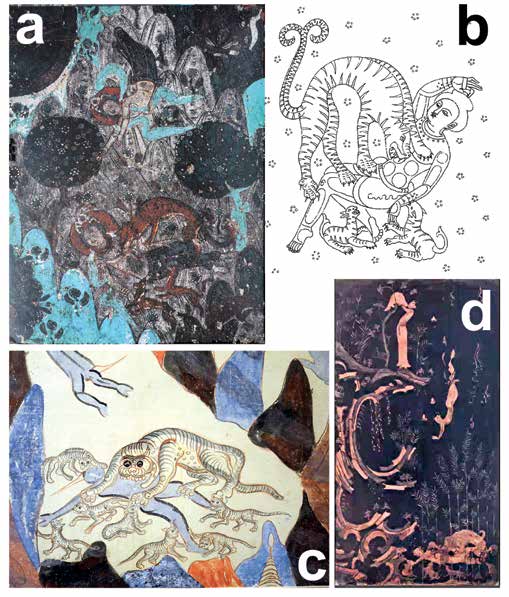
As can be understood from the content of the story "Sacrifice for Hungry Tigers", the "sacrifice" scene; it needs to be portrayed with blood and brutality to ignite the emotions of the audience. This scene is also seen in many wall paintings, as chaotic or bloody in the caves of Kizil 17, 38, 47 and 178, Kumutura Caves 63, Mogao Caves 55 (Song Dynasty), 72, 428 (North Zhou) and Longmen Bingyang (Northern Wei). However, the spiritual sense of sacrifice is neglected in these descriptions. However, the communication of this emotion is strong without the bloody scenes in his painting in cave 254. The
description in cave no. 254; It is a synthesis of the early period single-scene compositions and the compositional pattern of the mural painting in Mogao Cave 428. The method of showing the plot of the Sattva in different times and scenes
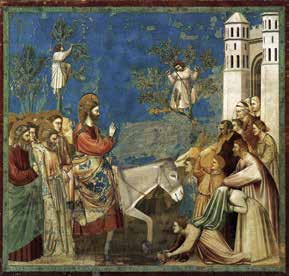
in a single frame, as in the paintings in the Kizil caves 38 and 178 and in the Horyuji Temple in Japan, was applied before and after (Pic. 18). The understanding of depicting different times in the same frame does not belong only to Buddhist
painting. We can also find these examples in the Middle Ages in Europe in later periods. (Pic. 19)
Conclusion
The influence of Indian culture, the origin of Buddhism, in the translation of sutras into visual narrative language in Buddhist art is undisputed. Simple compositional pattern made in important centers of Buddhist art such as Gandhara and Mathura were used in the visualization of Buddhist texts. These compositional patterns are often centralized and static. However, as Buddhist painting developed in the Quici region of northern China and the in the Northern Wei from the 4th century onwards, compositional patterns varied in form. Thus, art originating from the West has entered the process of sinicization by adopting some features of the nomadic culture. The Toba, a northern nomadic community, made some contributions with their nomadic culture to Buddhism and its art, which they first encountered and adopted when they took over northern China.
These elements are: strong visual memories, detachable items, and storytelling. Therefore, in the Northern Dynasties Buddhist painting, many battle scenes, hunting scenes, fighting animal figures, and nature scenes such as trees, mountains, water sources, and fantastic images were processed independently of the text. Besides, there were also compulsory formal preferences in the paintings: clothing, palaces, and buildings. However, artists used their own cultural environment as a visual source for these images. Other than that, artists sometimes “transcribe texts for specific audiences and situations” (Anderl, 2020Anderl, C. (2020). Budist Çevirilerinde Çevresel Nesnelerin Dönüşümü). Another factor affecting the organization of composition is the different narrative types of Buddhist texts translated into Chinese and some ethnic languages. These differences in narrative genres are reflected in the follow-up system and composition of the wall paintings as some sort of diversity. No matter how rich the content of Buddhist stories is, the texts' linguistic expressions in the narrative system are arranged linearly (Anderl, 2020Anderl, C. (2020). Budist Çevirilerinde Çevresel Nesnelerin Dönüşümü). Although the richness of the text content is a gain for visual expression, the precision in the "linear" narrative did not bind the visual narrative. In contrast, the rich text allowed many possibilities and means to construct the temporal sequence for the scene and "sequence" in the murals (Anderl, 2020Anderl, C. (2020). Budist Çevirilerinde Çevresel Nesnelerin Dönüşümü). The third factor affecting the compositional pattern is the connections between Buddhist texts and visual expression. It is necessary to examine the effect of these connections on compositions in several contexts: the depiction of the text with necessary images, its depiction with obligatory but obscure images, and its depiction with preferential (interpretive) images. Some Buddhist paintings from the period of the Northern Dynasties (such as the Western Wei and Northern Zhou), the successors of the Toba Wei dynasty, are depicted in linear and elongated scenes. Again, in the paintings of the Northern Dynasty, various compositional patterns were developed, such as the "S" form and the "Z" form of the follow-up system. The richness of the plot in
the Buddhist stories also provided the artist with the opportunity to organize multi-focused compositions. The number of scenes in the paintings has increased, and more event heroes have been included in the composition. The resulting hierarchical structure; While dignity in Buddhist texts differs according to adjectives, it is reflected in the compositions of the pictures with figures of relative sizes. All these factors contributed to the change in the compositional pattern and follow-up of the painting. Therefore, the Northern Wei painting art did not form a dominant pattern or precedent, and rich visual narratives were presented with very diverse composition.