Introduction
The 19th century ottoman economy was characterized by the opening of trade to Western countries and a peak in the weight of large landowners in relations of production. The opening of trade, which led to the expansion of Western capitalism in the Ottoman market, began after the Baltalimanı Trade Agreement, signed between the Ottoman Empire and the United Kingdom in 1838. This was followed by the implementation of the Tanzimat reforms for Westernization (1839), which further increased the disadvantages of Ottoman manufacturers. The law that restricted the Ottoman trade to the Ottoman citizens was abandoned, and “internal customs” were abolished for Western investors (Pamuk, 2014: 216Pamuk, Ş. (2014). Osmanlı Türkiye İktisadi Tarihi 1500-1914. İstanbul: İletişim.). Greek, Armenian and Jewish merchants, who were already controlling much of the Ottoman trade thanks to their strong community bonds as part of the “millet system” inscribed in Ottoman law, benefited greatly from the expansion of Western capitalism (Gürcan & Mete, 2017: 39-40Gürcan, E. C. & Mete, B. (2017). Neoliberalism and the Changing Face of Unionism: The Combined and Uneven Development of Class Capacities in Turkey. New York: Palgrave Macmillan.). The diplomatic and commercial advantages provided by the Ottoman capitulations (İnalcık & Seyitdanlıoğlu, 2020: 547İnalcık, H., & Seyitdanlıoğlu, M. (2020). Tanzimat Değişim Sürecinde Osmanlı İmparatorluğu. Ankara: İş Bankası Kültür Yayınları.) gave further impetus for the expansion of Western capitalism and its compradore collaborators.
The first parliament in the Ottoman era was opened in 1876, with the intervention of bureaucrats and intellectuals known as the New Ottomans, who also led to the adoption of the first Ottoman constitution. This event, which went down in history as the declaration of the First Constitutional Monarchy, marked the institutional beginning of Turkey’s democratization in the Ottoman era. As such, Turkey accumulated a 50-year tradition of democratization that started with the First Constitutional Monarchy in 1876 until the foundation of the Republic. On the other hand, the Turks in the Ottoman Empire had not been able to engage in any economic activity other than being constantly called to war and working in agriculture in the remaining times for about a hundred years (Kuruç, 2018: 299Kuruç, B. (2018). Mustafa Kemal Döneminde Ekonomi. İstanbul: İstanbul Bilgi Üniversitesi Yayınları.).
Throughout the 19th century, Western states made large infrastructure investments in Anatolia (Pamuk, 2020: 104Pamuk, Ş. (2020). Türkiye'nin 200 Yıllık İktisadi Tarihi. Ankara: İş Bankası Kültür Yayınları.) and shaped the development of the Ottoman market economy. Rather than significantly improve the relations of production and productive forces in the Ottoman Empire, this process led to a lumpendevelopment that only served to improve the market share of Western capitalism and tied the interests of the large landowners to the Western states (Pamuk, 2014: 216Pamuk, Ş. (2014). Osmanlı Türkiye İktisadi Tarihi 1500-1914. İstanbul: İletişim.). After the declaration of the Second Constitutional Monarchy in 1908, however, the Committee of Union and Progress (CUP) made attempts to raise a national bourgeoisie. The Industry Incentive Provision, enacted by the CUP in 1913, formed the basis of the Industry Incentive Law enacted by the Kemalist government in 1927 (Kasalak, 2012: 73Kasalak, K. (2012). Teşvik-i Sanayi Kanunları ve Türkiye’de Sanayileşmeye Etkileri. SDÜ Fen Edebiyat Fakültesi Sosyal Bilimler Dergisi, (27), 65-79.). Taking advantage of the onset of World War I, capitulations were abolished unilaterally, and customs tariffs intended for sector protection were imposed (Pamuk, 2020: 164Pamuk, Ş. (2020). Türkiye'nin 200 Yıllık İktisadi Tarihi. Ankara: İş Bankası Kültür Yayınları.). However, from the Balkan Wars that started in 1912 to the Turkish War of Independence in 1923, the continuous wars interrupted the construction of a national capitalism and the full-scale implementation of industrialization policies (Gürcan & Mete, 2017, 40-41Gürcan, E. C. & Mete, B. (2017). Neoliberalism and the Changing Face of Unionism: The Combined and Uneven Development of Class Capacities in Turkey. New York: Palgrave Macmillan.). It is therefore safe to argue that the Republic of Turkey has inherited a weak industrial base, even though the CUP era provided a strong inspiration for young Turkey’s future endeavours.
The lack of an endogenous industrial base led the founding cadres of young Turkey to adopt statist measures following the declaration of the Republic in 1923. Under these conditions, the Kemalist government concentrated its efforts on accumulating capital (Kuruç, 2018: 309Kuruç, B. (2018). Mustafa Kemal Döneminde Ekonomi. İstanbul: İstanbul Bilgi Üniversitesi Yayınları.). Mustafa Kemal Atatürk, the founder of the republic, defined Kemalism as “the main lines of our projects [those of the Republican People's Party, or RPP] covering not only the next few years but the future” (Yüceer, 2021: 1Yüceer, S. (2021). Kemalizm. Atatürk Ansiklopedisi.). These principles were summarized as the Six Arrows (Republicanism, Populism, Secularism, Revolutionism, Nationalism, and Statism). The Six Arrows bear the mark of not only the French Revolution, but also Eastern European Narodism and the Soviet Revolution. This being said, Kemalism is also shaped by the peculiarity of Turkey’s historical conditions.
In 1931, Mustafa Şerif Bey, Turkey’s Minister of Economy at the time, admitted that during the foundation of the Republic, “our citizens have nothing but to work as ranchmen in the economy (Kuruç, 2018: 418Kuruç, B. (2018). Mustafa Kemal Döneminde Ekonomi. İstanbul: İstanbul Bilgi Üniversitesi Yayınları.).” In the same period, Nurullah E. Sümer, General Director of Sümerbank, made similar remarks: “Turkey used to have an empirical economy, a medieval economy. Agriculture was barren, forests were devastated, mines were derelict, benches were broken, and the country was secluded. The Republic destroyed [these impediments] at once. The state itself took over to create an organic and planned economy in Turkey (Kuruç, 2018: 374Kuruç, B. (2018). Mustafa Kemal Döneminde Ekonomi. İstanbul: İstanbul Bilgi Üniversitesi Yayınları.).”
The Republic of Turkey, founded in 1923, was built on an agricultural economy using medieval production methods in a market regulated according to the interests of Western capitalists. Inheriting the institutional and social accumulation of the Ottoman Empire and the democratization and nationalization experiences that started with the First Constitutional Monarchy, the Republic undertook the task of transforming this agricultural economy into a modern national industrial economy. This study uses a descriptive case study method, understood as “one that is focused and detailed in which proportions and questions about a phenomenon are carefully scrutinized and articulated at the outset” (Tobin, 2010: 288Tobin, R. (2010). Encyclopedia of case study research. Thousand Oaks: Sage.), to examine the economic policies of the Kemalist government and the practices of “statism” from the establishment of the Turkish Republic to the beginning of World War II. The study aims to reveal the target and direction of these policies, which developed in two historical phases. The first began with the Izmir Economic Congress, whereas the second occurred in the Great Depression era. The first period was characterized by Turkey’s efforts at developing an endogenous private sector through government incentives and public expenditures directed towards infrastructure investments. In the second period, Turkey adopted an economic model driven by state-led industrial investments with an even stronger thrust. The weight of public investments gradually increased in the Great Depression era. In the final analysis, one could argue that these two historical phases reflect the implementation of a statist model of economic development with Turkish characteristics, otherwise known as the economic policies of Kemalism in the early Republican period.
Izmir Economic Congress and Subsequent Practices
The Izmir Economic Congress of 1923 convened to draw an economic framework and determine the method leading to the establishment of the Republic. Farmer, merchant, laborer, and industrialist groups represented the Turkish nation at the Congress. Each class made their own proposals to advance their material interests (Pamuk, 2020: 181Pamuk, Ş. (2020). Türkiye'nin 200 Yıllık İktisadi Tarihi. Ankara: İş Bankası Kültür Yayınları.). Despite the diversity of class interests, the common attitude of each group was in favor of nationalism and protectionism. Most of their claims expressed a strong desire to be treated as equals with foreign investors, to benefit from the state’s protection, and to encourage the consumption of local products (Kuruç, 2018: 306Kuruç, B. (2018). Mustafa Kemal Döneminde Ekonomi. İstanbul: İstanbul Bilgi Üniversitesi Yayınları.). Turkey’s first decisions on state-led industrialization and economic nationalizations were ta-ken during the Izmir Economic Congress. Much of these decisions took account of the predominantly agricultural character of Turkey, where two-thirds of the population were peasants. Therefore, the decisions mostly focused on easing the peasants’ tax burden, improving agricultural production, increasing domestic industrial production, and constructing a stronger railway infrastructure (Kuruç, 2018: 251Kuruç, B. (2018). Mustafa Kemal Döneminde Ekonomi. İstanbul: İstanbul Bilgi Üniversitesi Yayınları.).
The first action of the Kemalist government in agriculture was the abolition of the “tithe” (aşar) in 1925, a medieval tax collected from 10% on the peasants’ gross yield (Şenses, 2018, 238Şenses, F. (2018). İktisada (Farklı Bir) Giriş. İstanbul: İletişim.; Toprak, 2019: 243Toprak, Z. (2019). Türkiye'nin Ekonomik Gelişimi 1923-2018. Modern Türkiye Tarihi (ss. 240-258). Ankara: Pegem Akademi.). The abolition of this tax, which used to account for approximately 25% of state revenues, meant that land ownership passed from the sultan to the nation (Kayra, 2018: 77Kayra, C. (2018). Cumhuriyet Ekonomisinin Öyküsü 1923-1950 Devletçilik Altın Yıllar (Cilt 1). İstanbul: Tarihçi Kitabevi.). It created a favorable environment for the development of an efficient agricultural sector. This was followed by Ziraat (Agriculture) Bank, which had been established in the Ottoman era, initiating corporatization in agriculture (Kuruç, 2018: 453Kuruç, B. (2018). Mustafa Kemal Döneminde Ekonomi. İstanbul: İstanbul Bilgi Üniversitesi Yayınları.). In addition, a separate Ministry of Agriculture was established. These conditions led to a 2.5-fold increase in wheat production, the most important crop in Turkey's agriculture between 1925 and 1930, while the yield per hectare tripled (Kuruç, 2018: 458Kuruç, B. (2018). Mustafa Kemal Döneminde Ekonomi. İstanbul: İstanbul Bilgi Üniversitesi Yayınları.). In the meantime, the government worked to reorganize land ownership. In 1927, it forced the large landowners to migrate to the West from Eastern regions where tribalism was more pronounced, as well as in Konya and Muğla. In return for a compensation fee, it seized their lands and distributed them to landless peasants. The go-vernment’s declared intention was to free the peasants from captivity and motivate them to work (Kuruç, 2018: 470, 471Kuruç, B. (2018). Mustafa Kemal Döneminde Ekonomi. İstanbul: İstanbul Bilgi Üniversitesi Yayınları.).
In this environment, agriculture became the locomotive of the Turkish economy after 1925 (Kuruç, 2018: 254Kuruç, B. (2018). Mustafa Kemal Döneminde Ekonomi. İstanbul: İstanbul Bilgi Üniversitesi Yayınları.). Critical developments in this period included the abolition of the tax on sugar in 1925 and the production of the first Turkish cube sugar in 1926 (Kayra, 2018: 211Kayra, C. (2018). Cumhuriyet Ekonomisinin Öyküsü 1923-1950 Devletçilik Altın Yıllar (Cilt 1). İstanbul: Tarihçi Kitabevi.). In the meantime, the state adopted a new industrial policy for promoting private capital accumulation until the Great Depression era (Boratav, 1994: 12Boratav, K. (1994). 100 Soruda Türkiye’de Devletçilik. İstanbul: Gerçek Yayınevi.). This corresponded to a “mixed economy” model, which was to acquire a stronger role in the Great Depression era. What characterized this model were and nationalizations and targeted incentives for industrialization rather than the spontaneous functioning of free markets (Ku-ruç, 2018: 254). In the period leading up to the Great Depression era, the state mobilized infrastructure in-vestments for the construction of railways, ports, and waterworks with the aim of facilitating the expansion of a market economy and a stronger industrial base (Ku-ruç, 2018: 297). At this point, it is worthwhile to recall that most of the railways and ports had been controlled by Western states since the middle of the 19th century. However, the new republic turned infrastructure investments into a “national issue” and undermined the Western control in this area (Pamuk, 2019: 179). Maritime transport was nationalized with the enactment of the Cabotage Law in 1926.
Trade and Exchange Policy of the Republic
The underdeveloped state of the Ottoman market economy had facilitated the continuation of the Istanbul-centered foreign trade policy that undermined local producers. In the 19th century, the Ottoman Empire suffered continuous foreign trade deficits. Consequently, the bu-dget deficit was deepened to the point where domestic and foreign debts became unpayable. On the contrary, the Republic built its policy on “balanced budgets” (Kuruç, 2018: 273Kuruç, B. (2018). Mustafa Kemal Döneminde Ekonomi. İstanbul: İstanbul Bilgi Üniversitesi Yayınları.) and “avoiding external deficits”. In implementing a balanced budget policy, the Kemalist government followed two different methods: a) avoiding closing the budget deficit through foreign debts and b) restraining the government's ability to expand the budget by placing the financial affairs under absolute parliamentary control. Two policies were adopted to avoid external deficits: a) imposing tight controls on foreign exchange and foreign trade and b) collecting taxes (Kuruç, 2018: 291Kuruç, B. (2018). Mustafa Kemal Döneminde Ekonomi. İstanbul: İstanbul Bilgi Üniversitesi Yayınları.).
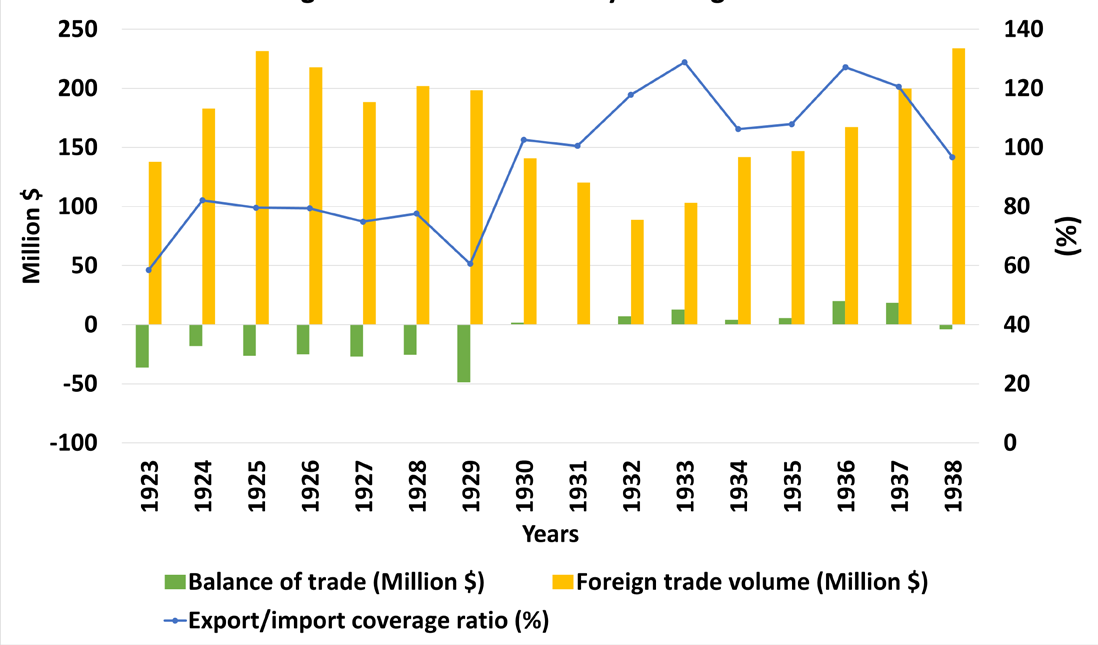
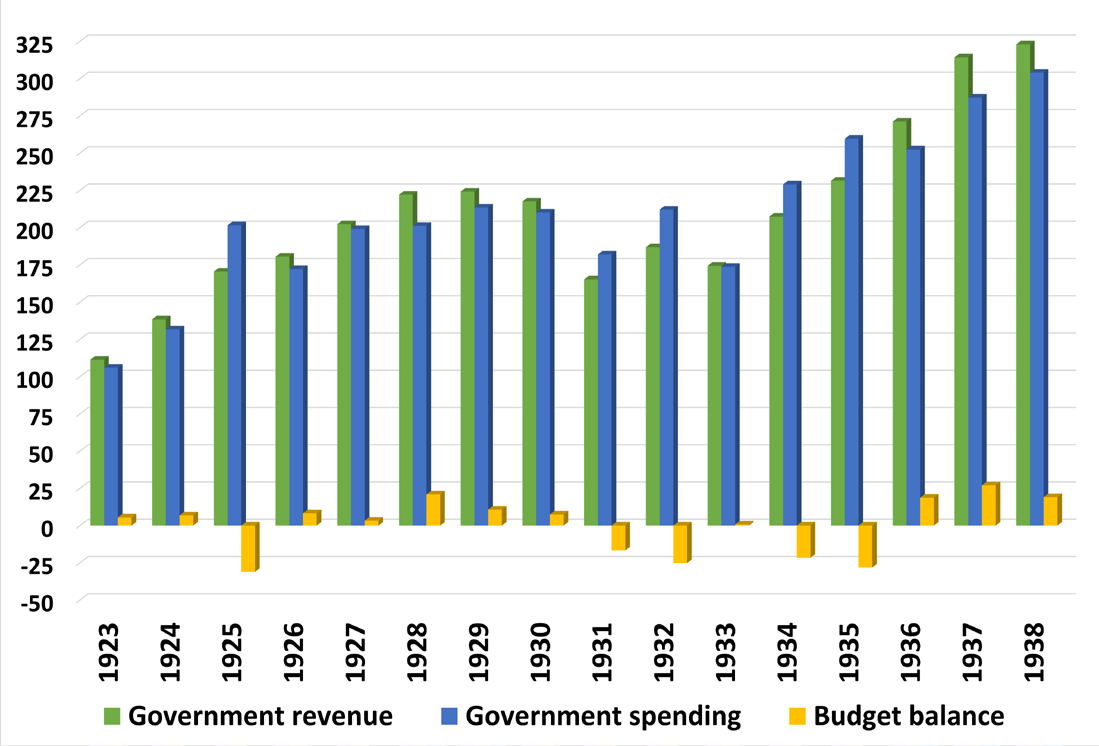
Between 1923 and 1938, the ratio of exports to imports showed an increasing trend. Despite direct incentives and investments provided by the government, budget surplus was the norm for much of the period 1923-1938 (Figure 2).
The Kemalist foreign trade policy was essentially ge-ared towards industrialization and nationalization. Şe-ref Bey expressed the situation as follows: “If a nation is undeveloped in production, counting on the regulatory ability of the international market to produce a balanced economy means turning a blind eye to the collapse of the country (Kuruç, 2018: 283Kuruç, B. (2018). Mustafa Kemal Döneminde Ekonomi. İstanbul: İstanbul Bilgi Üniversitesi Yayınları.).” Therefore, the Kemalist government took a strong stance at the Lausanne Peace Conference, which led to the abolition of the capitulations that gave legal and commercial privileges to the Western states. However, the conditions agreed in the Lausanne Peace Treaty forced Turkey to implement customs tariffs in accordance with the rates determined by the CUP go-vernment in 1916 (Pamuk, 2020: 176Pamuk, Ş. (2020). Türkiye'nin 200 Yıllık İktisadi Tarihi. Ankara: İş Bankası Kültür Yayınları.), which delayed the implementation of a new customs policy until 1929 (Öz-kardeş, 2015: 2; Şenses, 2018: 238Şenses, F. (2018). İktisada (Farklı Bir) Giriş. İstanbul: İletişim.). With the onset of the Great Depression in 1929, Turkey began to use customs tariffs in favor of its nationalization and industrialization policies (Kuruç, 2018: 284Kuruç, B. (2018). Mustafa Kemal Döneminde Ekonomi. İstanbul: İstanbul Bilgi Üniversitesi Yayınları.). This marked the beginning of a new era in Kemalist statism. This era testified to mounting discussions on whether the nationalization and industrialization policy is to evolve into liberalism or a stronger form of statism. While İsmet Pasha, the then Prime Minister, stated that it was out of the question to “give up statism completely and expect every blessing from the actions of capitalists” (Kuruç, 2018: 312Kuruç, B. (2018). Mustafa Kemal Döneminde Ekonomi. İstanbul: İstanbul Bilgi Üniversitesi Yayınları.), Şeref Bey argued that retaining the national character of the private sector's survival depends on the state controlling the dominant points in the economy. Otherwise, this would result in a system driven by “exploitation of man by man” (Kuruç, 2018: 313Kuruç, B. (2018). Mustafa Kemal Döneminde Ekonomi. İstanbul: İstanbul Bilgi Üniversitesi Yayınları.).
In the Great Depression era, protectionism began in foreign trade and the external deficit was ended by narrowing down the merchants’ field of action (Kuruç, 2018: 426Kuruç, B. (2018). Mustafa Kemal Döneminde Ekonomi. İstanbul: İstanbul Bilgi Üniversitesi Yayınları.). This was supported by a “strong currency” policy (Toprak, 2019: 246Toprak, Z. (2019). Türkiye'nin Ekonomik Gelişimi 1923-2018. Modern Türkiye Tarihi (ss. 240-258). Ankara: Pegem Akademi.) by which the government “should not allow such a delicate matter as the value of the national currency to be left to to chance, apart from its own decisions and opinions (Kuruç, 2018: 290Kuruç, B. (2018). Mustafa Kemal Döneminde Ekonomi. İstanbul: İstanbul Bilgi Üniversitesi Yayınları.).” İsmet Pasha stated that small economic measures are insufficient and that the economic situation calls for stronger interventions th-rough the stock market”, which “always presents an unnatural situation”. In 1930, foreign exchange control began to be implemented with the Law on the Protection of the Turkish Currency (Boratav, 1994: 125Boratav, K. (1994). 100 Soruda Türkiye’de Devletçilik. İstanbul: Gerçek Yayınevi.; Kuruç, 2018: 425Kuruç, B. (2018). Mustafa Kemal Döneminde Ekonomi. İstanbul: İstanbul Bilgi Üniversitesi Yayınları.).
Industry and Banking Relations
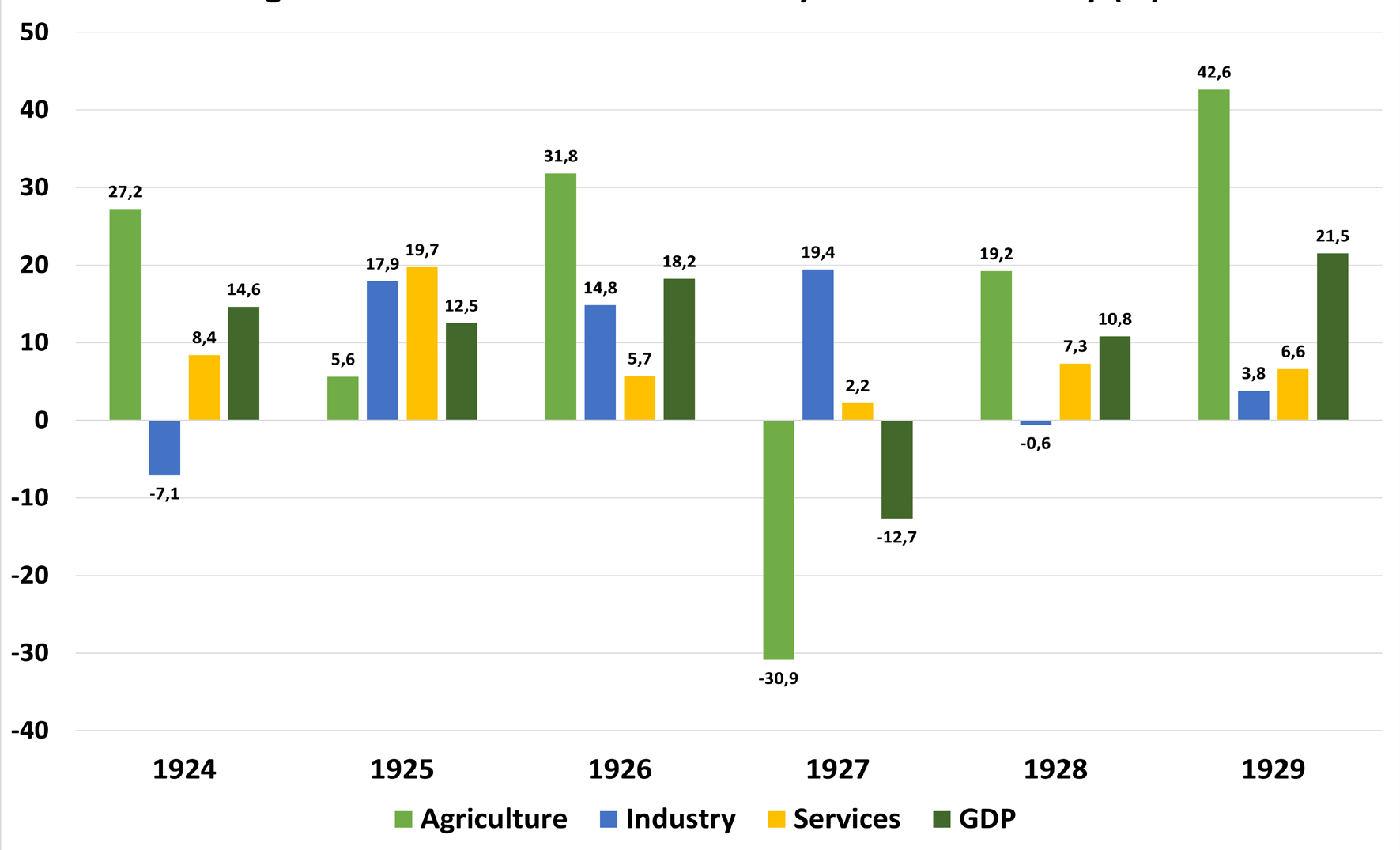
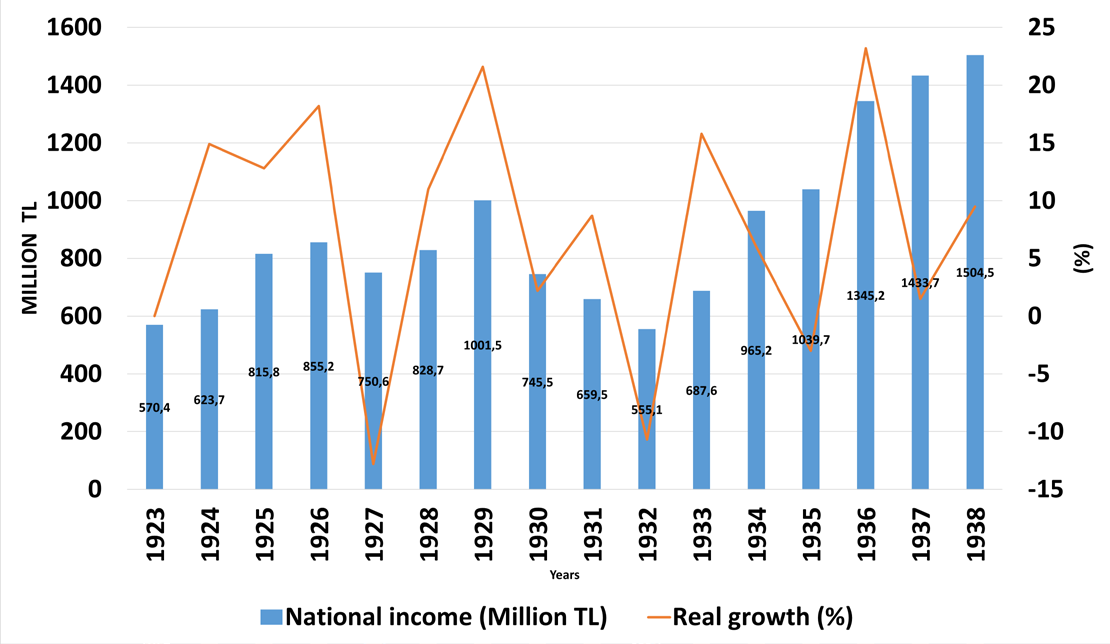
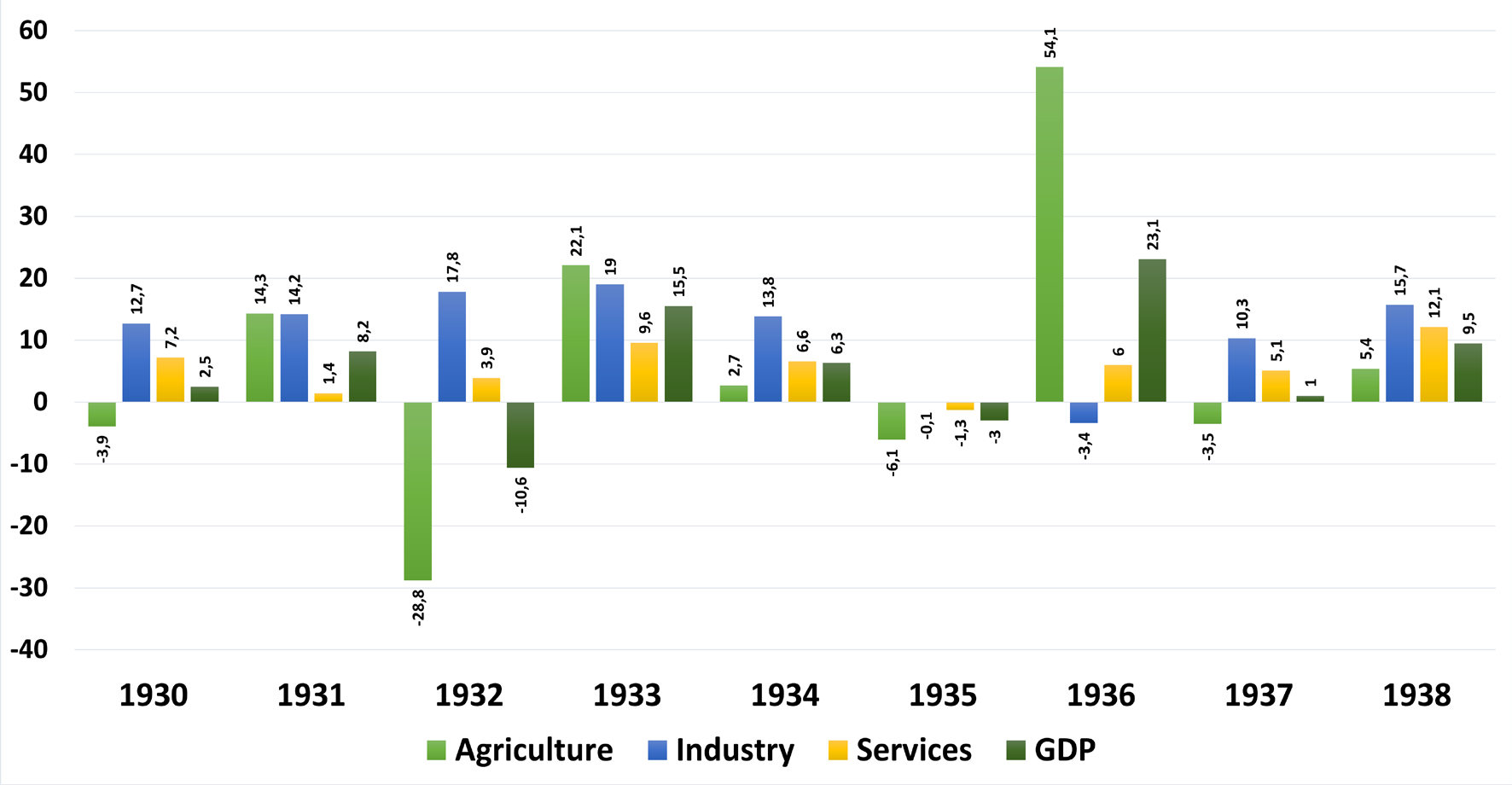
When the Republic was established, around 110,000 workers were employed in the industrial sector. By 1927, this number exceeded 250,000, but more than 70% of businesses employed only three or fewer workers. The Industry Incentive Law, which exemplifies government efforts at developing the domestic private sector, failed to generate the expected results due to the small size of domestic in-vestors (Gürcan & Mete, 2017: 41-42Gürcan, E. C. & Mete, B. (2017). Neoliberalism and the Changing Face of Unionism: The Combined and Uneven Development of Class Capacities in Turkey. New York: Palgrave Macmillan.). Nevertheless, this process succeeded in creating a stronger industrial base with the construction of Kayseri and Eskişehir Aircraft Factories, Kayaş Capsule Factory, Elmadağ Gunpowder Factory, and the Industry and Mines Bank (Gürcan & Mete, 2017: 41Gürcan, E. C. & Mete, B. (2017). Neoliberalism and the Changing Face of Unionism: The Combined and Uneven Development of Class Capacities in Turkey. New York: Palgrave Macmillan.). The state conducted investments for building and nationalizing new roads in cities including Istanbul, Ankara, Konya, Kayseri, Sivas, Samsun, Adana and Mersin (Kayra, 2018: 443Kayra, C. (2018). Cumhuriyet Ekonomisinin Öyküsü 1923-1950 Devletçilik Altın Yıllar (Cilt 1). İstanbul: Tarihçi Kitabevi.). In period 1924-1929, Turkey's GDP grew by 79.1% (Ministry of Development, 2015Ministry of Development (2015). The source article does not provide a separate full bibliographic entry for this citation.).
In the Great Depression era, the Republic devised a new policy to synchronize banking and industry. Şe-ref Bey, Deputy of Economy, stated the following in his speech where he identified the causes of the Depression: “Industrial capital also came under the forcible domination of financial capital. This has created a situation where collective interests were managed by the selfishness of the individual, which is the real reason behind the depression (Kuruç, 2018: 354Kuruç, B. (2018). Mustafa Kemal Döneminde Ekonomi. İstanbul: İstanbul Bilgi Üniversitesi Yayınları.).” Şeref Bey believed that “banking and operating a factory are almost incompatible” in terms of profitability. In this environment, the Industrial and Mi-nes Bank was abolished with the intention of creating two new institutions, one specialized in banking and the ot-her on industry (Kuruç, 2018: 355Kuruç, B. (2018). Mustafa Kemal Döneminde Ekonomi. İstanbul: İstanbul Bilgi Üniversitesi Yayınları.). The task of providing loans to the industry was given to the Industrial Credit Bank of Turkey, and the task of managing and developing all industrial establishments was given to the State Industry Office. Kuruç likens these two institutions to the operation of two cogwheels meshing in some complex piece of machinery, which also constitutes “the essence of the [Kemalist] statism project” (Kuruç, 2018: 404Kuruç, B. (2018). Mustafa Kemal Döneminde Ekonomi. İstanbul: İstanbul Bilgi Üniversitesi Yayınları.).
Recovery from the Great Depression
In the process of recovering from the crisis, Turkey pursued two basic economic policies: a) setting up agricultural cooperatives and b) accelerating direct state inter-vention in industry and trade. The government followed an industrialization approach to establish a triple chain linking raw materials, production, and markets within the country and attempted to mobilize domestic manufacturers accordingly (Kuruç, 2018: 370Kuruç, B. (2018). Mustafa Kemal Döneminde Ekonomi. İstanbul: İstanbul Bilgi Üniversitesi Yayınları.). In the Depression era, the government capitalized on the central role of merchants in lowering the prices of agricultural products. In this direction, the government attempted to establish cooperatives with the intention of organizing foreign trade. It aimed to grant each farmer family ownership of the land on which they work to increase agricultural productivity and establish production methods consistent with state policies by dividing up the approximately two and a half million properties (Kıvılcımlı, 1965: 149Kıvılcımlı, H. (1965). Türkiye'de Kapitalizmin Gelişimi. İstanbul: Tarihsel Maddecilik Yayınları.; Kuruç, 2018: 475Kuruç, B. (2018). Mustafa Kemal Döneminde Ekonomi. İstanbul: İstanbul Bilgi Üniversitesi Yayınları.).
The function of the state in the post-1929 economy went beyond the mere provision of incentives and directives. The government thus assumed a stronger role in expanding and developing the productive forces (Boratav, 1994: 205Boratav, K. (1994). 100 Soruda Türkiye’de Devletçilik. İstanbul: Gerçek Yayınevi.). Increased production in the Turkish economy was not found in abundance, but in crisis, thanks to policies for state-led industrialization (Kuruç, 2018: 365Kuruç, B. (2018). Mustafa Kemal Döneminde Ekonomi. İstanbul: İstanbul Bilgi Üniversitesi Yayınları.). In 1932, the First Five-Year Industrial Plan was prepared with Soviet loans and technical support (Boratav, 1994: 154Boratav, K. (1994). 100 Soruda Türkiye’de Devletçilik. İstanbul: Gerçek Yayınevi.). The plan was put into practice in 1934. Within the scope of this plan, which prioritized import substitution, production facilities were established in the fields of textiles, mining, cellulose, ceramics, and chemistry (Kuruç, 2018: 375Kuruç, B. (2018). Mustafa Kemal Döneminde Ekonomi. İstanbul: İstanbul Bilgi Üniversitesi Yayınları.). After it became clear that the plan, as the fastest attempt at industrialization in Turkey, could be completed sooner than a five-year period, pre-parations for the second plan began in 1935. The Second Five-Year Industrial Plan, which would be interrupted by World War II, was partially implemented as a new stage in Turkey’s industrialization, with special focus on iron and steel, mining, and electricity. In formulating the new stage of statism in Turkey, Deputy Minister of Economics Celal Bayar drew on a distinction between private and state enterprises and pointed to the inadequacy of Turkey's incentive policies before the Great Depression era: “None of the (private enterprises) established a factory in places designated by the state. However, we are establishing factories in Kayseri and Ereğli. Of course, if we had established these in İzmir, we would have earned more. But we had to go (to these regions)” (Kuruç, 2018: 385Kuruç, B. (2018). Mustafa Kemal Döneminde Ekonomi. İstanbul: İstanbul Bilgi Üniversitesi Yayınları.).
Statism, which was first established within the scope of small incentives for the private sector and then increased its weight with the creation of industrial plans, reached its zenith with the establishment of Sümerbank and the State Economic Enterprises (SEE). The term “fully-state-owned factories” emerged for the first time during the planning process for building the facilities to be established by Sü-merbank. The prominence of the investor-producer state model facilitated capital accumulation in the hands of the state. In this direction, SEEs were established in 1938 with a structure that can mobilize, accumulate, and re-invest capital already accumulated. Indeed, the state was directly involved in ensuring the integrity of the internal market as well as the prevalence and depth of industry (Kuruç, 2018: 413Kuruç, B. (2018). Mustafa Kemal Döneminde Ekonomi. İstanbul: İstanbul Bilgi Üniversitesi Yayınları.). The direct involvement of the state turned in-dustry into the locomotive of growth.
Conclusion
The Republic had inherited an agricultural economy from the Ottoman era, which used to function using medieval methods. This agricultural economy served the interests of Western capital. Besides transportation and trade, most companies employing wage workers belonged to Westerners or their compradore collaborators from the Ottoman “millet” system. Most of the Ottoman merchants, large landowners, and financial capitalists cooperated with Western states. This being said, the Ottoman bureaucrats and intellectuals had led a movement for democratization and nationalism, whose legacy inspired the Kemalist economic policies for “nationalization” and “industrialization” in the early Republican era.
The post-1923 economic policies in the early Republican era can be examined in two successive periods. The first period lasted until the Great Depression and was characterized by policies that seek balanced budget, balance of payments, strong currency, and a mixed model of industrialization. In the second period, Kemalist statism focused on promoting the private sector by gradually establishing an economy where the state became a direct and effective producer. Kemalist policies served to reinforce the domestic economy through land distribution to landless peasants, agricultural cooperatives, trade protectionism, and foreign exchange control. These developments also show that the Republic struggled to eradicate the medival relations of production. As a result, Turkey has became a country with well-established institutions that can implement rapid and targeted industrial plans. Kemalist policies for “nationalization” and “industrialization” revealed the benefits of state intervention in the Turkish economy.