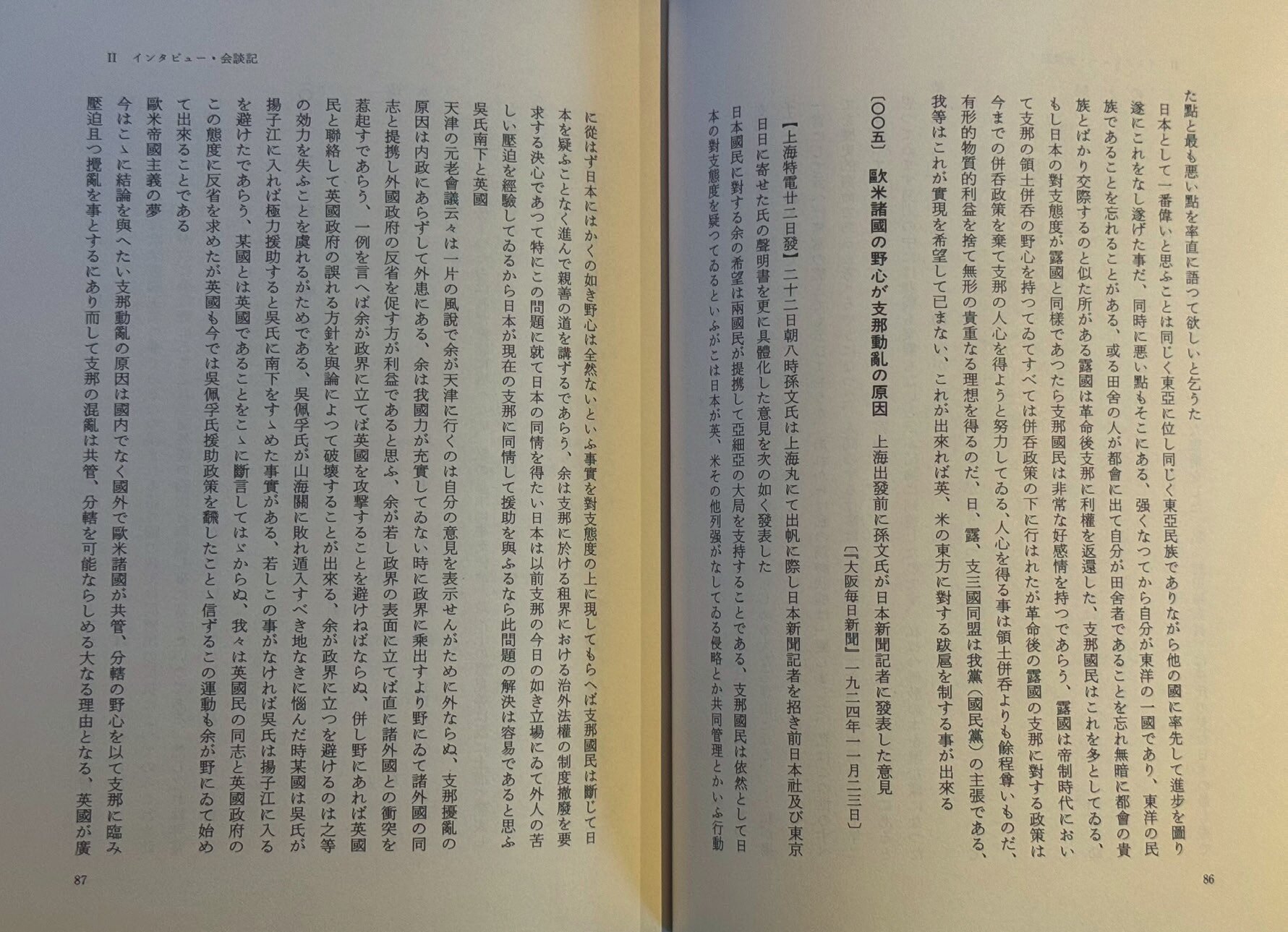
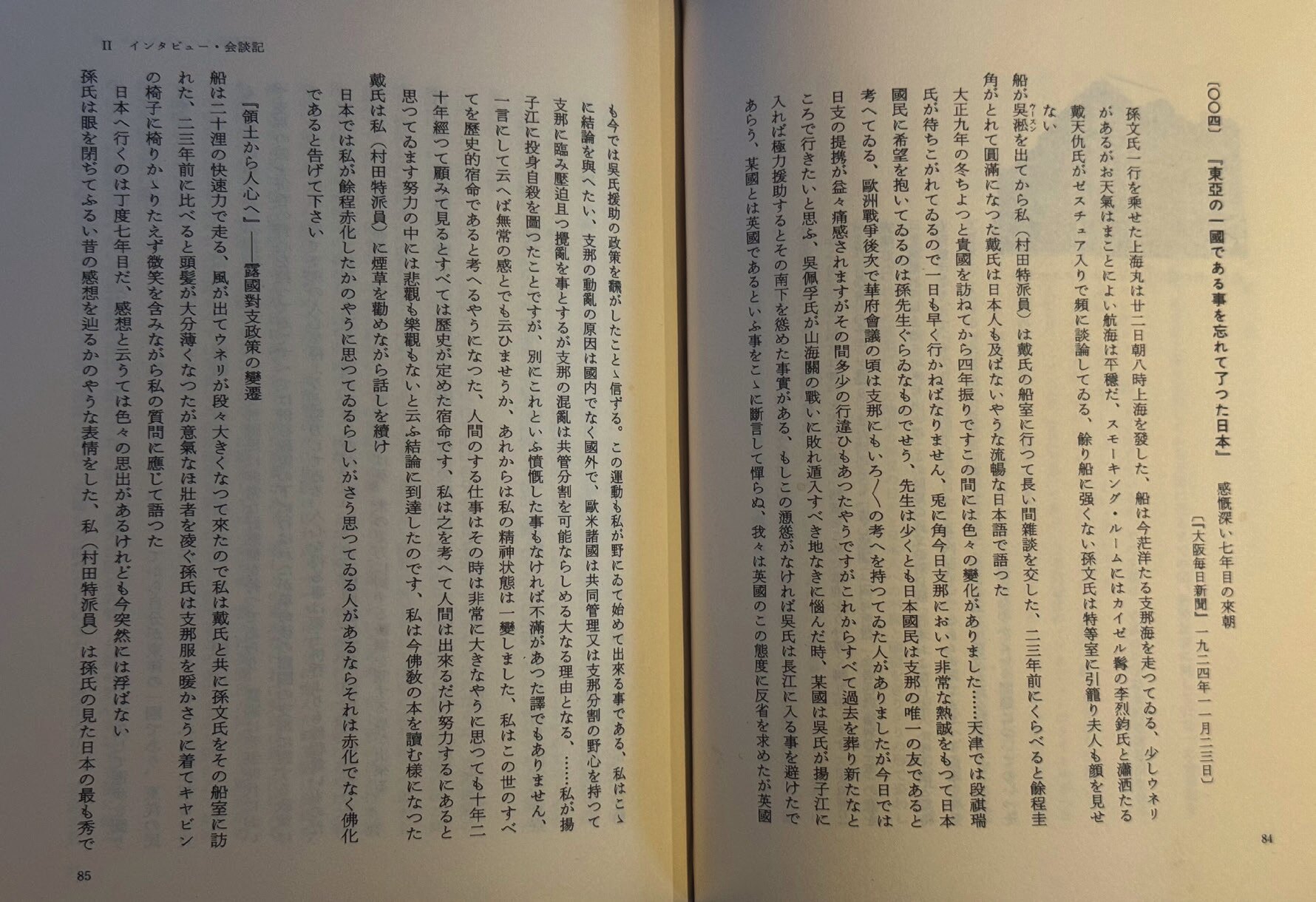
(The original Japanese text is taken from pages 84-88 of Sun Yat-sen’s ‘Pan-Asianism’ Speech Documents (1989). The text was translated into Turkish from the original Japanese version by İnan Öner. The English translation was done by BRIQ.)
İnan Öner was born in Berlin in 1974. He obtained his bachelor’s degree from the Department of Japanese Language and Literature at the Faculty of Language and History-Geography, Ankara University (AÜDTCF). He earned his master’s degree in 2001 from the Department of Language and Information Sciences Graduate School and College of Arts and Sciences, the University of Tokyo.
Sun Yat-sen undertook his last trip to Japan in November 1924, four months before his demise. On November 22, Sun Yat-sen departed from Shanghai, arrived in Nagasaki on November 23, visited Kobe on November 24, and convened the notable “Pan-Asianism” conference on November 28 following several meetings. During his visit to Japan, Sun Yat Sen conducted interviews with Japanese journalists, articulating the concepts he presented at the “Pan-Asianism” conference in an effort to communicate his message to the Japanese people. Below is the Turkish translation of the interview conducted by Murata Shiro, the Shanghai correspondent for the Osaka Mainichi Shimbun, published on November 23, 1924. The original Japanese text is taken from the book of Documents of Sun Yat-sen’s ‘Pan-Asianism’ Speech (1989).
THE VESSEL FROM SHANGHAI, transporting Sun Yat-sen and his companions, set sail at eight o’clock in the morning on November 22. The vessel is presently navigating the expansive South China Sea. Light waves are present; however, the weather is pleasant, and the travel is secure. In the smoking room, Li Liejun, with a Kaiser mustache, and Dai Jitao, savoring his drink, engaged in an animated discussion characterized by exaggerated gestures. Sun Yat-sen, averse to maritime journeys, had retreated himself in his private cabin while his wife was nowhere to be seen.
Upon the vessel disembarking from Wusong, I (Ed. n.: reporter Murata) proceeded to Dai Jitao’s cabin and engaged in an extensive conversation with him. Dai Jitao articulated in Japanese, with a fluency that even native speakers could not attain, having relinquished the rigidity of his previous perspective from two or three years prior and embraced a more adaptable approach: “Following my visit to your country in the winter of 1920, numerous developments transpired in the subsequent four years.
Duan Qirui in Tientsin (Tianjin) is anticipating our arrival. We must arrive at the earliest opportunity. Today in China, there exists just one individual who genuinely embodies hope for the Japanese country with fervent sincerity, and that is our teacher Sun Yat-sen. Our teacher Sun Yat-sen asserts that the Japanese nation is China’s sole ally.
After the European war, during the Washington Conference, many perspectives emerged in China. Nonetheless, the collaboration between Japan and China has increasingly become arduous. Historically, numerous misunderstandings have occurred; nonetheless, we now deem it essential to relinquish the past and pursue a new direction. When Wu Peifu recognized the absence of a retreat following his defeat at Shanhai Pass, a nation stated that if they advanced into the Yangtze River, they would provide him with substantial support and urged him to proceed southward. Without this incentive, Wu Peifu would not have traversed the Yangtze. We are certain that England was the country that inspired him. We have urged England to reassess its position, and it appears that England has now renounced its strategy of endorsing Wu Peifu. I can only sustain this movement if I am independent. I wish to discuss the result in this context. The fundamental source of the unrest in China originates elsewhere rather than domestically. American and European nations are contemplating a collaborative governance or partition of China. Informed by this dream, they engage with China, instigating turmoil through coercion, as only such turmoil can facilitate either collaborative governance or fragmentation within China.
My attempt to end my life by leaping into the Yangtze River was not motivated by anger or discontent. In summary, it was an experience of emptiness. Subsequently, my disposition underwent a full transformation. I began to contemplate that all occurrences in the world are a historical necessity. An individual may perceive their current activity as highly meaningful; nevertheless, upon reflection after a decade or two, it becomes evident that these endeavors were only historical needs. Upon reflection, I concluded that an individual must exert maximum effort, devoid of both pessimism and optimism. I have recently commenced reading literature on Buddhism.”
Dai Jitao offered me (reporter Murata) a cigarette and continued his statement as follows: “In Japan, there are those who think I have completely turned red. If there are individuals who have such beliefs, inform them that my experience is not one of mere reddening but rather a transformation into Buddhism.”
The Transformation of Russia’s China Policy “From Land Annexation to People’s Spirituality”
The vessel was traveling at twenty nautical miles per hour. The wind intensified, and the waves started to swell. We visited Sun Yat-sen’s cabin accompanied by Dai Jitao. His hair had become sparser than before; however, the enthusiasm he elicited was of a magnitude that would evoke envy in the youth. He was seated in the cabinet chair, clad in her fitted Chinese dress. He responded to my inquiries with a continuous smile.
“I am returning to Japan after a seven-year break. Should I refer to them as impressions that I have several recollections of, although none currently come to my mind?”
Sun Yat-sen shut his eyes. His expression suggested he was immersed in nostalgic recollections. I (Ed. n.: reporter Murata) indicated my desire for him to candidly articulate both the strengths and weaknesses of Japan: “I contend that Japan’s superiority lies in its pursuit and attainment of advancement ahead of other East Asian nations. The worst point occurs here. Upon acquiring power, he occasionally neglects his origins from an Eastern country and an Eastern nation. It resembles a provincial individual relocating to the city, neglecting their origins, and indiscriminately associating solely with urban elites. Subsequent to the revolution, Russia reinstated its privileges to China. The Chinese populace received this with acclaim. If Japan’s stance parallels that of Russia, the Chinese nation will be rather gratified.
During the Tsarist era, Russia sought to seize Chinese regions. All actions were aligned with the annexation policy. Post-revolution, Russia’s strategy towards China shifted from a stance of annexation to one aimed at appealing to the spirit of the Chinese people. Gaining the affection of the people is far more holy than territorial acquisition. Concrete material concerns should be relinquished in favor of abstract and significant aspirations.
Our party (Kuomintang: Nationalist Party)
advocates for the establishment of a tripartite alliance among Japan, Russia, and China.
We genuinely desire this to occur. By accomplishing this, we may deter England and America from redirecting their attention to the East.”
Opinions by Sun Yat-sen to Japanese Journalists Before Departure from Shanghai “The Ambitions of America and European States are the Fundamental Cause of the Turmoil in China”
(Shanghai Telegram, November 22) On the morning of November 22, at eight o’clock, Mr. Sun Yat-sen invited Japanese journalists on the occasion of the departure of the Shanghai Ship, further elaborating on the statements he had previously made to the Japan Newspaper and the Tokyo Nichinichi Newspaper, and expressed his views as follows: “What I hope from Japan is that the two countries will work together to help Asia as a whole.
It is said that the Chinese people view Japan’s attitude towards China with suspicion, but if Japan does not adhere to the invasions, joint governance, and similar behaviors imposed by Britain, America, and other major powers, and clearly expresses in its attitude towards China that it has no such ambitions and desires, the Chinese people will never view Japan with suspicion, and a path will be opened for the construction of good relations. I am determined to demand the abolition of the legal immunity system in the concession areas in China. Especially regarding this issue, I want to see sympathy from Japan. Japan was once in the same situation as China is today and suffered harsh oppression from foreigners. Because of this experience, I believe that if Japan shows empathy towards China’s current situation and offers help, the solution to this problem will be easier.”
Wu Peifu’s Southward Advance and Britain
“The question of a Council of Elders in Tientsin is a kind of rumor. The purpose of my visit to Tientsin is only to express my views. The disturbances in China are caused not by internal politics but by external disturbances. I think that instead of entering the world of politics when the strength of our country is not yet sufficient, it is better for us to remain outside and, in cooperation with our comrades in various countries, urge foreign countries to reconsider their policies. I think that if I were to enter the world of politics directly, there would immediately be a conflict with foreign countries. For example, if I were in power, I would hesitate to attack England. However, if I were in opposition, I could communicate with the British people and counteract the wrong policies of the British government through public opinion. I do not engage in politics for fear of losing the effectiveness of these activities. Following his defeat at the Battle of Shanhai Pass, Wu Peifu was confronted with a situation where he had no viable options for retreat. At this juncture, a nation offered him their support, contingent on his entry into the Yangtze region. This encouragement was instrumental in persuading Wu Peifu to undertake a strategic shift in his course, leading him to embark on a southward journey along the Yangtze. It is highly probable that the nation in question was Britain, whose actions and motivations remain a subject of historical analysis. We have approached our associates in Britain, both the general public and the government, to request a re-evaluation of this policy. However, it would appear that Britain has now abandoned its support for Wu Peifu.
In order to proceed with our endeavors, it is essential that we be independent.
The Dreams of US-European Imperialism
“I wish to discuss the fundamental issue at hand. The fundamental source of the unrest in China is external rather than internal. The American-European nations are converging on China with aspirations for collaborative governance or division, exerting pressure on China, generating confusion, which is increasingly facilitating the prospect of joint control or partition. Britain is trying to bring China together through violence. They are doing this by sending a trade delegation to Guangdong or by supporting Wu Peifu. The 10-year period of turmoil is also the result of the great powers trying to bring China together through warlords. We cannot hope for the peaceful unification of China unless these foreign forces are eliminated. This is what American and European imperialism wants. The policies of these foreign states can only be stopped by the resistance of their own nations. I intend to remain in the opposition and fight by communicating with the nations of various countries, but this is a very difficult task, and no one else can do it. I am determined not to appear on the political scene until the great powers give up their intentions of partition or joint rule and until the conflicts are settled once and for all.”