Method Employed to Preserve Fish Resources: Maritime Piracy
In African waters, despite the West’s illegal fishing activities, there exists a fishing sector that generates over $24 billion annually and provides jobs to more than 12 million people (Chatham House, 2013Chatham House. (2013). Maritime Security in the Gulf of Guinea. Retrieved October 5, 2023 from; Kırval, 2022Kırval, L. (2022). Deniz Haydutluğu (Korsanlık) Faaliyetleri ve Afrika Kıtası. In E. İsmail (Ed.), Dünya Siyasetinde Afrika 8 (pp. 279–305). Nobel Yayınları.). In Africa, where over 50% of total protein consumption can be obtained from fish, this is a critical nutritional component for the poorest 40% of the population. However, trawler fishermen from all over the world, converging in Guinean and Somali waters, are engaging in fish theft to an extent that leads to the depletion of fish resources. The “illegal, unreported, and unregulated (IUU)” fishing activities, which weak African maritime states are unable to prevent, pose a significant security issue for Africa (Chatham House, 2013Chatham House. (2013). Maritime Security in the Gulf of Guinea. Retrieved October 5, 2023 from). For example, in 2017, 53% of the 405,000 tons of tuna consumed annually by the European Union was fished from East African waters (Onyango-Obbo, 2019Onyango-Obbo, Charles. (2019). Africa in Global Geopolitics. Retrieved October 5, 2023 from). The “illegal, unreported, and unregulated (IUU) fishing” activities, a priority concern for Africans over issues like oil theft, maritime piracy, or armed robbery at sea, are neglected by imperialists who leave the solution to weak African states. Additionally, there are claims that the West has been dumping nuclear and toxic wastes in Somali waters, causing extraordinary damage to the ecosystem (and fish stocks) (Kabba, 2009Kabba, A. (2009). Somalia: Pirates or Patriots of the Sea? The Patriotic Vanguard. Retrieved January 1, 2024 from; Morabito, 2016Morabito, G. (2016). Dangerous Waters-The Economic Impact of Maritime Piracy [PhD, University of Messina, Department of Economics].).
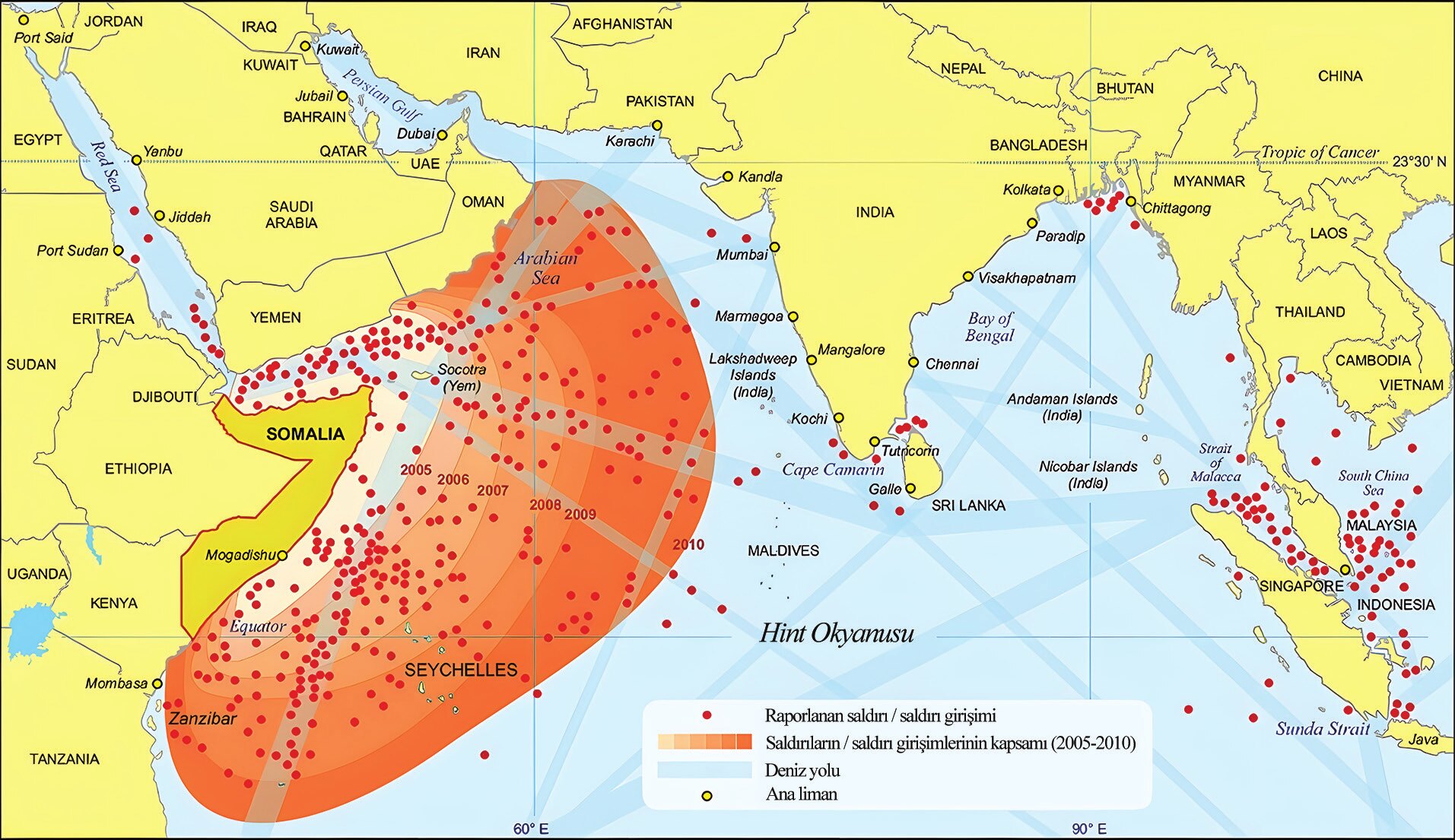
In Somalia and Nigeria, unable to cope with the threat of losing fisheries and the ecosystem due to reasons like political fragmentation/lack of authority, local people have resorted to asymmetric solutions that evolved into “maritime piracy” or “armed robbery” in a state of “madness”. The general view in Somalia and Nigeria is that poor, heroic, and patriotic fishermen have taken up arms to keep illegal trawl vessels out of their waters or at least reduce the amount of stolen fish. Especially in Somalia, the collapse of General Mohamed Siad Barre’s dictatorship regime in 1991 and the ensuing civil war and chaos have exacerbated the issue of illegal fishing, along with maritime piracy and armed robbery in territorial waters. After 2001, incidents of “maritime piracy or armed robbery” in the Gulf of Aden have drawn Western attention (Kabba, 2009Kabba, A. (2009). Somalia: Pirates or Patriots of the Sea? The Patriotic Vanguard. Retrieved January 1, 2024 from; Morabito, 2016Morabito, G. (2016). Dangerous Waters-The Economic Impact of Maritime Piracy [PhD, University of Messina, Department of Economics].). The unsuccessful attack on the luxury passenger ship Seabourn Spirit carrying 151 passengers and weighing 10,000 tons on November 5, 2005, by Somali pirates, caught the Western public’s attention (Williams, 2005Williams, C. J. (2005). Pirates Attack Cruise Ship Off Horn of Africa. Los Angeles Times. Retrieved January 1, 2024 from; Hürriyet, 2005Hürriyet. (2005). Somali’de korsanlar yolcu gemisine saldırdı. Retrieved October 5, 2023 from; CBS News, 2005CBS News. (2005). Pirates Attack Cruise Ship. Retrieved January 1, 2024 from). Maritime piracy in Somalia, initially started by the impoverished local population, later transformed into a sector providing economic resources to destabilizing tribes and radical Islamist terrorist organizations within a few years (Kırval, 2022Kırval, L. (2022). Deniz Haydutluğu (Korsanlık) Faaliyetleri ve Afrika Kıtası. In E. İsmail (Ed.), Dünya Siyasetinde Afrika 8 (pp. 279–305). Nobel Yayınları.).
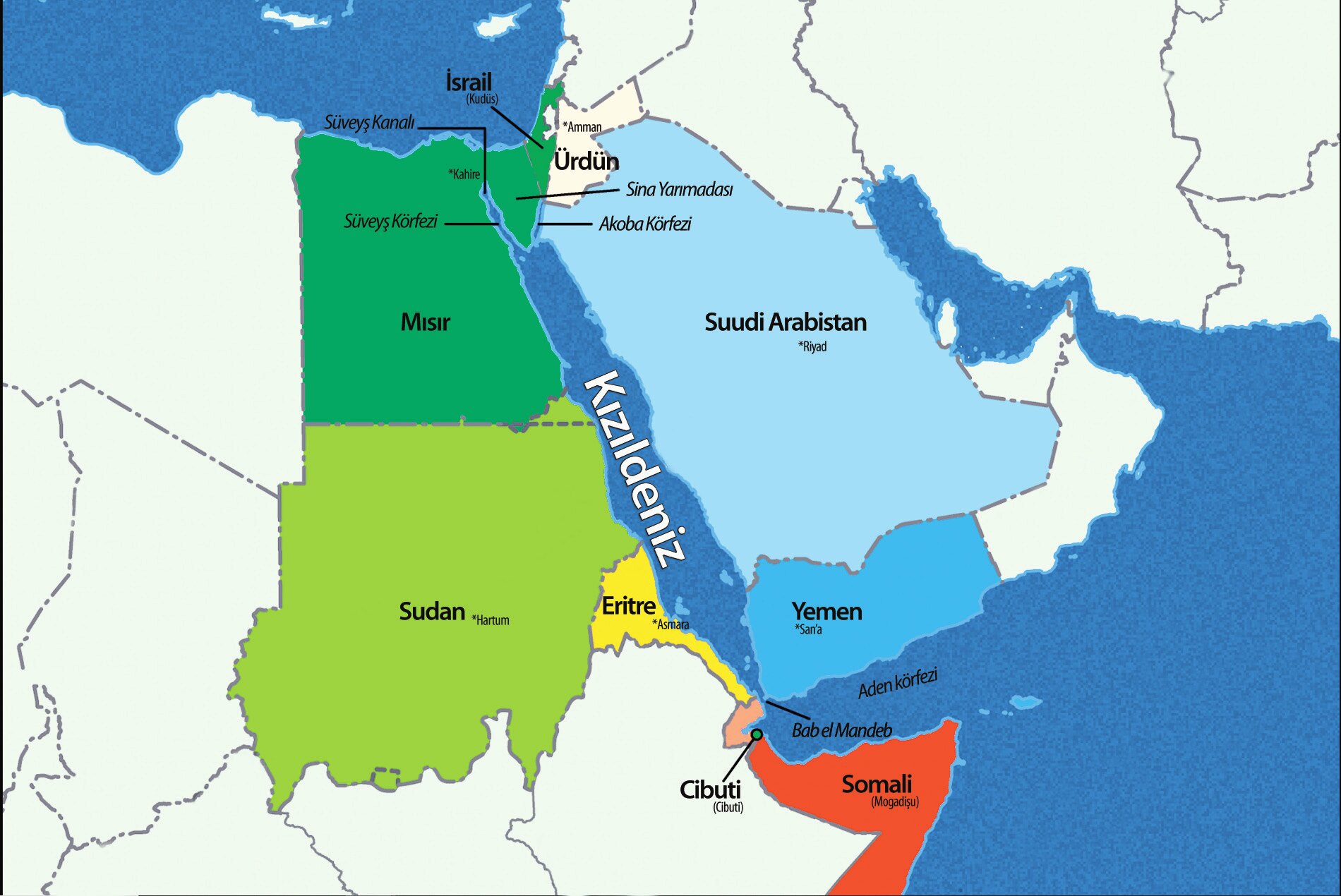
Therefore, Western sources do not limit their reasons for maintaining a military presence in the region to merely maritime piracy; they also assert the impacts of terrorism, terror-crime nexus, arms and drug trafficking, marine pollution, and environmental disasters related to oil, affecting them, and claim that coastal states are not powerful enough to handle these issues (Ghosh, 2004Ghosh, C. (2004). Pacific Sealanes Security Institute conference on Maritime Security in Asia. Retrieved October 5, 2023 from). However, keeping the Suez Canal, a vital route for 12% of global maritime trade and seizing the geopolitical power of the Afro-Asian junction comprising the Suez Canal, Red Sea, Bab-el-Mandeb Strait, and Gulf of Aden from Africa and Asia, or at least preventing their real owners from using it, are goals consistent with the spirit of imperialism.
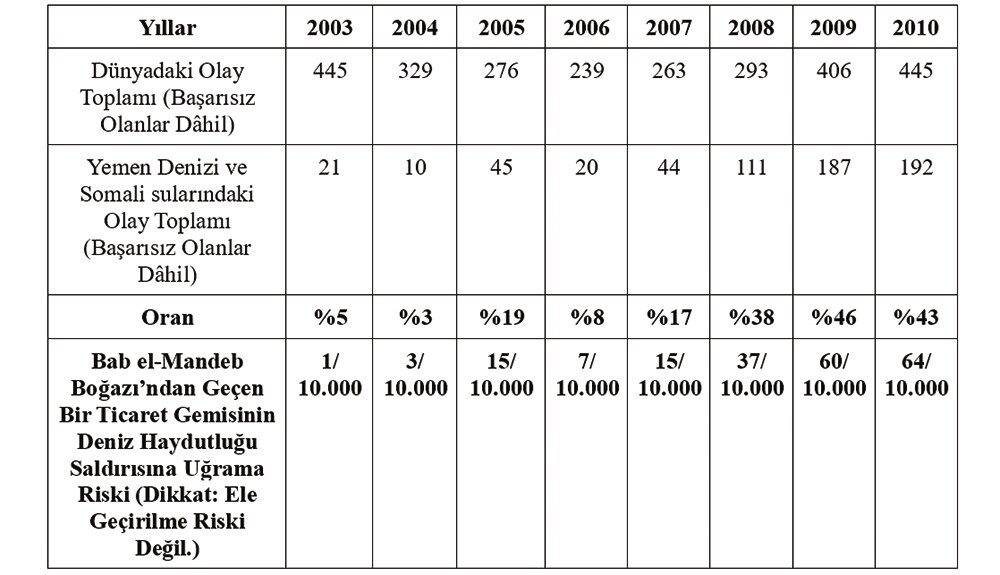
When examining the above table, it becomes apparent that the incidents of “maritime piracy” at the entrance and exit of the Red Sea have never escalated to a level that would necessitate the West’s exaggerated military measures. During the 2003-2010 period, the risk of facing a “maritime piracy” attack, varying between 3 to 64 in 10,000, is not significant enough to stop or slow down the annual maritime traffic of 30,000 vessels through the Bab el-Mandeb Strait (Kırval, 2022Kırval, L. (2022). Deniz Haydutluğu (Korsanlık) Faaliyetleri ve Afrika Kıtası. In E. İsmail (Ed.), Dünya Siyasetinde Afrika 8 (pp. 279–305). Nobel Yayınları.).
Even in 2010, when maritime piracy in the Horn of Africa waters was at its peak, only 15 of the 192 attacks were successful; the 326 sailors taken hostage along with these ships were eventually released following ransom negotiations (Onyango-Obbo, 2019Onyango-Obbo, Charles. (2019). Africa in Global Geopolitics. Retrieved October 5, 2023 from). This means that out of the annual 30,000 ships passing through the Horn of Africa waters, only 15, or 5 in 10,000, fell into the hands of pirates. In other words, only 15 of the 77,768 commercial ships in the world’s seas in 2010 were captured by Somali pirates, and their release along with their sailors, secured by paying a ransom, does not justify the Western military reaction (EMSA, 2010EMSA. (2010). The world merchant fleet in 2010. Retrieved November 29, 2023 from). After all, maritime piracy is common in all the world’s seas, even in American waters. Moreover, in 2021, the 192 “ship robbery” incidents in Somali waters should have been considered less significant in priority compared to the 1,964 “bank robbery” incidents on U.S. soil alone (Federal Bureau of Investigation, 2021Federal Bureau of Investigation. (2021). Bank Crime Statistics. Retrieved November 25, 2023 from).
According to Western sources, the financial damage caused by Somali pirates to the global maritime industry is not excessively high. A study by The One Earth Future Foundation in Colorado (USA) titled “Oceans Beyond Piracy,” conducted in 2011, estimated that maritime piracy in Somali waters had caused damage to the global maritime industry between $6.6 and $6.9 billion over ten years (Onyango- Obbo, 2019Onyango-Obbo, Charles. (2019). Africa in Global Geopolitics. Retrieved October 5, 2023 from). Accordingly, during the 2000- 2010 period when piracy in Somalia escalated, the world maritime industry incurred annual losses of approximately $660-690 million. With the global GDP in 2010 being $65 trillion, it raises the question: Has the Horn of Africa waters been occupied by the West just for 1 in 100,000 of the world’s income?
Furthermore, the calculated damage includes not only the paid ransoms but also additional costs such as: - Costs of route changes, - Security equipment and private protection costs, - Additional fuel consumption due to the speed increase required for safe passage, - Increase in risk payments to personnel, - Rise in insurance premiums for passing through risky areas, - Costs of prosecuting and imprisoning pirates, - Expenses of military operations by warships, - Costs of multinational organizations created against piracy.
Therefore, most of the mentioned damages are additional expenses made by the West, unwilling to pay the ransom (Çınar, 2022Çınar, M. (2022). Geçmişten Günümüze Süveyş Kanalı’nın Jeopolitiği. İKSAD Publishing House.).
The limited and low-damage incidents of maritime piracy have been used as an opportunity by the West for systematic control of the waters forming the Afro-Asian junction. A similar instance occurred in 1984.
Implications of Suspicious Naval Mines in the Red Sea for African Geopolitics in 1984
On July 9, 1984, the Soviet-flagged cargo ship Knud Jespersen sustained minor damage due to an underwater explosion while sailing south from the Suez Canal. Since the batteries of mines laid during the Arab-Israeli wars would not have lasted after 1973, it was clear that this was not a missed bottom mine from those conflict zones. Between July 27-29, 1984, when seven more commercial ships incurred minor mine damage, it became certain that there was an active minefield south of the Suez Canal. Between July 31 and August 2, 1984, six new explosions in the southern Red Sea indicated that mines had been “secretly” laid in various areas of the Red Sea. Besides Egypt, which feared losing Suez Canal revenues, Saudi Arabia also panicked, concerned about the safety of tens of thousands of pilgrims who would arrive by ferries at the ports of Jeddah and Yanbu for the Hajj pilgrimage starting on September 4, 1984 (Çınar, 2022Çınar, M. (2022). Geçmişten Günümüze Süveyş Kanalı’nın Jeopolitiği. İKSAD Publishing House.).
On August 3, 1984, when the Chinese container ship Tang He also suffered minor mine damage, Egypt and Saudi Arabia were compelled to formally request Western assistance on August 5-6, 1984. A naval force consisting of British, French, Dutch, and Italian minehunters, along with the USS La Salle and USS Shreveport amphibious ships carrying two fleets of mine-sweeping capable helicopters, was dispatched to the region (Çınar, 2022Çınar, M. (2022). Geçmişten Günümüze Süveyş Kanalı’nın Jeopolitiği. İKSAD Publishing House.).
The United States rapidly completed its mine-searching operations in the Gulf of Suez, relying on its helicopters. To prove that the area where no mines were found was clear, the aircraft carrier USS America passed through the Suez on August 19. The speed of the U.S. mine-searching operations and the use of Sea Batallion RH-53D helicopters, designed not for bottom mines but solely to detect moored mines, were suspicious. However, the inadequacy of these helicopters was not questioned at the time by states other than the United States, as it was not known (Özsaraç, 2024Özsaraç, Halil. (2024). Batı Asya denizlerinde emperyalist oyunlar-II. Aydınlık. Retrieved October 5, 2023 from).
Dutch and Italian minehunters, which also searched Saudi waters in the Red Sea in addition to the Gulf of Suez, did not encounter any mines in their searches until the end of October 1984. French minehunters found 10 obsolete bottom mines left from the Arab-Israeli wars in the Gulf of Suez on their return route. The British minehunter HMS Gavinton, on September 12, 1984, in the Gulf of Suez at a depth of 42 meters, examined a mine stuck in the mud using remotely operated underwater devices and divers and then destroyed it in place. The discovered mine was a Soviet bottom mine, capable of causing more than minor damage with its 720 kg explosive, but it was not set to explode. This meant that the found Soviet stock mine had no relation to the mines being searched for (Çınar, 2022Çınar, M. (2022). Geçmişten Günümüze Süveyş Kanalı’nın Jeopolitiği. İKSAD Publishing House.; Özsaraç, 2024Özsaraç, Halil. (2024). Batı Asya denizlerinde emperyalist oyunlar-II. Aydınlık. Retrieved October 5, 2023 from).
Although a little-known terrorist organization called “Al Jihad” claimed responsibility for the incidents, this group, lacking the capability to lay mines, was not taken seriously. No live mine samples were found, yet a state suspected of secretly laying mines was sought based on assumptions. Initially, the West tried to blame Iran, which in turn accused the United States and Israel. In reality, Iran, engaged in a war with Iraq at that time, lacked the capability to lay mines, as it did not have a single mine in its inventory until mid-1985. Realizing that Iran, being the 4th largest user of the Suez Canal at that time, would also economically suffer from the mines in the Red Sea, the West then attempted to accuse Libya, which used the Suez Canal less frequently (Mobley, 2022Mobley, R. A. (2022). Revisiting the 1984 Naval Mining of the Red Sea: Intelligence Challenges and Lessons. Studies in Intelligence, 2(66), 19-28.; O'Flaherty, 2019O'Flaherty, C. (2019). The Red Sea 1984. Retrieved October 5, 2023 from; Özsaraç, 2024Özsaraç, Halil. (2024). Batı Asya denizlerinde emperyalist oyunlar-II. Aydınlık. Retrieved October 5, 2023 from; Chicago Tribune, 1987Chicago Tribune. (1987). American-Owned Tanker Hit in Gulf. Retrieved October 5, 2023 from from; Christ, 2009Christ, D. B. (2009). A History of U.S.-Iranian Confrontation at Sea. The Washington Institute for Near East Policy, Washington, Retrieved December 1, 2023 from; The New York Times, 1984The New York Times. (1984). Teheran Blames U.S. and Israel for Red Sea Mines. Retrieved October 5, 2023 from).
According to the CIA and Egyptian Intelligence, the Libyan-flagged Ghat Ro-Ro vessel, carrying mine-trained Captain Suheir Adham, set sail to the Red Sea on July 6, 1984. The Libyan ship, which took cargo from the port of Assab, remained in the Red Sea for 7 days longer than usual, exiting on July 21, 1984, which raised suspicions. According to the U.S., the Ghat Ro-Ro had laid the bottom mines timed to activate on July 27; the mine that exploded on July 9 had detonated early due to a timing mechanism failure. It was a highly speculative and forced accusation without solid evidence (Mobley, 2022Mobley, R. A. (2022). Revisiting the 1984 Naval Mining of the Red Sea: Intelligence Challenges and Lessons. Studies in Intelligence, 2(66), 19-28.; O'Flaherty, 2019O'Flaherty, C. (2019). The Red Sea 1984. Retrieved October 5, 2023 from; Özsaraç, 2024Özsaraç, Halil. (2024). Batı Asya denizlerinde emperyalist oyunlar-II. Aydınlık. Retrieved October 5, 2023 from).
On August 23, 1984, while in Marseille, the Ghat Ro-Ro was temporarily detained by French authorities for a few hours under the pretext of a commercial dispute. Examination of photographs taken during this process led to the interpretation that slight wear on the stern ramp was evidence of mine laying. However, finding a Ro-Ro ship without wear on its ramp is nearly impossible. Although Gaddafi denied the allegations, the West declared Libya, a state causing problems for them, as the scapegoat for the Red Sea mines (Mobley, 2022Mobley, R. A. (2022). Revisiting the 1984 Naval Mining of the Red Sea: Intelligence Challenges and Lessons. Studies in Intelligence, 2(66), 19-28.; O'Flaherty, 2019O'Flaherty, C. (2019). The Red Sea 1984. Retrieved October 5, 2023 from; Özsaraç, 2024Özsaraç, Halil. (2024). Batı Asya denizlerinde emperyalist oyunlar-II. Aydınlık. Retrieved October 5, 2023 from).
To summarize, in 1984, 17 commercial ships sustained minor damage from mine explosions in the Red Sea, but none sank, suffered heavy/ medium damage, or had casualties. The explosives in the mines were just enough to cause alarm. During the four months of mine searching by Western states, no ready-to-explode mines were found in the Red Sea. The world maritime industry appeared to be briefly panicked; in reality, only Egypt and Saudi Arabia were the ones truly alarmed (Özsaraç, 2024Özsaraç, Halil. (2024). Batı Asya denizlerinde emperyalist oyunlar-II. Aydınlık. Retrieved October 5, 2023 from).
Western Consolidation in the Afro-Asian Maritime Junction With the Pretext of Suppressing Piracy in the Horn of Africa
Article 101 of the 1982 United Nations Convention on the Law of the Sea (UNCLOS) defines attacks within territorial waters as “armed robbery,” leaving the responsibility to the coastal state, while terming ship attacks outside territorial waters as “piracy (United Nations, 2020United Nations. (2020). Preamble to The United Nations Convention on the Law of the Sea. Retrieved October 5, 2023 from).” This distinction laid the groundwork for international intervention in attacks beyond territorial waters and served as a justification for the West’s establishment of a permanent military mechanism in the Bab-el-Mandeb Strait and Gulf of Aden, preventing coastal states from utilizing their geopolitical power of the Red Sea.
Indeed, in 2008, the Somali Federal Transitional Government, unable to withstand Western pressures and lacking the capacity to ensure maritime security, prevent piracy, and prosecute pirates on its own, sought cooperation from various states and organizations. In response, the UN Security Council (UNSC) passed five separate resolutions during the period of June 2, 2008, to November 30, 2009 (Evin, 2012Evin, B. (2012). Uluslararası Hukukta Deniz Haydutluğu Kavramı ve Şiddet Faktörü. Güvenlik Bilimleri Dergisi, 1(1), 119–151.).
The fact that the majority of ships passing through the Bab-el-Mandeb Strait carried Chinese trade, and the incidents of piracy in the Horn of Africa began to affect Russia’s interests, facilitated the UNSC’s adoption of these resolutions. For instance, the seizure of the Belize-flagged Ukrainian ship MV Faina by Somali pirates on September 8, 2008, angered Russia. The MV Faina was carrying hundreds of millions of dollars’ worth of cargo, including 33 T-72 tanks, 73 tank maintenance kits with spare parts, numerous weapons, and ammunition, while en route via the Bab-el-Mandeb. It was later captured by 50 Somali pirates, identifying themselves as the “Central Region Coast Guard,” demanding a $35 million ransom for the ship’s release (Reuters, 2008Reuters. (2008). Somali Pirates Demand $35 Million Ransom for Ship. Retrieved January 1, 2024 from). Although the ship’s captain claimed to be transporting the military cargo to South Sudan, the governments of Ukraine, Kenya, and the administration of South Sudan denied this. However, there were reports that over 100 T-72 and T-55 tanks had reached South Sudan during those months (Van Oudenaren, 2008Van Oudenaren, D. (2008). Evidence mounts that tanks on Somali-hijacked ship were headed to Southern Sudan. Sudan Tribune. Retrieved January 1, 2024 from). Following negotiations, the Ukrainian ship was released after a payment of $3.2 million to the pirates. Kenya subsequently claimed to have purchased the tanks on the ship for its own army. The involvement of 6 U.S. warships surrounding the hijacked Ukrainian vessel and preventing the Kenyan Armed Forces from boarding operations also drew attention (McGreal, 2009McGreal, C. (2009). Somali pirates “have been paid $3.2m” for ship carrying Soviet tanks. The Guardian. Retrieved November 25, 2023 from). Considering that the Kenyan Armed Forces used British Vickers Mk3 tanks and not Soviet weapons, Kenya’s role in the arms shipment to South Sudan, despite UN embargoes, seemed to be a cover-up. The exposure of such incidents by piracy facilitated Russia’s endorsement of UNSC resolutions.
Based on UNSC resolutions, NATO initiated the “Allied Provider” Operation from October 24, 2008, deploying warships in the region. From December 2008 to August 2009, the EU Naval Force (EUNAVFOR) operated under the “Atalanta” Operation, followed by the establishment of the multinational Combined Task Force 151 (CTF 151), led by the U.S., from January 1, 2009 (Evin, 2012Evin, B. (2012). Uluslararası Hukukta Deniz Haydutluğu Kavramı ve Şiddet Faktörü. Güvenlik Bilimleri Dergisi, 1(1), 119–151.). It should be noted that CTF 151 is a multinational force composed of warships from U.S. allies or partner states. Among the U.S. fleets, the 5th Fleet has the smallest area of responsibility. Nevertheless, the United States tends to maximize the use of its allies and partners to maintain or enhance maritime control in the areas of responsibility of the 5th Fleet, which includes the Red Sea, Gulf of Aden, Somali waters, Arabian Sea, and Persian Gulf. The Combined Maritime Forces (CMF), a multinational naval force led by the U.S. and significantly relieving the burden of the 5th Fleet, includes CTF 151, a highly effective force supported by about 15 countries, tasked with combating piracy (Combined Maritime Forces, 2010aCombined Maritime Forces. (2010a). About Combined Maritime Forces (CMF). Retrieved January 1, 2024 from; 2010b). Among these 15 countries, Pakistan (10 times), Türkiye (6 times), South Korea (6 times), Singapore (5 times), and Japan (4 times) have been the most active in assuming command duties every six months; while the United States, Kuwait, Denmark, Thailand, New Zealand, UK, Brazil, Jordan, Philippines, and Bahrain have tended to be relatively passive. The effective presence of CTF 151 has led to the eastward expansion of the area of maritime piracy activities in the Horn of Africa waters during 2009-2012 (Morabito, 2016Morabito, G. (2016). Dangerous Waters-The Economic Impact of Maritime Piracy [PhD, University of Messina, Department of Economics].).
Alongside CTF-151, which controls the southern entrance of the Red Sea, a multinational naval force named Combined Task Force 153 (CTF 153), composed of U.S, and Egyptian warships, was established on April 17, 2022, for the security of the Red Sea (Combined Maritime Forces, 2010aCombined Maritime Forces. (2010a). About Combined Maritime Forces (CMF). Retrieved January 1, 2024 from). The United States, seizing the opportunity of the Yemeni Civil War spilling into the Red Sea, clearly intends to solidify its position in the region using CTF-153. Indeed, CTF-153 has targeted the asymmetric capabilities of the Houthis in Yemen that can be used at sea. According to U,S. sources, the number of Houthi attacks on Israel-linked civilian trade ships in the Red Sea starting on November 19, 2023, rose to 23 by December 31, 2023; most of these attacks failed to hit their targets, and the drones that did hit caused no significant damage (Anadolu Ajansı, 2023Anadolu Ajansı. (2023). US Navy exchanges fire with Houthis in 4 boats, sinking and killing all aboard 3 of them: CENTCOM. Retrieved October 5, 2023 from; Gambrell, 2023Gambrell, J. (2023). Ships face Houthi-claimed attack in Red Sea as officials say a US warship also fires in self-defense. AP News. Retrieved February 1, 2024 from). The United States, aiming to eliminate the Houthis’ weak attempts to regain control of Yemeni waters, invited Saudi Arabia, Israel, UAE, Bahrain, Canada, France, Germany, Italy, Japan, and the UK to join CTF-153 (Bowman, 2023Bowman, B. (2023). Expand existing task force to protect Red Sea from Houthi attacks. Defense News. Retrieved November 25, 2023 from). However, when the United States launched “Operation Prosperity Guardian” against the Houthis on December 18, 2023, Egypt withdrew from CTF-153, and Saudi Arabia and the UAE, hostile to the Houthis, refused to join.
According to a U.S. Department of Defense statement dated December 18, 2023, “Operation Prosperity Guardian” was joined by the United States, UK, Bahrain, Canada, France, Italy, the Netherlands, Norway, Seychelles, and Spain. On December 21, 2023, Pentagon Press Secretary Pat Ryder stated that about 20 countries intended to support the operation, but Spain and Italy were considering withdrawing their support (Helou, 2024Helou, A. (2024). Why Saudi Arabia and the UAE may sit out new US-led Red Sea initiative. Breaking Defense. Retrieved November 25, 2023 from). Like CTF 151, CTF-153 should be seen as blocking the geopolitical power of East Africa’s seas. The gradual decline of maritime piracy incidents in the Bab-el-Mandeb Strait, Gulf of Aden, and Somali waters from 2012, and their almost negligible level from 2018, can only be attributed to “imperialism,” using Houthi attacks as a pretext for the persistent presence of CTF 151 and CTF 153 in the region (Kalay, 2023Kalay, E. (2023). ABD-Çin Rekabeti Kapsamında Afrika Jeopolitiği. In H. Çomak (Ed.), Afrika Jeopolitiği (pp. 305–316). Nobel Yayınları.).
Global Power Rivalry for Establishing Military Bases on African Coasts near the Bab-el-Mandeb Strait
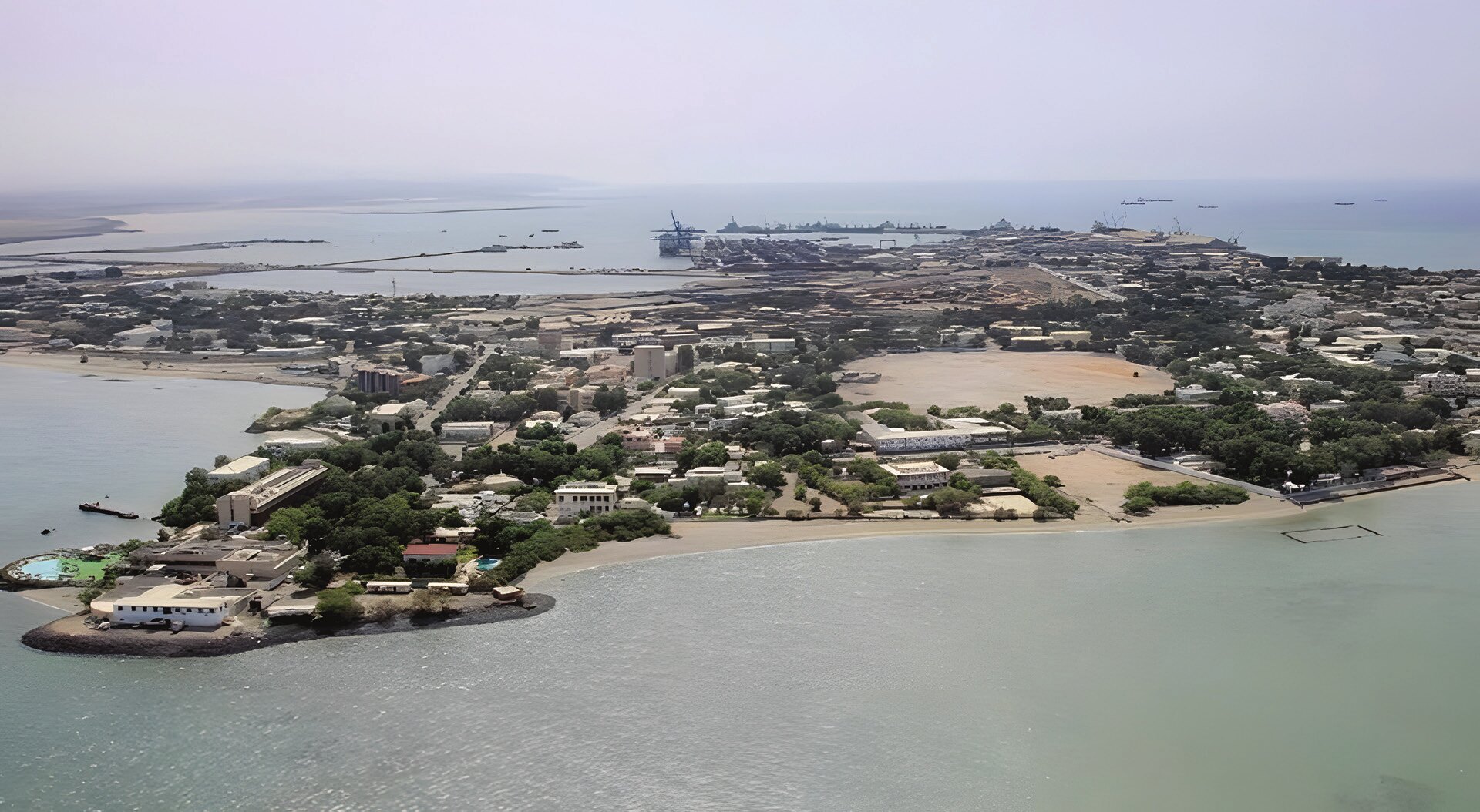
Ethiopia, Kenya, Somalia, Eritrea, and Djibouti, attempting to recover from the economic slowdown caused by the Covid-19 pandemic, experienced in 2020 the worst locust invasion in the last 70 years, leading to significant agricultural production losses and a food security crisis (Smith, 2020Smith, E. (2020). Plague of locusts threatens East African economies as UN sounds alarm. CNBC. Retrieved November 25, 2023 from). However, in recent years, African countries where China has invested have generally exhibited economic performance above the world average (Mürsel, 2018Mürsel, B. (2018). Güç ve Kimlik Perspektifinden Çin-Afrika İlişkileri. Savaş Yayınevi.). Among these states, Ethiopia and Djibouti in the Horn of Africa particularly stand out. While the IMF predicts a global growth average of 2.9% in 2024, the figure is projected to be 6.2% for Ethiopia and 6% for Djibouti (Visual Capitalist, 2023Visual Capitalist. (2023). Ranked: The Fastest Growing Economies In 2024. Retrieved November 25, 2023 from). Ethiopia, promising as an agricultural country, is unfortunately landlocked. Djibouti, Ethiopia’s eastern neighbor with a 370 km coastline, acts as a lifeline for Ethiopia’s foreign trade. Since the end of the Ethiopia-Eritrea War in 2000, Ethiopia, having lost hope of accessing the sea, relies on Djibouti for 90% of its imports. Djibouti, with a population of only 1 million and a GDP of $5.6 billion, is a dwarf in terms of national power but a geopolitical giant due to its location at the entrance of the Bab-el-Mandeb Strait. Lacking the capacity to utilize its geopolitical potential independently, Djibouti has recently turned into an international military garrison (Cabestan, 2019Cabestan, J.-P. (2019). China’s Military Base in Djibouti: A Microcosm of China’s Growing Competition with the United States and New Bipolarity. Journal of Contemporary China, 29(125), 1–17.).
French air and naval base, hosting about 1,450 troops (1,000 of which are elite Légion étrangère soldiers), has been present in Djibouti since 1978. Since 2009, this base also accommodates 30- 80 German and 50 Spanish soldiers providing support for the Atalanta Operation conducted by EUNAVFOR; they use the Kempinski and Sheraton Hotels in the region for accommodation and rest. Additionally, an Italian air base is located in the same area (Styan, 2020Styan, D. (2020). Djibouti: Geostrategic Balancing Between the Horn and Red Sea. In G. Carbone (Ed.), Africa’s Thorny Horn, Searching For a New Balance In The Age of Pandemic. ISPI.; Cabestan, 2019Cabestan, J.-P. (2019). China’s Military Base in Djibouti: A Microcosm of China’s Growing Competition with the United States and New Bipolarity. Journal of Contemporary China, 29(125), 1–17.; Downs, 2017Downs, E. (2017). China’s Military Support Facility in Djibouti: The Economic and Security Dimensions of China’s First Overseas Base. Retrieved January 1, 2024 from).
In October 2002, the U.S. established a military unit called ‘Combined Joint Task Force-Horn of Africa’ (CJTF-HOA) under CENTCOM, consisting of 1,500 personnel (200 civilians), and stationed it at Camp Lemonnier, a former French base in Djibouti. The operational area for CJTF-HOA includes all the land and airspace of Kenya, Somalia, Ethiopia, Sudan, Eritrea, Djibouti, Seychelles, and Yemen, along with their coastal waters in the Red Sea, Gulf of Aden, and the Indian Ocean. CJTF-HOA was established to “identify, disrupt, and defeat international terrorist groups operating in the region (Ploch, 2007Ploch, L. (2007). Africa Command: U.S. Strategic Interests and the Role of the U.S. Military in Africa, CRS Report For Congress. Retrieved January 1, 2024 from),” and its additional tasks include: - Providing freedom of movement for the United States in East Africa, - Protecting U.S. military personnel, diplomats, facilities, and interests in the region (Yüksel, 2016Yüksel, M. A. (2016). Afrika Jeopolitiği ve ABD’nin Afrika Politikası [Review of Afrika Jeopolitiği ve ABD’nin Afrika Politikası]. Turkish Studies, 11(2), 1389–1408.).
As the rationale behind the establishment of CJTF-HOA suggests, the United States uses terrorist organizations to legitimize its military presence in Africa (Şimşek, 2020Şimşek, Z. (2020). Afrika’da Alicengiz Oyunları. In E. İsmail (Ed.), Dünya Siyasetinde Afrika 6 (pp. 37–50). Nobel Yayınları.).
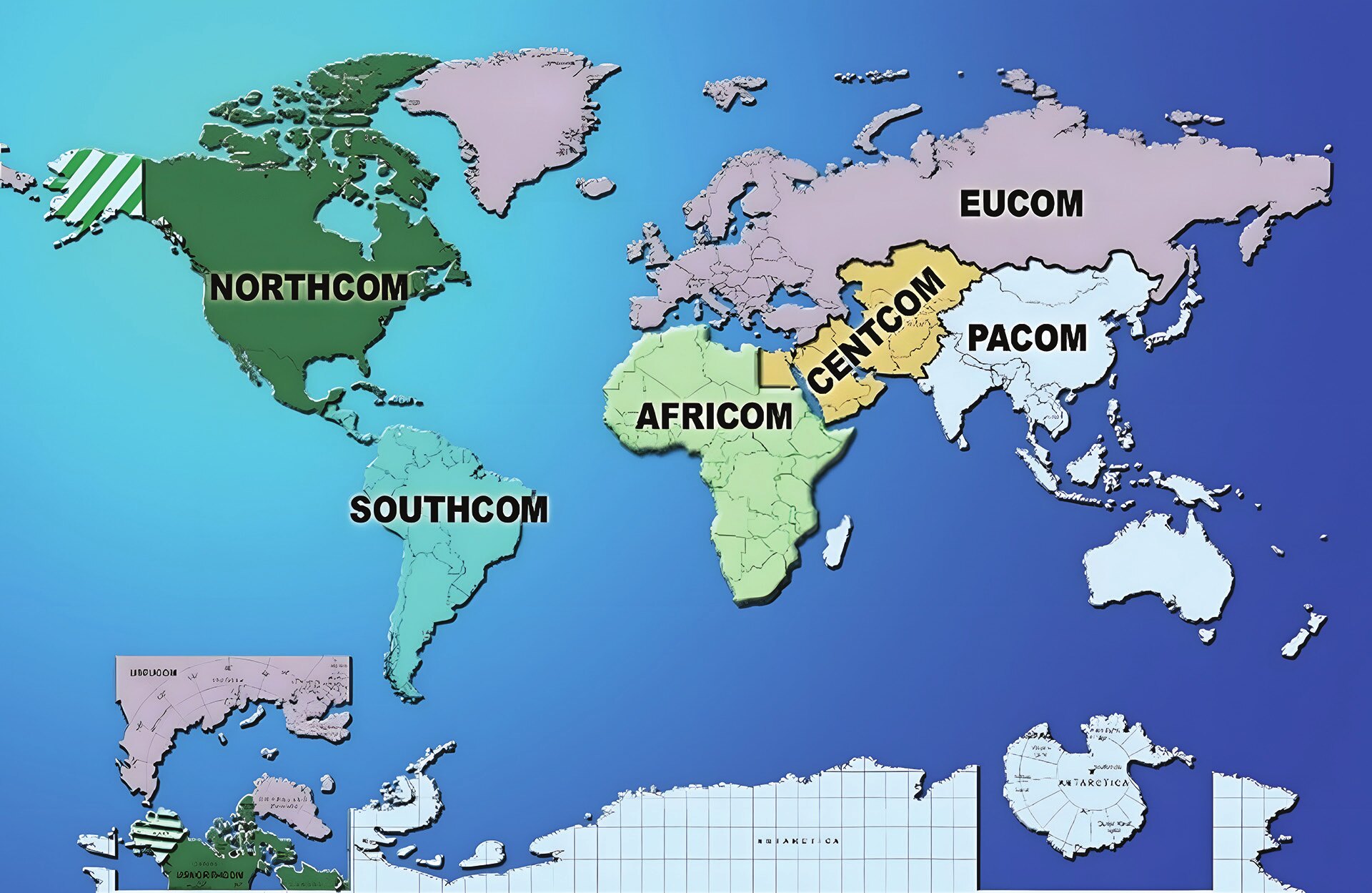
On February 6, 2007, U.S. President Bush directed the establishment of a new structure called ‘U.S. Africa Command’ (U.S. AFRICOM). Using the headquarters infrastructure of ‘U.S. European Command’ (EUCOM), AFRICOM became an independent command under the U.S. Department of Defense on January 1, 2008, with its area of responsibility being all of Africa, except Egypt (Yüksel, 2016Yüksel, M. A. (2016). Afrika Jeopolitiği ve ABD’nin Afrika Politikası [Review of Afrika Jeopolitiği ve ABD’nin Afrika Politikası]. Turkish Studies, 11(2), 1389–1408.). The decision by the United States to approach Africa holistically is thought to be driven by the increasing influence of many new actors in Africa, including China, Russia, Brazil, Japan, and Türkiye. The rising competition in the African continent has been interpreted by some experts as a “New Cold War unfolding in Africa (TASAM Afrika Enstitüsü, 2020TASAM Afrika Enstitüsü (2020). The source article does not provide a separate full bibliographic entry for this citation.).” Some sources summarize the establishment purpose of AFRICOM as U.S. desire to expand its “offshore balancing” strategy, compete with China’s growing diplomatic, political, economic, and cultural presence in Africa, increase trade and investment with African countries around mutual interests, and improve the United States’ tarnished image (Conteh-Morgan, 2018Conteh-Morgan, E. (2018). The United States and China: Strategic Rivalry in Africa. Insight Turkey, 20(1), 39–52.; Özel, 2020Özel, Y. (2020). 2005-2015 Perspektifinden Amerika Birleşik Devletleri’nin Sahraaltı Afrika Politikası ve Afrika Komutanlığı (AFRICOM). Güvenlik Stratejileri Dergisi, 16(35), 461–517.; Bekar, 2021Bekar, N. (2021). Avrupa Birliği (AB) Ülkelerinin Afrika’daki Kalkınma Programları. Bölgesel Araştırmalar Dergisi, 5(1), 312–345.).
Prior to AFRICOM, responsibility for Africa was divided among the European Command (EUCOM), responsible for Europe, the Central Command (CENTCOM), responsible for the Middle East, and the Pacific Command (PA- COM), responsible for the Pacific and countries with Pacific coastlines. The creation of an independent strategic command for Africa reflects the continent’s increasing geopolitical significance and indicates the long-term nature of U.S. military policies towards Africa (Yüksel, 2016Yüksel, M. A. (2016). Afrika Jeopolitiği ve ABD’nin Afrika Politikası [Review of Afrika Jeopolitiği ve ABD’nin Afrika Politikası]. Turkish Studies, 11(2), 1389–1408.). AFRICOM has supported operations aimed at stabilizing conflict zones, establishing strategic relationships, and promoting military cooperation, as well as supporting the efforts of U.S. soft power institutions like the U.S. Agency for International Development (USAID) (Buğra, 2012Buğra, S. (2012). Amerikan ulusal çıkarları ve Afrika. Ankara Üniversitesi Afrika Çalışmaları Dergisi, 1(2), 95–119.).
With the transfer from CENTCOM to AFRI- COM, the strength of CJTF-HOA was increased to 2,000-2,500 military and civilian personnel. Although CENTCOM retains primary responsibility against “maritime piracy” in the waters of the Horn of Africa, the regional CFTF-HOA force under AFRICOM plays a critical role in providing land support to the U.S. “blue water” navy operating in the region (Ploch, 2007Ploch, L. (2007). Africa Command: U.S. Strategic Interests and the Role of the U.S. Military in Africa, CRS Report For Congress. Retrieved January 1, 2024 from). Today, CJTF-HOA carries out its missions using Camp Lemonnier Naval Base, which accommodates 4,500 U.S. troops (2,000 of them marines), and Chabelley Air Base located in the desert area of Djibouti. Since 2017, the U.S. Camp Lemonnier Naval Base has also hosted a British platoon. Since 2011, the U.S. has used Chabelley Air Base for continuous MQ-1 Predator and MQ-9 Reaper Armed Unmanned Aerial Vehicle (UAV) flight operations over Yemen and Somalia (Cabestan, 2019Cabestan, J.-P. (2019). China’s Military Base in Djibouti: A Microcosm of China’s Growing Competition with the United States and New Bipolarity. Journal of Contemporary China, 29(125), 1–17.).
Despite the presence of numerous U.S. bases in Africa, the U.S. military presence is perceived as an occupation in many parts of Africa, still bearing the fresh traces of Western colonialism. Consequently, no African state has agreed to host the AFRICOM headquarters, so it remains in Stuttgart, Germany. This situation has created an irony of an Africa command not located in central Africa (Yüksel, 2016Yüksel, M. A. (2016). Afrika Jeopolitiği ve ABD’nin Afrika Politikası [Review of Afrika Jeopolitiği ve ABD’nin Afrika Politikası]. Turkish Studies, 11(2), 1389–1408.).
In recent times, China’s use of the allure of its economic investments in Ethiopia and Djibouti to gain military presence in Djibouti has forced the United States into economic competition with China. The $1.55 billion, 550 km long Horn of Africa (Djibouti-Ethiopia) Fuel Pipeline is a product of this competition, an investment by the U.S. Extending from Damerjog Port in Djibouti to a storage facility with a capacity of 950,000 barrels in Awash, central Ethiopia, the 20-inch diameter Horn of Africa Pipeline can transfer 240,000 barrels per day. Completed in 2018, this pipeline enables the United States to transport refined diesel, gasoline, and jet fuel from Africa or the Middle East to Ethiopia (VOA, 2015VOA. (2015). Contractors Agree on Djibouti-Ethiopia Pipeline Deal. Retrieved January 1, 2024 from; Ecofin Agency, 2015Ecofin Agency. (2015). $1.55bn fuel pipeline intended for Horn of Africa. Retrieved January 1, 2024 from; Sudan Tribune, 2015Sudan Tribune. (2015). Ethiopia and Djibouti to build $1.55 billion fuel pipeline venture. Retrieved November 25, 2023 from; CGTN Africa, 2023CGTN Africa. (2023). Ethiopia, Djibouti Sign $1.55 Billion Deal to Construct Pipeline. Retrieved January 1, 2024 from).
The spillover of the Yemeni Civil War into the Red Sea since 2015 has served as a pretext for the West, supported by UAVs or warplanes from imperialist bases in Djibouti, to establish a firmer presence in the Red Sea and engage in shows of force. For instance, on October 1, 2016, a high-speed hybrid catamaran military cargo vessel owned by the UAE, Swift-1, was damaged by a C-802 missile launched by the Houthis from land. Subsequently, on October 10, 2016, the USS Mason, a U.S. destroyer, and the USS Ponce, a U.S. amphibious ship, assessed two objects launched from the Yemeni coast while crossing the Bab-el-Mandeb Strait as a suspected guided missile attack. The USS Mason quickly launched two Standard Missile-2 (SM-2) and one Evolved Seasparrow Missile (ESSM) air defense missiles towards the aerial objects, also deploying Nulka decoys as a passive measure. The Houthis, through the Saba News Agency, denied the allegations of attacking the USS Mason and USS Ponce (Lagrone, 2016Lagrone, S. (2016). USS Mason Fired 3 Missiles to Defend From Yemen Cruise Missiles Attack. USNI News. Retrieved October 5, 2023 from; Vaughan, 2016Vaughan, J. (2016). Missile Attacks on the USS Mason: Principles to Guide a U.S. Response. The Washington Institute. Retrieved October 5, 2023 from). There is no available information on whether the two aerial objects were anti-ship missiles, launched by the Houthis, targeted at U.S. ships, or if they were shot down by the SAMs launched by the USS Mason. However, the U.S. government, sharing its military sources’ speculative information and reactions with the global public, has created the perception that the Houthis attacked U.S. warships.
Since 2009, Japan, maintaining a constant naval presence in Somali waters and the Gulf of Aden, has built a runway suitable for fighter jets at its logistical base in Djibouti in 2016, which houses 600 troops (Pajon, 2017Pajon, C. (2017). Japan’s Security Policy in Africa: The Dawn of a Strategic Approach?. IFRI. Retrieved January 1, 2024 from).
It is claimed that since 2012, Israel has had some small naval units stationed in the Dahlak Archipelago and Massawa in Eritrea and even an intelligence facility on Mount Soira (Amba Sawara) in Eritrea to monitor Iran’s activities in the Red Sea. Indeed, in 2017, a Houthi spokesperson threatened that Israeli targets in Eritrea could be struck (Melvin, 2019Melvin, N. (2019). The Foreign Military Presence In The Horn of Africa Region. SIPRI. Retrieved January 1, 2024 from).
In recent years, China’s peaceful policies in global competition, challenging the dominance of the United States, are based on principles of: - Mutual respect for sovereignty and territorial integrity, - Non-aggression, - Non-interference in each other’s internal affairs, - Equality, - Mutual benefit (Yüksel, 2016Yüksel, M. A. (2016). Afrika Jeopolitiği ve ABD’nin Afrika Politikası [Review of Afrika Jeopolitiği ve ABD’nin Afrika Politikası]. Turkish Studies, 11(2), 1389–1408.).
These peaceful policies have facilitated China’s investments in Africa under the Belt and Road Initiative (BRI). A 2019 study by the Center for Strategic and International Studies found that China is involved in at least 46 of the existing, operated, and planned port projects among 172 Sub-Saharan African ports, having a role in the construction of 41, financing 27, and controlling 11 of them (CSIS, 2014CSIS (2014). The source article does not provide a separate full bibliographic entry for this citation.). In short, Sub-Saharan African port investments have become one of the primary ways for China to establish commercial superiority in the region. This is believed to provide strategic depth to the People’s Liberation Army Navy (PLAN) in meeting future logistical needs (CSIS, 2014CSIS (2014). The source article does not provide a separate full bibliographic entry for this citation.; Devermont, Cheatham, & Chiang, 2019Devermont, J., Cheatham, A., & Chiang, C. (2019). Assessing the Risks of Chinese Investments in Sub-Saharan African Ports. CSIS. Retrieved January 1, 2024 from).
Since its first military presence in Africa in 2003 with peacekeeping duties in the Democratic Republic of Congo, China has increased its trade relations with Ethiopia over the last 20 years (Cabestan, 2019Cabestan, J.-P. (2019). China’s Military Base in Djibouti: A Microcosm of China’s Growing Competition with the United States and New Bipolarity. Journal of Contemporary China, 29(125), 1–17.). This economic relationship has also benefited Djibouti, Ethiopia’s gateway to the sea. Indeed, the Djibouti-Addis Ababa railway, originally built by France in 1890, was renovated by Chinese companies China Railway Group Ltd. and China Civil Engineering Construction Corporation as part of a $3.95 billion project from 2011-2017 and opened in January 2018 (Downs, 2017Downs, E. (2017). China’s Military Support Facility in Djibouti: The Economic and Security Dimensions of China’s First Overseas Base. Retrieved January 1, 2024 from). The railway line, now with a capacity of 3,500 tons per trip (seven times its original capacity), reduces the travel time between Addis Ababa and the Doraleh Port from three days to 12 hours, also cutting the cost of freight transport by a third (Çelik, 2023Çelik, M. T. (2023). Çin’in Yükselişi, Bir Kuşak Bir Yol Projesi ve Afrika [MA, Süleyman Demirel Üniversitesi, Sosyal Bilimler Enstitüsü].). Following the completion of this large-scale transportation infrastructure, China continued its investments in Djibouti with the $340 million Doraleh Port, a $320 million daily 100,000 m3 capacity freshwater pipeline between Ethiopia and Djibouti, the $64 million Ghoubet Port, and the $30 million Djibouti International Free Trade Zone (Downs, 2017Downs, E. (2017). China’s Military Support Facility in Djibouti: The Economic and Security Dimensions of China’s First Overseas Base. Retrieved January 1, 2024 from).
Since 2008, China has conducted anti-piracy operations in the Gulf of Aden, where 40% of its total imports pass, and until 2017, tried to support its warships sent for this purpose from regional civilian ports (Cabestan, 2019Cabestan, J.-P. (2019). China’s Military Base in Djibouti: A Microcosm of China’s Growing Competition with the United States and New Bipolarity. Journal of Contemporary China, 29(125), 1–17.). It is claimed that some Chinese warships could not port for 124 days during these missions (People’s Daily, 2013People’s Daily. (2013). News Ifeng. Retrieved January 1, 2024 from). Between 2009-2013, Chinese warships made at least 23 port visits in Djibouti (Downs, 2017Downs, E. (2017). China’s Military Support Facility in Djibouti: The Economic and Security Dimensions of China’s First Overseas Base. Retrieved January 1, 2024 from). During this period, as economic relations between China and Djibouti continued to rise, they also began to gain a military dimension. Indeed, a security and defense agreement signed between China and Djibouti in 2014 was vehemently protested by the United States. In 2015, China and Djibouti signed agreements for 14 mega projects worth $9.8 billion as part of the Belt and Road Initiative (Edens, 2015Edens, R. (2015). China’s Naval Plans for Djibouti: A Road, a Belt, or a String of Pearls?. The Diplomat. Retrieved November 25, 2023 from).
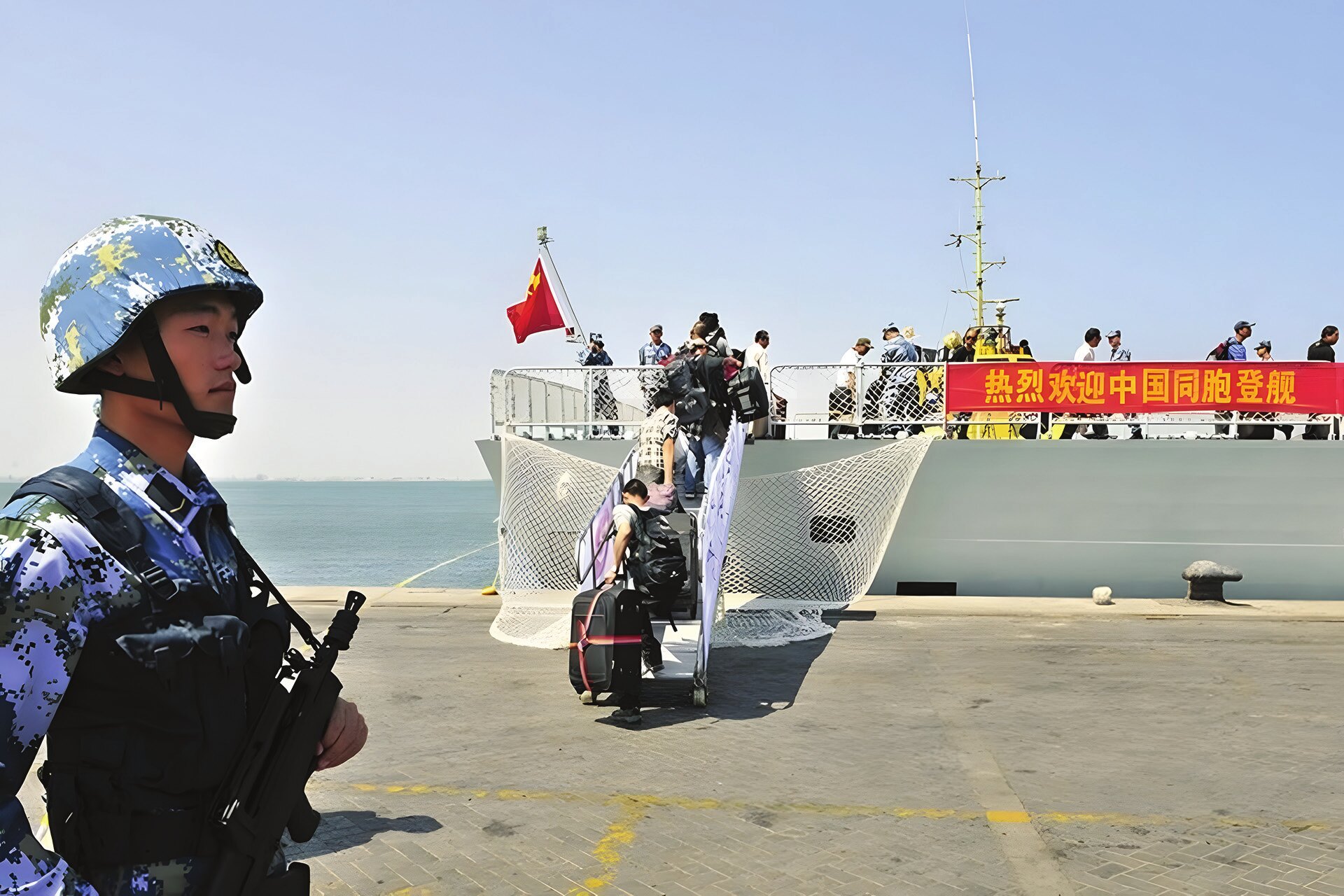
During this time, China frequently expressed the need for a naval base in Africa to evacuate hundreds of thousands of Chinese nationals when necessary, citing the evacuation of 36,000 Chinese citizens from Libya in 2011 as an example (Cabestan, 2019Cabestan, J.-P. (2019). China’s Military Base in Djibouti: A Microcosm of China’s Growing Competition with the United States and New Bipolarity. Journal of Contemporary China, 29(125), 1–17.). Indeed, China’s use of civilian ports in Djibouti to evacuate 900 Chinese nationals from Yemen in March-April 2015 confirmed this thesis (Zhen, 2016Zhen, L. (2016). China starts work on Horn of Africa military base in Djibouti, defence ministry confirms. South China Morning Post. Retrieved January 1, 2024 from).
In November 2015, China announced its decision to establish a logistics facility to escort merchant ships in the Gulf of Aden and Somali waters and to support UN peacekeeping/humanitarian aid/evacuation missions (Cabestan, 2019Cabestan, J.-P. (2019). China’s Military Base in Djibouti: A Microcosm of China’s Growing Competition with the United States and New Bipolarity. Journal of Contemporary China, 29(125), 1–17.; Jacobs & Perlez, 2017Jacobs, A., & Perlez, J. (2017). U.S. Wary of Its New Neighbor in Djibouti: A Chinese Naval Base. The New York Times. Retrieved January 1, 2024 from). Although the Chinese Government tries to mask it as a military area, this facility possesses all the characteristics of a military base.
The Chinese Djibouti Naval Base, operational since August 2017 under a 10-year leasing agreement between China and Djibouti, houses approximately 2,000 military personne (Wong, 2015Wong, K. (2015). China’s military makes move into Africa. The Hill. Retrieved January 1, 2024 from; Cabestan, 2019Cabestan, J.-P. (2019). China’s Military Base in Djibouti: A Microcosm of China’s Growing Competition with the United States and New Bipolarity. Journal of Contemporary China, 29(125), 1–17.)l. According to some sources in Western media, China has built the base in Djibouti with the capacity to accommodate up to 10,000 soldiers (Winsor, 2016Winsor, M. (2016). Djibouti May Become “Africa’s Singapore.” International Business Times. Retrieved November 25, 2023 from; Dube, 2016Dube, F. (2016). China’s Experiment in Djibouti. Retrieved October 5, 2023 from; Cabestan, 2019Cabestan, J.-P. (2019). China’s Military Base in Djibouti: A Microcosm of China’s Growing Competition with the United States and New Bipolarity. Journal of Contemporary China, 29(125), 1–17.).
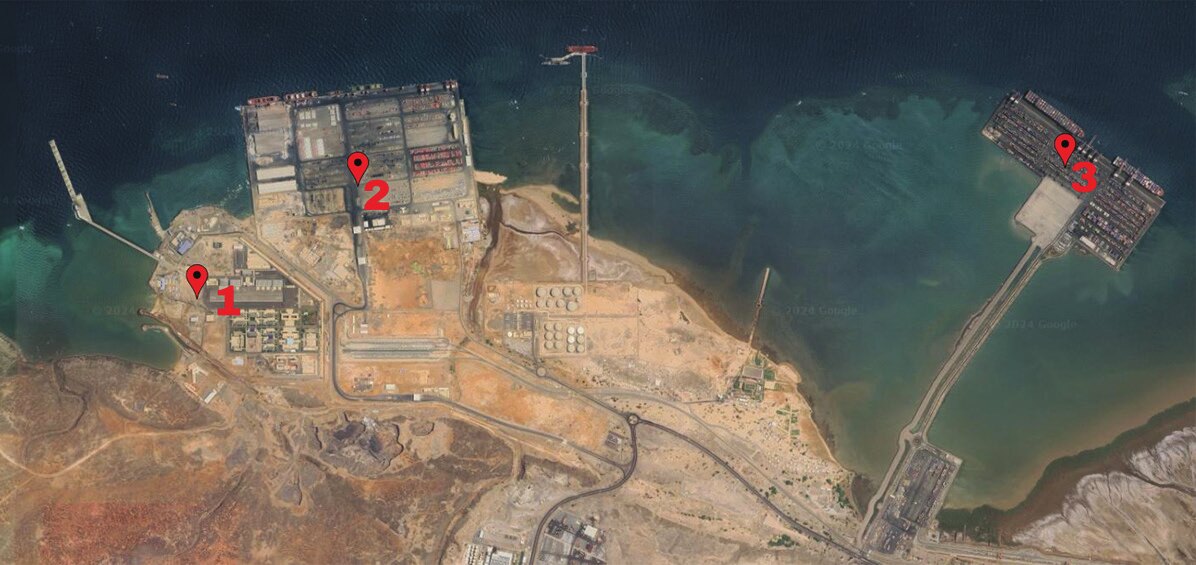
The Chinese Djibouti Naval Base, adjacent to the Doraleh Multipurpose Port and costing $590 million, allocates one of its six docks for Chinese warships (Zhen, 2016Zhen, L. (2016). China starts work on Horn of Africa military base in Djibouti, defence ministry confirms. South China Morning Post. Retrieved January 1, 2024 from). This particular dock can accommodate all Chinese warships except aircraft carriers and Type 071 Yushao-class amphibious transport docks (LPD) (Downs, 2017Downs, E. (2017). China’s Military Support Facility in Djibouti: The Economic and Security Dimensions of China’s First Overseas Base. Retrieved January 1, 2024 from).
The Chinese Djibouti Naval Base, situated 8 miles from the U.S. Base at Camp Lemonnier, covers 36 hectares. The base includes four-story logistics warehouses, a helipad with a helicopter runway, hangars, and maintenance facilities. It also has a hospital and sports facilities and is surrounded by an 8-meter high security wall and patrol roads. The helicopter runway (Bhat, 2017Bhat, C. V. (2017). China’s mega fortress in Djibouti could be model for its bases in Pakistan. The Print. Retrieved October 5, 2023 from) is suitable for drone take-offs and landings, but a major disadvantage of the Chinese base is the absence of a runway suitable for aircraft take-offs. The Chinese Djibouti Naval Base is five times smaller than the U.S. Base at Camp Lemonnier (Cabestan, 2019Cabestan, J.-P. (2019). China’s Military Base in Djibouti: A Microcosm of China’s Growing Competition with the United States and New Bipolarity. Journal of Contemporary China, 29(125), 1–17.).
Since the opening of the Chinese Djibouti Naval Base in 2017, regular heavy weapons firing training exercises have been observed for the security of the base’s Chinese military units (Zhao, 2017Zhao, L. (2017). Live-fire exercises conducted by PLA base in Djibouti - China. China Daily. Retrieved January 1, 2024 from).
The U.S. forces in Djibouti meet their logistic needs through the Doraleh Container Terminal, located near the Chinese Djibouti Naval Base. This situation, implying an additional security problem for the U.S. Base at Camp Lemonnier, is uncomfortable for the United States (U.S.-China Economic and Security Review Commission, 2020U.S.-China Economic and Security Review Commission. (2020). 2020 Annual Report to Congress. Retrieved January 1, 2024 from).
In Djibouti, due to the proximity of the bases, tensions between China and the United States are on the rise. For instance, it has been alleged by the United States that “10 separate laser attacks were carried out from the Chinese Djibouti Naval Base against U.S. warplanes, resulting in serious eye injuries to two U.S. pilots (Dahir, 2018Dahir, A. L. (2018). US-China tensions are escalating in Africa as lasers are pointed at US planes over Djibouti. Quartz. Retrieved October 5, 2023 from).” Besides these “allegation-level” tensions, the U.S. Government closely monitors multinational exercises conducted by the South African, Chinese, and Russian Navies in the southern waters of Africa and by the Iranian, Russian, and Chinese Navies in the Indian Ocean. According to reports presented to the U.S. Congress, during joint military activities, China has allowed Russian warships to use its base in Djibouti (Shainn, 2020Shainn, D. H. (2020). China in Africa: Testimony before the U.S.-China Economic and Security Review Commission. Retrieved January 1, 2024 from).
Seeking to increase its influence in the Red Sea, Russia has been searching for a base near the Bab-el-Mandeb Strait since 2009 (Ramani, 2018Ramani, S. (2018). Russia’s Mediating Role in Southern Yemen. Carnegie Endowment for International Peace. Retrieved November 25, 2023 from). Amid the Russia-Ukraine tensions and seeking political support internationally, Russia’s visibility in Africa began to increase, leading to the signing of 19 military cooperation agreements with African countries between 2015 and 2019 (TASAM Afrika Enstitüsü, 2022TASAM Afrika Enstitüsü. (2022). Afrika 2063 Ağı İstişare Toplantıları (1-2) Sonuç Raporu. Retrieved October 5, 2023 from). Although not officially acknowledged by the Moscow administration, Russian mercenaries from the Wagner Group are stationed in Libya, Mali, the Central African Republic, Madagascar, Mozambique, and Sudan, which has a coastline on the Red Sea (Siegle, 2021Siegle, J. (2021). Russia and Africa: Expanding Influence and Instability. In G. P. Herd (Ed.), Russia’s Global reach: A Security and Statecraft Assessment. George C. Marshall European Center for Security Studies.; Lindén, 2023Lindén, K. (2023). Russia’s Relations with Africa Small, Military-Oriented and with Destabilising Effects. FOI Studies in African Security. Retrieved October 5, 2023 from).
According to statements made in August 2017 by former RF Naval Forces Commander Admiral Feliks Gromov, Russia’s need for a naval base in the Gulf of Aden has become vital. The Moscow-based Institute of Oriental Studies, after extensive research, has suggested Yemen’s Socotra Island as an ideal location for a Russian naval base. Russia continues negotiations with the al-Hadi Administration in Southern Yemen regarding this. Similarly, Russia has been intensively pursuing the establishment of a naval base in Eritrea since September 2018, alongside a logistics center, to facilitate trade in agricultural products and minerals in the Red Sea and in Berbera, a major trade port in Somaliland on the Gulf of Aden (Ramani, 2018Ramani, S. (2018). Russia’s Mediating Role in Southern Yemen. Carnegie Endowment for International Peace. Retrieved November 25, 2023 from; Tesfa News, 2018Tesfa News. (2018). Eritrea, Russia Foreign Ministers Meets in Sochi. Retrieved January 1, 2024 from).
Since May 2019, Russia has been in talks with the Sudanese Government and successfully signed a military cooperation agreement in November-December 2020. This agreement granted Russia a “logistical support point” in Port Sudan and allowed for the establishment and operation of a military facility by 300 Russian military and civilian personnel for 25 years, providing Russia with the convenience of basing in the Red Sea for shortterm shelter of warships. However, this agreement was canceled in April 2021 (Kollakowski, 2022Kollakowski, T. (2022). Great Regional Engagement Rather Than Great Sea Power: Russia-Russia’s New Supply Point on the Red Sea Coast. Naval War College Review, 75(1), 83–105.; Saballa, 2021Saballa, J. (2021). Sudan Reportedly Suspends Planned Russian Naval Base in Red Sea. The Defense Post. Retrieved November 25, 2023 from). Negotiations between Sudan and Russia continue regarding the reinstatement of the military cooperation agreement (Reuters, 2022Reuters. (2022). Sudan’s Hemedti Seeks Deeper Russia Ties on Moscow Visit. Retrieved October 5, 2023 from).
In recent years, Russia’s persistent search for permanent military bases in African countries, including Sudan, Egypt, Eritrea, the Central African Republic, Madagascar, and Mozambique, particularly in the Red Sea waters, has been closely monitored by the global community (Ersozoglu, 2021Ersozoglu, E. (2021). Russian Military Base in Mozambique: Intent, Impact & Impediment. Grey Dynamics. Retrieved October 5, 2023 from; Lindén, 2023Lindén, K. (2023). Russia’s Relations with Africa Small, Military-Oriented and with Destabilising Effects. FOI Studies in African Security. Retrieved October 5, 2023 from; Nia, 2020Nia, O. T. (2020). Russia building military bases in Africa: Report. Anadolu Ajansi. Retrieved January 1, 2024 from).
Led by Saudi Arabia and with the participation of some Arab countries, a coalition launched military operations against the Houthi-Saleh forces starting March 25, 2015 (T.C. Dışişleri Bakanlığı, 2014Dışişleri Bakanlığı. (2014). Yemen’in Siyasi Görünümü. Retrieved January 1, 2024 from). Due to the multifaceted Yemeni Civil War, weapons like anti-ship missiles, naval mines, and improvised explosive devices (IEDs) used in the south of the Red Sea have impacted a small number of merchant ships, in addition to the warships participating in the conflict (Kozanhan, 2020Kozanhan, M. K. (2020). Deniz Ortamında El Yapımı Patlayıcı Düzenek (EYPD)’ler Genelinde Terörist Tehditler ve Deniz Güvenliğine Etkileri. Güvenlik Stratejileri Dergisi, 16(34): 341–381.). Particularly, the attacks by the Houthis on Saudi Arabian war/commercial ships using drones, boats, and explosive devices (especially during 2017-2018) have been a major topic in the global public discourse (Kalay, 2023Kalay, E. (2023). ABD-Çin Rekabeti Kapsamında Afrika Jeopolitiği. In H. Çomak (Ed.), Afrika Jeopolitiği (pp. 305–316). Nobel Yayınları.).
In an attack near Yemen’s Al-Hudaydah Port on January 30, 2017, a fast boat loaded with an unmanned bomb used by the Houthis struck the Saudi Al-Madinah (RSN 702) frigate near its helicopter platform, resulting in the death of two and injury of three Saudi soldiers. Saudi Arabia reported that the attack involved two remote-controlled, bomb-laden fast boats, of which two were detected and evaded by Al-Madinah, but the third boat hit the ship (Lagrone, 2017Lagrone, S. (2017). Two Saudi Sailors Dead In Houti Suicide Boat Attack. USNI News. Retrieved January 1, 2024 from; BBC, 2017’ RSN AL Madinah, 2017BBC. (2017). Yemen conflict: Rebels in deadly attack on Saudi warship. Retrieved January 1, 2024).
Months after this incident, in 2017, Saudi Arabia joined the list of countries with military bases in Djibouti (Downs, 2017Downs, E. (2017). China’s Military Support Facility in Djibouti: The Economic and Security Dimensions of China’s First Overseas Base. Retrieved January 1, 2024 from; Cabestan, 2019Cabestan, J.-P. (2019). China’s Military Base in Djibouti: A Microcosm of China’s Growing Competition with the United States and New Bipolarity. Journal of Contemporary China, 29(125), 1–17.; Al-Abyadh, 2017Al-Abyadh, S. (2017). Djibouti’s Defense Minister to Asharq Al-Awsat: We Welcome Saudi Military Base. Retrieved January 1, 2024 from). The number and function of Saudi personnel in Djibouti remain largely undisclosed.
During 2018-2019, Saudi Arabia entered into close military cooperation with Egypt in the Red Sea, exemplified by their joint execution of “The Red Wave” Exercise in December 2018 in the Red Sea. Following the drone attack on two Saudi oil facilities in the Persian Gulf on September 14, 2019, the armed forces of Egypt, Saudi Arabia, Jordan, Sudan, Djibouti, Yemen, and Somalia decided to make “The Red Wave” series of joint exercises a regular event to be repeated annually in the waters of Jeddah in the Red Sea. The fifth of these series, “The Red Wave-5,” was conducted in June 2022 (Muhammed, 2019Muhammed, M. S. E. (2019). 7 Red Sea countries launch military drill in Jeddah. Anadolu Ajansi. Retrieved October 5, 2023 from; Khan, 2019Khan, S. (2019). Djibouti’s Defense Minister to Asharq Al-Awsat: We Welcome Saudi Military Base. The Arab Weekly. Retrieved October 5, 2023 from; Arab News, 2022Arab News. (2022). Saudi Arabia’s Red Wave 5 joint naval drill wraps up. Retrieved January 1, 2024).
To support its military operations in Yemen, the UAE, which has deployed troops in Eritrea and Somaliland, had its 2015 request to establish a naval base rejected by Djibouti (Cabestan, 2019Cabestan, J.-P. (2019). China’s Military Base in Djibouti: A Microcosm of China’s Growing Competition with the United States and New Bipolarity. Journal of Contemporary China, 29(125), 1–17.; Meester & Lanfranchi, 2021Meester, J., & Lanfranchi, G. (2021). Policy Brief: “A careful foot can step anywhere” The UAE and China in the Horn of Africa: Implications for EU engagement. Clingendael Institute. Retrieved September 8, 2023 from; Chegraoui, Lyammouri, & Skah, 2021Chegraoui, K., Lyammouri, R., & Skah, M. (2021). Emerging Powers in Africa: Key Drivers, Differing Interests, and Future Perspectives. Policy Center for the New South. Retrieved January 1, 2024 from). Although the UAE’s military activities have recently decreased, it has a naval and air base in Assab, Eritrea, which it has leased for 30 years since April 2015 for use against the Houthis in Yemen. The Assab base in Eritrea has also served as a transportation terminal for the transit of 10,000 Sudanese fighters to Yemen and is alleged to have been used for transporting military equipment to Haftar in Libya (Taşkömür, 2023Taşkömür, F. (2023). UAE dismantles Africa base to avoid US wrath, but policy change unlikely. UAE Dismantles Africa Base to Avoid US Wrath, but Policy Change Unlikely. TRT World. Retrieved November 25, 2023 from; Alexandre, 2020Alexandre, A. M. G. (2020). A Geopolitical Analysis of The Horn Of Africa (Uma Análise Geopolitica do Corno de África). Revista de Ciências Militares, 8(1), 45–72.).
In 2002, Türkiye only had 12 embassies in Africa, but with its “Africa Opening Policy,” it has increased this number to 44 in 20 years. Today, Türkiye has the second-highest number of embassies in Africa after France. Similarly, while only 10 African countries had embassies in Ankara in 2008, this number has now risen to 37. Expanding rapidly in Africa, Türkiye opened embassies in Somalia in 2011, and in Eritrea and Djibouti in 2013, and then began to implement its “Africa Partnership Policy.” Closely monitoring terrorism, civil wars, coups, social and humanitarian crises, political chaos, and security threats arising from climate change in Africa, Türkiye has gained sympathy as an advocate of “African solutions” by sharing its experiences (TA- SAM Afrika Enstitüsü, 2022TASAM Afrika Enstitüsü. (2022). Afrika 2063 Ağı İstişare Toplantıları (1-2) Sonuç Raporu. Retrieved October 5, 2023 from).
The port visits to 24 African countries by the Barbaros Turkish Naval Task Group, consisting of two frigates, one corvette, and one replenishment oiler, during its 102-day journey starting from Gölcük on March 14, 2014, have strengthened Türkiye-Africa relations (Mavi Vatan, 2023Mavi Vatan. (2023). Türk Deniz Görev Grupları. Retrieved January 1, 2024 from).
Türkiye’s use of the waters of Africa, including the Red Sea and Gulf of Aden, stands at a high level. In fact, according to 2019 figures, 5.3% of the north/south cargo transported through the Suez Canal consists of Türkiye’s imports and exports. Among the countries using the Suez Canal, Türkiye ranks: - 5th for southbound petroleum products, - 7th for southbound ore and metals, - 4th for southbound fertilizers, - 1st for southbound processed metals, - 3rd for northbound petroleum products, - 5th for northbound LNG, - 4th for northbound chemicals, - 2nd for northbound processed metals, - 4th for northbound vegetable oils, - 1st for northbound coal, - 2nd for northbound fertilizers (Mavi Vatan, 2023Mavi Vatan. (2023). Türk Deniz Görev Grupları. Retrieved January 1, 2024 from; Suez Canal Authority, 2019Suez Canal Authority. (2019). Annual Report. Retrieved January 1, 2024 from).
According to these statistics, Türkiye is among the top users of the Red Sea. As can be seen, Türkiye, which vitally depends on the waterways of the Afro-Asian junction, is compelled to have a military presence in the Red Sea and the Gulf of Aden, where Western imperialism is militarily concentrated.
Since 2017, the Turkish Task Force in Somalia has been based in Mogadishu to provide training support to the Somali Armed Forces (Al-Jazeera, 2017Al-Jazeera. (2017). Turkey sets up largest overseas army base in Somalia. Retrieved January 1, 2024). However, the distance from Mogadishu to the Bab-el-Mandeb Strait is about 1,400 nautical miles by sea. There have been reports that Türkiye, seeking a base closer to the strategically important Bab-el-Mandeb Strait, has acquired land for a military base in Djibouti (Erandaç, 2018Erandaç, B. (2018). Yakın Coğrafya Türkiye Üslerinin Anlam ve Önemi. Stratejik Düşünce Enstitüsü. Retrieved January 21, 2024 from). It is unclear if the land mentioned in these reports is the 500-hectare area allocated to Türkiye for 99 years to establish a “Special Economic Zone” under an agreement signed on December 10, 2014 (DEIK, 2023DEIK. (2023). Türkiye-Cibuti İş Forumu, Cibuti’de Yapıldı. Retrieved November 25, 2023 from).
Following the economic hardship caused by 20 years of U.S. sanctions and the loss of over 70% of its oil revenues, with South Sudan’s independence in 2011, Sudan under Omar al-Bashir’s regime grew closer to Türkiye after 2014 (Mashamoun, 2022Mashamoun, J. (2022). Turkey and Sudan: An enduring relationship?. Middle East Institute. Retrieved January 1, 2024 from). In this positive atmosphere, on December 29, 2017, Türkiye and Sudan signed 22 agreements, including leasing Suakin Island for 99 years for $650 million and increasing bilateral trade volume to $10 billion annually. Although Türkiye claimed it intended to restore the dilapidated old Ottoman port on Suakin Island and turn the island into a cultural and tourism center, this assertion was not found credible by Egypt, UAE, and Saudi Arabia (Cagaptay, 2019Cagaptay, S. (2019). Erdoğan’s Failure on the Nile. The Cairo Review of Global Affairs. Retrieved October 5, 2023 from; Habertürk, 2018’ Arpa, 2019Habertürk. (2018). Ortadoğu’ya Kıbrıs’tan sonra ikinci Türk gözü “Sevakin”. Retrieved January 1, 2024 from; Mashamoun, 2022Mashamoun, J. (2022). Turkey and Sudan: An enduring relationship?. Middle East Institute. Retrieved January 1, 2024 from; ASSAM, 2022ASSAM. (2022). Türkiye’nin Asker Bulundurduğu Ülkeler; Millî Savunma ve Proaktif Bağımsız Dış Politikası. Retrieved October 5, 2023 from). According to some reports in the Turkish and Egyptian media in 2018, Türkiye planned to complete the construction of a military base on Suakin Island by 2020 and additionally make a $4 billion investment to renovate Suakin Port (Mourad, 2018Mourad, H.. (2018). The Scramble fort he Red Sea. Ahram. Retrieved November 25, 2023 from). These reports triggered the formation of a reflexive anti-Türkiye axis comprising Saudi Arabia, UAE, and Egypt in the Red Sea (İnanç, 2023İnanç, H. (2023). Ak Parti Hükûmetleri Döneminde Türk Dış Politikasının Afrika Yönelimi. In H. Çomak (Ed.), Afrika Jeopolitiği (pp. 109–124). Nobel Yayınları.).
In 2019, Sudanese Vice President Ibrahim es Senusi stated that Türkiye would not establish a military base on the island, but he found it difficult to understand the reaction to this agreement by those who did not object to the many foreign military bases in the Red Sea (Bag, 2019Bag, M. (2019). Türkiye’nin Sudan’la yaptığı anlaşmalar ve Sevakin Adası’nın önemi. Euronews. Retrieved October 5, 2023 from). Sudanese Foreign Minister Ibrahim Ghandour said that Türkiye would first construct a port on the island for the repair and maintenance of military and commercial ships (Kaya, 2021Kaya, İ. (2021). Türkiye-Sudan İlişkileri (1998-2020). In E. İsmail (Ed.), Dünya Siyasetinde Afrika 7 (pp. 421–454). Nobel Yayınları.).
After the overthrow of Omar al-Bashir’s regime in Sudan in 2019, the transitional government canceled the lease agreement of Suakin Island to Türkiye (Sofos, 2022Sofos, S. (2022). Peacebuilding in Turbulent Times: Turkey in Mena and Africa. LSE Middle East Centre Paper Series, 61. Retrieved January 1, 2024 from). Abdulfettah el-Burhan, the head of the Sudanese Transitional Military Council formed in 2019, announced on social media his opposition to the allocation of Suakin Island to Türkiye for 99 years and his intention to work for its cancellation. Amid increasing debates, former Sudanese Minister of International Relations Idris Suleiman defended that the agreement was legally signed at the state level and could not be changed (Kaya, 2021Kaya, İ. (2021). Türkiye-Sudan İlişkileri (1998-2020). In E. İsmail (Ed.), Dünya Siyasetinde Afrika 7 (pp. 421–454). Nobel Yayınları.). Despite these controversies, the momentum between Türkiye and Sudan did not diminish, and in a bilateral meeting between Turkish Vice President Fuat Oktay and Sudanese Sovereignty Council Deputy Chairman General Mohammed Hamdan Dagalo, it was stated that the agreements signed during the Omar al-Bashir era between the two countries would remain in effect (Mashamoun, 2022Mashamoun, J. (2022). Turkey and Sudan: An enduring relationship?. Middle East Institute. Retrieved January 1, 2024 from). Moreover, Türkiye expressed its willingness to mediate the ongoing issues between Sudan and Ethiopia (Orakçı, 2021Orakçı, S. (2021). Türkiye-Sudan İlişkilerinde Yeni Dönem. INSAMER. Retrieved November 25, 2023 from). Finally, in August 2021, President Erdogan met with Sudanese Sovereignty Council Chairman Abdel Fattah al-Burhan to sign a series of agreements and restart cooperation (Sofos, 2022Sofos, S. (2022). Peacebuilding in Turbulent Times: Turkey in Mena and Africa. LSE Middle East Centre Paper Series, 61. Retrieved January 1, 2024 from).