A Declaration of War Against Reality
Within mere weeks, the global economy, medical infrastructure and national politics have lost their stability and even shifted into a chaotic path in some parts of the world; as, for example, in Bergamo, Italy (Zamapano, 2020Zamapano, G. (2020). COVID-19 study suggests Italy's death poll much higher.; Jones & Montale, 2020Jones & Montale (2020). The source article does not provide a separate full bibliographic entry for this citation.). Already on March 2, 2020, the Organization for Economic Co-operation and Development (OECD) published an interim report under the alarmist title "The World Economy at Risk". Every single index in this report is pointing downwards (OECD, 2020: 15): "If downside risks materialize, including a much wider spread of the coronavirus outbreak, and global growth looks set to be much lower than projected, governments could be faced with the challenge of having to respond to significant weakness at a time when domestic policy space is limited." After a rather pessimistic outlook, the report concludes (OECD, 2020: 14): "Looking ahead, this episode of weak growth reinforces the need for stronger public investment in many countries, broadly defined to include education and health care spending, to support demand and boost medium-term living standards." Since March 2020, the negative global macroeconomic effects of COVID-19 have accelerated.
While international organizations have tried to describe, from a very early stage, the immediate, mid- and long-term economic and financial outcomes of the pandemic (Lagarde, 2020Lagarde (2020). The source article does not provide a separate full bibliographic entry for this citation.; IMF, 2020IMF (2020). The source article does not provide a separate full bibliographic entry for this citation.), national policies have had to address unstable situations, risking a total loss of control. In a decisive moment, French president Emmanuel Macron used the term guerre sanitaire (sanitary war) (Elysée, 2020Elysée (2020). The source article does not provide a separate full bibliographic entry for this citation.)1 – not as a metaphor, but as a factual description. His membres de cabinet obediently took over the phrase of "being at war" (Vignaud, 2020: 29).
The fight against COVID-19 has turned out to be an epic war against an invisible foe; yet every state fights it alone, and sometimes states even fight against each other. "America First" was a phrase often heard before the COVID-19 crisis, but policies of a strictly national perspective can also be recognized among E.U. member states. Tensions between Germany, France and Italy have become apparent. French commuters crossing the German border to go to work were abused and insulted as "dirty French" (FAZ, 2020aFAZ (2020a). The source article does not provide a separate full bibliographic entry for this citation.). The Belgian politician Charles Michel, president of the E.U. Council, recently had to explain "why the E.U. is not on the brink of failure" (FAZ, 2020bFAZ (2020a). The source article does not provide a separate full bibliographic entry for this citation.). Spanish foreign secretary Arancha González Laya was asked if the coronavirus would be "lethal to the E.U." (González Laya, 2020González Laya (2020). The source article does not provide a separate full bibliographic entry for this citation.). Are there any symptoms or indicators of a real political decline behind these questions?
During the COVID-19 crisis, the E.U. proved its inability to speak and stand up as one. Instead, since March 2020, national positions have dominated media, economic discussions and monetary negotiations alike. Of course, all frontiers in Europe were closed – it was never easier to fall back to a regime ante the Maastricht treaty and the Schengen agreement.
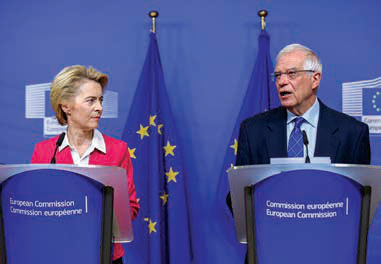
Under the rule of a pandemic, isolation makes absolute sense; as a political symptom in a globalized economy, it is simply devastating. A supranational union like the E.U. loses its meaning when it only consists of isolated members and ceases to represent a higher order or historical vision. During COVID-19, the E.U., and the European Commission as the executive institution, were simply non-existent. Peoples – and voters – all over Europe will not forget this sign of decreasing relevance, visibility and importance. The E.U. missed the chance to prove its strength and unity in a moment of extreme external pressure. This critical moment passed without any understanding of its political potential. True statesmanship, once part of the European political tradition,2 was entirely missing at a time when it was crucial. This opportunity is now completely lost, leaving disappointment if not indifference towards E.U. politics among citizens and voters.
The Absence of E.U. Politics and Its Consequences
During the COVID-19 crisis, every single state could easily do without the E.U. Public health was not a matter of official E.U. politics: member states looked out for themselves and took, or did not take, precautions. But if the E.U. market is common, and frontiers are open for trade and travel, why is there not also a common organizational and infrastructural standard of public health? Unlike Asian states, particularly those which had learned from the SARS epidemic in 2008, the E.U. member states were not prepared for a pandemic, as improbable as it might have seemed beforehand. The successful crisis management of Asian states, among them China, stands out against the relatively late and hesitant reaction of European states. Singapore and South Korea, too, managed to handle the crisis remarkably smoothly and without much ado. The highly digitized infrastructure of both countries enabled officials to initiate punctual measures against COVID-19 instead of mass invasive measures. Citizens behaved in a disciplined manner; the number of those infected remained low compared to other states (Normile, 2020Normile, D. (2020). Coronavirus cases have dropped sharply in South Korea. What's the secret to its success? OECD (Organisation for Economic Cooperation and Development). (2020). The world economy at risk. Retrieved from oecd.org/economic-outlook). In South Korea, even legislative elections were held in mid-April. Public life has returned to normal.3
The outcome of COVID-19 may weaken the E.U. and encourage centrifugal political forces. More specifically, the current crisis will lead to a reorientation towards national agendas of politics and economics. All over Europe, bankrupt airlines are likely to be nationalized (Asquith, 2020Asquith, J. (2020). Could airlines be nationalized? As Italy takes full ownership of Alitalia, will more airlines fol low?); national – not European or global – infrastructure in agriculture, medical surveillance, pharmaceuticals and digital information is in demand; for individuals and nations alike, autarky has become desirable again. Even Brexit is now a marginal topic. Who cares about Britain's new "splendid isolation" while COVID-19 drives the world economy into the deepest recession since the late 1920s (Riley, 2020Riley, C. (2020). The world hasn't seen a recession this bad since the 1930s: The recovery is far from certain. The Economist (2020a, April 18). Unlucky millenials. Young southern Europeans face the second crisis of their adult lives. Will it radicalize them? The Economist (2020b, April 18). GDP Forecast and Economic Downturn 2020.; FAZ, 2020cFAZ (2020a). The source article does not provide a separate full bibliographic entry for this citation.)? The impact of COVID-19 overshadows any other political decision in Europe. But what are the pending consequences of all of these developments and powershifts? The actual figures and forecasts for Western economies give an idea of what might be expected in the aftermath of COVID-19.
But the E.U. acts – again – divided. While Southern E.U. member states demand that the negative economic effects of COVID-19 should be shouldered fairly by all E.U. members, wealthier countries like Germany or the Netherlands prefer to continue their policy of national responsibility. Economic disaster is regarded as a matter of national policy; every state, therefore, should be held responsible for its own debts and financial situation. This is a hardliner position that is only shared by the relatively wealthy E.U. member states. These petty discussions reflect a total lack of the metapolitical perspective.
"When you are covering the United States," says French RFI correspondent Anne Corpet (Corpet, 2020Corpet (2020). The source article does not provide a separate full bibliographic entry for this citation.), "it's as if you're on the frontline of Western culture." Latest figures from the IMF (2020The Guardian (2020a). Mafia distributes food to Italy's struggling residents.) and U.S. Bureau of Labor Statistics (2020U.S. bureau of labor statistics. (2020). Employment situation summary. Vignaud, M. (2020, April 2). Bercy en mode «Shining». Le Point, (2484), pp. 28–29.) indicate a dramatically increasing U.S. unemployment rate – a rise of 16 million between March and April 2020 alone. Only the Great Depression in the 1930s hit harder on the American labor market. The European outlook is equally gloomy. Millennials in Southern Europe (Italy, Portugal, Spain, Greece) see themselves as members of a "lost generation" (The Economist, 2020a: 20The Guardian (2020a). Mafia distributes food to Italy's struggling residents.). "After two big crises at a formative period of their lives, a politicised and traumatized generation will need to be catered for … The anger built up during the previous crisis has not receded. About two-thirds of Spaniards declare themselves dissatisfied with democracy in their country" (The Economist, 2020a: 20The Guardian (2020a). Mafia distributes food to Italy's struggling residents.). But what would be the alternative to democracy? Authoritarian national regimes promising more economic security? The rise of anti-establishment movements? The loss of interest in politics? The return of openly fascist ideas in Europe (Albright, 2019Albright, M. (2019). Fascism: A warning. London: William Collins.)?4
The symptoms of societal decay are evident. In Southern Italy, organized crime replaces state authority, distributing food to the poor and offering loans to small shopkeepers as financial support and compensation for an absent state (The Guardian, 2020aThe Guardian (2020a). Mafia distributes food to Italy's struggling residents.). All over Europe, as well as in the U.S., Russia, Brazil and Argentina – to mention but a few – national economies are at stake and forecasts predict decreasing GDP (The Economist, 2020b: 6The Guardian (2020a). Mafia distributes food to Italy's struggling residents.). As in 2008, economic figures have turned into nightmares; only this time, it might last much longer.
The idea of Europe as a visionary project is losing momentum, inspiration and, maybe for the first time, real relevance. A formerly powerful political idea – the best Europe has ever had in centuries, measured not in money but in common cultural values and shared experiences – is evaporating. It could be that these values have simply become insignificant. Which political powers will emerge from the void of a weakened and disunited Europe?
The European Unease
Even before spring 2020, the E.U. as an institution struggled with shrinking acceptance among citizens and voters. The 2018 elections to the European Parliament strengthened the radical political parties in France, the UK, Italy and Germany. Brexit, much debated since 2016, is only the most prominent symptom of a stronger underlying feeling of unease among E.U. member states and their citizens. Without a doubt, from education to economics, from individual rights to institutionalized prosperity, from peace to mobility, the E.U. has a lot to offer. But not to everyone. Social and political reality within E.U. member states (and likewise in non-member states, e.g. Switzerland and Norway) consists not only of those who profit from tax privileges, high educational standards, professional mobility, second homes in the countryside and a relaxed liberal-cosmopolitan lifestyle where minority rights are guaranteed, but also of those who consider themselves not as winners but as losers from competitive markets, global production and the growing internationalization of the economy. These people, large segments of the European population, prefer – for very personal economic reasons – protected national markets. They are also those who are suffering the most from the negative impact of COVID-19: small shopkeepers, underpaid staff in restaurants and cafés, self-employed entrepreneurs without much of a financial cushion, blue-collar workers whose working conditions are dramatically worsening5 and all those who have already lost or will lose their jobs in an economy already going into a deep and long-lasting recession. Their skepticism towards a political-economic system that could not protect them from loss, deprivation or even poverty will only grow.
The European idea, once meant as a unifier and peace-bringer after the bloodshed and disasters of the early and mid-20th century (Mak, 2007Mak, G. (2007). In Europa: Eine reise durch das 20. Jahrhundert. München Siedler/Pantheon: Random House. Müßgens, C. (2020, April 20). Otto erwartet rabattschlacht. Frankfurter Allgemeine Zeitung (FAZ), p. 19.), has lost most of its attractiveness. It doesn't reflect the political polarization and radicalization of European societies. The political climate, already distorted before COVID-19, is deteriorating, posing new risks in an already unstable situation. Populist parties and rightwing movements are reckless enough to take advantage of the – from the perspective of their voters – political impotence of the E.U. "The siren is ringing" (Jones & Montale, 2020Jones & Montale (2020). The source article does not provide a separate full bibliographic entry for this citation.); not only for the poor all over Europe, who have become even poorer by now, but also for well-established bourgeois pro-European representatives as they face the growing risk of losing their political influence and majorities. Those who suffered economic losses during the COVID-19 crisis and its aftermath will not forget those who left them alone and did not provide help when it was most needed. They will remember the pictures of the endless discussions and nightly negotiations at the E.U. headquarters in the Berlaymont building in Brussels, which ended without a solution. They will not consider the E.U. flag with its 12 golden stars as their own anymore. The enormous sum of €2.7 trillion, the new "Marshall Plan" for Europe (von der Leyen, 2020Von der Leyen, U. (2020). Ein Marshall-Plan für Europa. Wang, Y. & Yang, C. (2020, April 9). Wuhan limbs back from lockdown. The New York Times International Edition, 42(632), pp. 1-7. Welter, P. (2020, April 7). Ein viruswunder in Südkorea. Frankfurter Allgemeine Zeitung (FAZ), p. 15.), will not change their negative attitudes towards the E.U.
Again, COVID-19 exposes one of the most vital weaknesses of the E.U.: its inability to explain itself and its vision of a unified and strong Europe. In its institutionalized form, the E.U. is totally helpless against populism. "In this pandemic," writes Scott L. Greer, a professor of public health (Greer, 2020Greer (2020). The source article does not provide a separate full bibliographic entry for this citation.), the E.U. "doesn't appear to live up to its ideals: A union that speaks often of solidarity between peoples initially saw little solidarity. A union often reproached for technocracy showed none of it. A union built on the freedom of movement of people and goods has become a chaotic continent of closed borders and export bans." Chaque-un pour soi seems to be the realpolitik of each E.U. member state when facing a severe crisis. European institutions like the European Center of Disease Prevention and Control (E.C.D.C.) in Stockholm or the newly founded RescEU, the European Union's organization for crisis response at home and abroad, were more or less invisible during the outbreak of COVID-19.
Under the regime of the COVID-19 pandemic, petty national interests, particularly in Europe, overshadowed individual sacrifices. Acts of solidarity between European states were more or less entirely lacking. The Italian public, whose emotions were fueled by political rightwing agitation, is openly disappointed at the unwillingness of relatively rich E.U. member states to share, as true partners, the financial and economic burdens of the COVID-19 crisis. Help and solidarity, when it comes to mutual sacrifices, have become unpopular among E.U. member states. Under pressure, individuals and institutions reveal their true reliability and strength. Facing hard times could have been one of the rare cathartic moments of contemporary politics: Europe's "finest hour". But it turned out that the European Commission only represented the political calamity of an organization fragmented and disunited by partial economic interests. The rich member states (Netherlands, Germany and others) are obviously not willing to share their privileges with weaker partners. Political alienation – or better, political distancing – between E.U. member states is already one of the paradoxical outcomes of the COVID-19 crisis.6
Are There Any Other Humanitarian Topics Left, Apart From COVID-19?
One of the most astonishing phenomena of the COVID-19 crisis is the total disappearance in the Western media of the formerly hot topic of mass migration from the Southern Mediterranean and Sub-Sahara regions. In February 2020, 11 migrants were assassinated in Hanau, Germany; one of the most violent and bloodiest xenophobic assaults in recent German history (The Guardian, 2020bThe Guardian (2020a). Mafia distributes food to Italy's struggling residents.). A brief outcry in the media followed, before COVID-19 swept away any other topic, including the public debates over refugees, asylum seekers, and xenophobic and antisemitic tendencies in Western democracies. But under the surface of the pandemic, the conflictual dynamite of a society that suppresses its inner self-contradictions is still there, ready to explode at any given moment.
COVID-19 dominates as a monothematic wave the international news circus; be it print, TV or social media. Obviously, the news industry follows its own rhythm; nevertheless it is somehow irritating that the destinies of tens of thousands of emigrants are no longer of any public concern. Questions of personal health and individual well-being are, seen from the perspective of the broad public, apparently more important than the fate of the damned of this world. The German parliament, representing a population of 80 million people, agreed to take in 50 unaccompanied minor-aged refugees from the war-ridden regions of the East. This is nothing more than a weak humanitarian gesture, tired from former generosity and political confrontation.
Emigration has ceased to be of any public concern. COVID-19 is the ideal pretext, a true deus ex machina, for establishing a restrictive border regime in Europe without facing any opposition. It also exposes the hollowness and unreliability of European humanitarian engagement and the moral hypocrisy of both officials and citizens. Turkey, Russia and China are not blind to the weak ethical commitments of Western Europe.
Western Lifestyle and Consumerism, Coming to Its End
The coronavirus pandemic might be as costly and destructive as going to war. But is it also as decisive, brutal and reckless as war? Behind the epidemiological facts and the obvious dangers of COVID-19 stands another adversary, as hard to grasp as the virus itself: the corrugated way of life in Western societies. Nobody was prepared for the complete shutdown of economic activity. There were no holidays, either; and what was left, apart from queueing for food, eating, jogging and watching Netflix or Disney+, was the shocking proof of the hollowness of the Western materialistic way of life. What could be seen was the abyss of an absolute conceptional, philosophical and emotional emptiness, where only petit-bourgeois anxieties reigned and a diffusive existential angst lay hidden.
Short after the official lockdown and the de facto curfew in Europe began, the novel La Peste by Albert Camus was briefly out of stock.7 world under the threat of infection quickly develops socio-phobic attitudes. Once again, reality follows literature; the worldly regime and daily life under COVID-19 closely resemble T.S. Eliot's 1925 poem The Hollow Men (Eliot, 1974: 91Eliot, T.S. (1974). Collected poems 1909–1962. London: Faber and Faber Elysée. (2020, March 16). «Nous sommes en guerre sanitaire». Speech of president Emmanuel Macron. Frankfurter Allgemeine Zeitung (FAZ). (2020a, April 18). Grenzen der Freundschaft, p. 2. Frankfurter Allgemeine Zeitung (FAZ). (2020b, April 18). Herausforderung dieser Generation (Interview with Charles Michel), p. 18. Frankfurter Allgemeine Zeitung (FAZ). (2020c, April 15). Schwerste Krise seit Großer Depression, p. 1.): "In this last of meeting places / We grope together / And avoid speech / Gathered on this beach of the tumid river". In times of external pressure, humility – and not self-confidence – has become the main virtue. When shops are closed and, apart from food, nothing can be bought, what is the essence of consumerism? Staying at home, attending webinars, following video conferences or working on Excel sheets are the main activities, apart from eating, sleeping and – at least in Northern Europe – amassing toilet paper in astonishing amounts. Refrigerators and freezers became top sellers overnight (Müßgens, 2020Müßgens (2020). The source article does not provide a separate full bibliographic entry for this citation.). The masses prepared themselves to outlast the crisis. What does all this tell us about the self-perception and self-deception of a society where entertainment and amusement suddenly turn into fear?
Behind all these rituals, imposed by a strict medical regime, lies the fragility, fearfulness and emptiness of a hedonistic and post-heroic society. Wealthy Western societies have learned to delegate a lot to absent third parties: hard working conditions, exploitation, poverty, pollution, violence and crime. Now, they learn that everything can be delegated, but not one's own fears. Like acid, COVID-19 exposes the unpleasant aspects beyond the shiny surface of Western wealth and values. Materialism easily turns to decadence, and decadence to decay.
Cultural Criticism and COVID-19
One would have to be politically naïve – or truly optimistic – to believe that the E.U. and, in a broader sense, the European idea of partnership among equals, will be among the winners from the recent developments. COVID-19 has already given a boost to nationalistic and reactionary ideas throughout Europe, particularly in Italy, France, Poland and Hungary. In Italy, the neofascist movement Fratelli d'Italia (Brothers of Italy) and its charismatic leader Georgia Meloni have become more popular than ever before. The concept of an authoritarian state based on reactionary ideas – the late and unlikely heritage of fascism – has recovered its appeal among democracies.
Authoritarian tendencies become more apparent as governments all over Europe demand unconditional obedience from their citizens. COVID-19 boosts the desire for control and security; authoritarian policies satisfy these demands. In Germany, where citizens traditionally believe in state authority and control, the joyless atmosphere of total conformity is almost palpable. "Never in my wildest dreams did I imagine seeing in a European democracy a police-enforced order that limits personal freedoms", writes Russian editor-at-large Maxim Trudolyubov (Trudolyubov, 2020Trudolyubov (2020). The source article does not provide a separate full bibliographic entry for this citation.).
COVID-19 puts democracy to the test as the antivirus regime oppresses all actions – and even attitudes – that oppose the executive orders. The ratio of seemingly necessary restrictions knocks out all liberal and democratic rights. What is good for public health can be bad or even devastating for a political culture. Obedience and conformism are regarded as social and personal virtues; in Germany it has become popular to snitch on neighbors flouting virus rules (Chambers, 2020Chambers (2020). The source article does not provide a separate full bibliographic entry for this citation.). This is reminiscent of certain totalitarian practices of the past.
It is strange to observe how easily a pluralistic and open society can be turned into a homogenous angst-ridden community where all members try to avoid each other. Again, the virus brutally exposes the fragility and vulnerability of modern societies and their political-economic systems. COVID-19 unveils the true emotional driving forces behind the mask of peace, profit and prosperity. Without any doubt, we are on the threshold of a new age of angst. Citizens, colleagues and family members are avoiding each other. Social distancing, considered before as borderline behavior, has become a virtue. Making new contacts is regarded as a major offence. Physical contact of any kind has strangely become a health risk. To love someone is to endanger that very person; whether a partner, a child or a parent.
COVID-19 depicts a society of obedience and conformism. It is not about technocratic functionality or what seems to be necessary from a strictly medical viewpoint – it is about the republican and individual right to agree or disagree with official policy. Mainstream society obediently and uncritically follows executive orders. Thus, within weeks, COVID-19 has already exposed the potential for an absolute Orwellian system. Democratic procedures, critical reasoning, enlightened discourses, the Socratic right to disagree; all forgotten when the political system is under pressure. This timeless political lesson about democracy turning into an authoritarian regime or even a dictatorship has to be learned again and again, although it tells us nothing new. Alexis de Tocqueville already knew the risks of mass conformity, obedience and intolerance within the system of democracy (de Tocqueville, 1992De Tocqueville, A. (1992). Œuvres II (De la démocratie en Amérique I & II). Paris: NRF, Bibliothèque de la Pléjade.).
Some Remarks on the Macroeconomic and Geopolitical Effects of the COVID-19 Crisis
COVID-19 Crisis COVID-19 stands in the same tradition as the European economic crisis of 2012–2014, the global financial crisis of 2008 and the brief but intense economic recession after 9/11 in 2001 (Hillinger, 2010Hillinger, C. (2010). The Crisis and beyond: Thinking outside the box. Economics: The Open- Access, Open-Assessment E-Journal, 4, 2010-2023. IMF (International Monetary Fund). (2020). The great lockdown. Jones, B. & Montale, F. (2020, April 9). Italy is sending another warning. The New York Times International Edition, 42(632), p. 10.). The immediate and indirect effects of the COVID-19 crisis also impose some questions that demand political answers: What is the price of globalization and are we willing to pay it? Are we ready to live, act and cooperate in a world that overnight has become dangerous again? How often can an economic system undergo deep crises before it corrugates and implodes? And finally, are we all in need of a new global order?
For the fourth time since 9/11, the global economy has been devastated by a severe crisis. Throughout this period, the economic system, based on private possession and the accumulation of personal wealth, has been heavily backed up by public means. Trillions of Euros and U.S. dollars were practically pumped into the staggering capitalistic system. As a consequence, after 9/11, 2008 and 2012 many states in Europe and all over the world faced severe budget problems. Public infrastructure was neglected. But COVID-19 is not the only thing that kills; poverty, poor social and medical infrastructure, and an underfinanced state can be lethal too. Western governments are heavily subsidizing the neoliberal economic system and its idea of the free market. Risks are carried in public hands, but profits belong exclusively to the shareholders. But why should dysfunctional competitive markets be regularly subsidized? When state power becomes such a strong economic player as during COVID-19, it should also be regarded and rewarded as such. Are we getting closer to a multilateral capitalistic system where governmental control and public shares are the two main economic pillars – instead of free-market competition and neoliberal globalization? Massive public means are necessary to cover the negative economic effects of COVID-19. When governments step in and take economic responsibility, the discourse on renationalization and new forms of capitalism, depending both on state control and the forces of the free market, enters a new stage. Another "new deal" – this time, paradoxically, without the U.S. – has become possible again. Will China be its leader?
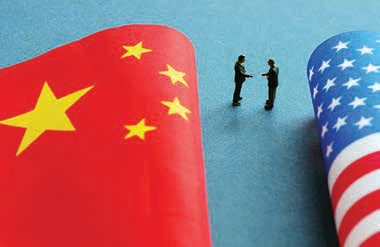
Since China systematically opened its huge market of 1.4 billion consumers to international investment, two different politico-economic systems have been competing against each other. On the one hand, the state-controlled capitalism of China; on the other, the self-controlled market capitalism of traditional Western understanding. Both models represent giant experiments. At the moment, each model is having to prove its capability to adapt to the heavy risks and highly volatile markets of a globalized economy. COVID-19 puts both models to the test. But China seems to be in a better starting position.
Geostrategic investments along the Belt and Road Initiative (BRI) will not come to a halt, although they might be reprioritized or slowed down. China has no interest in losing its new allies along the trade routes and coastlines of Africa, South East Asia and Latin America. Unlike the U.S., China has no interest in protected markets; meanwhile, international markets depend heavily on Chinese exports. COVID-19 is undoubtedly a backlash against globalization; but it will not change the historic direction towards Asian hegemony (Khanna, 2019Khanna, P. (2019). The future is Asian: Commerce, conflict, and culture in the 21st century. New York: Simon & Schuster.; Maçães, 2018Maçães, B. (2018). The dawn of Eurasia: On the rail of the new world order. London: Penguin Books.) and Chinese dominance in the Eastern hemisphere. The Asian century has just begun; COVID-19 will be nothing more than a footnote. Maybe it is worth remembering the Spanish influenza of 1918–1919. It took more lives than World War I, but it had practically no impact on the growing importance, and soon Western hegemony, of the U.S.
“From Russia With Love” – Learnt Lessons From the East
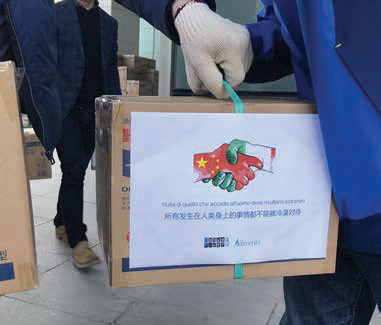
Even in a post-COVID-19 world, some major aspects of global importance remain. The dramatic and unavoidable power shift from West to East (Rachman, 2016Rachman, G. (2016). Easternization: War and peace in the Asian century. London: Random House Rice, S. E. (2020, April 9). Trump is the wartime president we have (not the one we need). The New York Times International Edition, 42(632), p. 9.) is not affected by COVID-19; it might even be accelerated. China was the first nation to be hit by the pandemic; but it was also the first state to get out of the acute state of crisis. Since the end of March, daily life has returned to Shanghai (a metropole of 25 million inhabitants); since April 11, shops and factories have restarted their business and production activities in Wuhan, once the epicenter of the COVID-19 pandemic (Wang & Yang, 2020Wang & Yang (2020). The source article does not provide a separate full bibliographic entry for this citation.). As the pandemic was reaching its peak, China sent medical equipment directly to Lombardy, the Italian region that was suffering the most.8 Now, China is offering practical help, equipment and medical knowhow to the U.S. and other Western countries (Cui, 2020Cui (2020). The source article does not provide a separate full bibliographic entry for this citation.). Russia, too, sent medical corps to Northern Italy. These gestures generated huge media coverage; their propagandistic goals were perfectly matched. The East Helps the West out of the Crisis: the underlying message is absolutely clear.
"Will China win?" (The Economist, 2020The Guardian (2020a). Mafia distributes food to Italy's struggling residents.) – the cover title of the April 18 issue of The Economist – points to the bête noire of European and Western polities: the perception of the growing influence of Asian societies over the occidental hemisphere (Khanna, 2019Khanna, P. (2019). The future is Asian: Commerce, conflict, and culture in the 21st century. New York: Simon & Schuster.). Those states and national economies which recover the fastest from the critical blow of COVID-19 will be able to enlarge their global influence. China will be among these states; the U.S. probably not. In fact, China has offered active help to the U.S., proving its ability to swiftly change its diplomatic tonality from competition in a de facto trade war to solidarity and empathy in a moment of common suffering (Cui, 2020Cui (2020). The source article does not provide a separate full bibliographic entry for this citation.). No other administration has proved capable of reacting in its international relations as smoothly and quickly as the Chinese, although Russia didn't hesitate to send medical staff and equipment to Italy. "From Russia with love" was written on the Tupolev transport aircrafts of the Russian air force. It was, as the Italian media observed, the first time since the Napoleonic wars that Russian troops had entered Italian territory (BBC, 2020BBC. (2020). Coronavirus: What does 'from Russia with love' really mean?). The Russian PR stunts won global media coverage. The strategists of the Kremlin have well understood that dominance in symbolic pictures and gestures counts nearly as much as military dominance over territories (Corman & Coraci, 2020Corman, M. R. & Coraci, E. (2020). Geopolitical symptoms of COVID-19: Narrative battles within the Eastern partnership. Corpet, A. (2020, April 18). Washington is a never- ending story. T – The New York Times Style Magazine, International Edition, p. 81. Cui, T. (2020, April 7). Cooperation vital for U.S. and China. The New York Times International Edition, 42(630), 1-11.). This is something that the E.U. administration seems to have totally forgotten.
Summary
The ideas and findings of this article can be summarized in a few aphoristic sentences:
(1) Th e COVID-19 crisis mercilessly exposes the political fragility of the European Union and its institutions..
(2) Post-COVID-19 Europe will have to deal with the centrifugal potential of stronger nationalistic political movements.
(3) Th e disjunction between the E.U.'s self-perception, and how it is perceived by its citizens, is becoming palpable.
(4) Poverty, ideological radicalization and political instability are coming back to Europe.
(5) Th ose national states that mastered – as quickly and strictly as possible – the COVID-19 crisis will be the economic, political and strategic winners of the recent developments: China, South Korea, Singapore, Japan; in Western Europe maybe Germany.
(6) Neoliberalism and laissez-faire capitalism have lost their legitimacy; in the U.S. the neoliberal macroeconomic framework will survive, but in Europe it will be drastically rebuilt.
(7) Th e divides between Europe and the U.S., and also among European states, are growing; political alienation in a multipolar world will be the consequence.
(8) Seen from a cultural-critical perspective, COVID-19 unveils the self-contradictions and, fi nally, the shallowness of the Western value system.
(9) Digitization is no longer revolutionary; it enters the stadium of being the new normal.
(10) Clio, the muse of history, looks to the East. Her view remains unclouded, unchanged, unbiased.