Introduction
Archaeological investigations on the territory of the Far East during the last decades show the intensity and energy of activities on the routes of the Silk Road and how far the works of arts and crafts have penetrated Western countries. On the Silk Road, tireless traders led caravans to distant lands, carrying crafts, works of art, and treasures of the subsoil. Along with them were artists, monks, and pilgrims, promoting religious teachings and technique ideas. In some cases, peoples from various ethnicities were pressed into moving by a powerful enemy, searching for safer and more fertile land.
Along the same routes were organized military expeditions. For example, we know from the Chinese chronicle (Shiji, n.d.: Chapter 123) about a military campaign organized by order of the Han dynasty emperor for the “heavenly horses” of Dayuan (Fergana). A lot is written about Sogdian trading posts of the early Middle Ages, and brilliant discoveries of Chinese archeologists confirm cultural influences and interactions.
We will probably never be able to touch the
events of that time, full of drama and the brightness of paints of historical scenes. Maybe, only the rivers, valleys, and gorges which ran the road could be mute witnesses of the distant past. Each archaeological discovery along these routes brings us an echo of ancient cultures and civilizations. In each discovery, researchers try to restore the thread linking the present to antiquity and attempt to answer the questions about their origins, their religions, and their language. They carried their culture to the other parts of the world. We can only try to build a hypothesis based on the analysis of fragmentary written sources and remnants of material culture. The written sources, particularly the Chinese chronicles, give us information about the powerful waves of movement of the nomadic tribes of Xiongnu, Yuezhi, and Wusun. In the struggle for survival and vital space, they often faced each other in combat. The defeated peoples were forced to leave their lands and seek for a new one.
The period between the late second century BC and the first centuries AD, which makes up the chronological framework of this paper, is scarcely reflected in the Western written tradition and
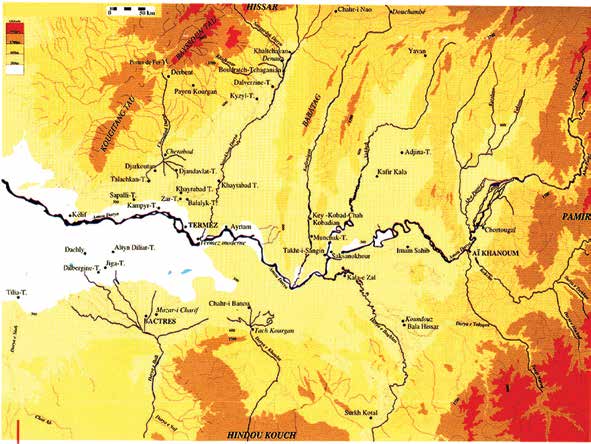
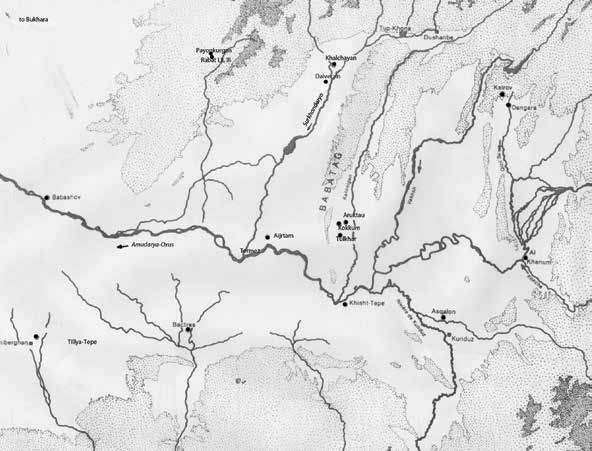
Chinese chronicles. However, we have relatively rich material which multiplies with every archaeological season. In fact, all kinds of information demonstrate the intensive cultural contacts of peoples who lived along the routes of the Great Silk Road (Fig. 1). Namely, we associate migrations of various tribes and successive displacement of each other with this period. Speaking figuratively, the conquerors pass in Central Asia, nearly stepping on each other’s toes.
One of the most significant events on the western borders of China was a clash of two powerful tribes of the Xiongnu and the Yuezhi. The consequence of this collision was the migration of the Yuezhi (Da Yuezhi) to the west. We cannot know the exact routes of these tribes. They are often unexpected, but the
first option that comes to mind is, in my opinion, the well-known trade routes, the most comfortable and well-tested for many generations.
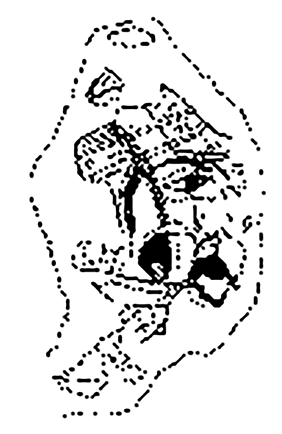
The kurgan burials are our primary source for knowledge about the nomads’ material culture. (Fig. 2). A detailed study of the artifacts and their location makes it possible to judge the level of the kurgan’s development and, more importantly, to trace the approximate route of their journey. Weapons, clothing and accessories, works of art, and everyday objects fall under the category of material findings that can be the most illuminating. Not all of them were well-preserved because of the vulnerability and fragility of the materials. For example clothes can only be preserved in particularly favorable
conditions, such as the dry sands of Xinjiang and the permafrost of the Altai. Ultimately, it depends on the unique features of the soil and microclimate. There are ceramics, metal products, and tools among the findings, which can be found almost everywhere. Some of them are quite characteristic and, at the same time, common. They can serve as markers of where they were produced and how they reached other regions by trade or military means, then moved in space and time together with their owners, outlining their route.
Especially valuable are the works of art that reveal the many aspects of the material and spiritual culture of the peoples of antiquity. Found in archaeological
layers, they acquire exceptional value as a historical source. Samples of Western art, usually with images on the theme of ancient (Greek or Roman) mythology, found in China, Mongolia, and other countries of the Far East, are quite often covered in scientific literature (Marshak 2004; Polosmak et al. 2011London. Polosmak, N.V. (2010). My vypili Somu, my stali bessmertnymi. Nauka iz pervykh ruk, 3(33), Moskva: 50-59. Polosmak et al. Polosmak N.V., Bogdanov E.S., Tseveedorzh, D. (2011).; Li Yusheng, 2020Li, Yusheng, (2020). The Preliminary Study of the Image on the Golden Plate Collected in Datong Museum. Humanities Research. Vol. 31.).
This paper, on the other hand, aims to show certain artifacts made in Far East countries. They were found in the archaeological context of the sites of Sogdia and Bactria and indicate the location of different ethnicities on the Great Silk Road. Notably, some categories of findings were rarely found in the previous period, if not found at all. All this may
testify that these things penetrate Central Asia during the migration period, specifically with a big migration wave of Yuezhi.
Figurative art as a narrative source
One of the most saturated sources for studying the cultural and ethnic identification of the peoples on the Silk Road are the monuments of fine arts that are not subject to transport and were created at the place. This gives them exceptional value as a source. This category may include the monumental sculpture made of clay and the reliefs that make up the interior
of the frame and wall paintings. This is a special kind of source, which reveals both the artistic features of the monument and its style, and provides a wealth of useful information and a narrative character. The examples below justify this thesis.
In the early 1960s, a remarkable discovery of a clay sculpture in Khalchayan was made, which raised questions about the army of Central Asia and its importance in the ancient world. For the first time in Bactria, the army was presented as bright and expressive images of warrior-nomads: a lightly armed cavalry and heavily armed soldiers, so-called cataphracts.
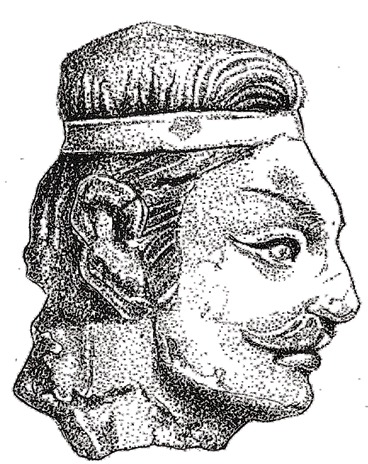
The subject of interpretation of the Khalchayan reliefs that decorated the walls of the staterooms was already covered in previous studies (Bernard, 1987Paris. Bernard, P. (1985). Les Monnaies Hors Tresors. Question d’Histoire Greco-Bactrienne. Fouillesd’AiKhanoum. IV, Memoirs de la Delegation Archeologique Francaise en Afghanistan.T.XXVIII. Paris. Bernard, Р. (1987). Les nomads conquerants de l’Empire greco-bactrien.; Abdullaev, 1992Abdullaev K. (1992). K voprosu o voinstve Sredney Azii v ellinisticheskuyu epohu. Srednyaya Aziya i mirovaya tsivilizatsiya. Tezisy mezhdunarodnoy konferentsii. Tashkent. Abdullaev K. (1995a). Armor of Ancient Bactria. In the Land of the Griphon. Papers on Central Asian Archaeology in Antiquity. A.; Abdullaev, 1995aAbdullaev K. (1992). K voprosu o voinstve Sredney Azii v ellinisticheskuyu epohu. Srednyaya Aziya i mirovaya tsivilizatsiya. Tezisy mezhdunarodnoy konferentsii. Tashkent. Abdullaev K. (1995a). Armor of Ancient Bactria. In the Land of the Griphon. Papers on Central Asian Archaeology in Antiquity. A.; Abdullaev, 1995bAbdullaev K. (1992). K voprosu o voinstve Sredney Azii v ellinisticheskuyu epohu. Srednyaya Aziya i mirovaya tsivilizatsiya. Tezisy mezhdunarodnoy konferentsii. Tashkent. Abdullaev K. (1995a). Armor of Ancient Bactria. In the Land of the Griphon. Papers on Central Asian Archaeology in Antiquity. A.; Bernard & Abdullaev, 1997Bernard & Abdullaev (1997). The source article does not provide a separate full bibliographic entry for this citation.; Abdullaev 2005Invernizzi ed. Firenze: 151-161. Abdullaev, K. (2005). New Finds of Pre-Kushan and Early Kushan Plastic Art in Northern Bactria and the Khalchayan Reliefs. Parthica. 6.; Abdullaev 2007Abdullaev (2007). The source article does not provide a separate full bibliographic entry for this citation.). Here it should be noted that, according to the studies of G. A. Pugachenkova on the Khalchayan reliefs, there was a scene of “the triumphant march of the soldiers”. The subject had been revised and interpreted in a new way. The composition actually shows a battle scene, which involves not just two warring groups of warriors but, judging by the physical type and attributes, the representatives of different ethnic groups. Light cavalry, represented in the fragments of sculptures depicting horse archers, were more mobile and fastpaced in their attacks on the enemy and sudden retreats. [1] For the members of this group, it is characteristic of an anthropological type with some Mongoloid admixture. One of these characters, based on the analogy with coins of Heraios, was conditionally named by G.A. Pugachenkova as “Heraios’ Prince” (Fig. 3).
The second group of fighters is an armored cavalry, whose physical appearance is more typical of Caucasians. In this respect, the most expressive
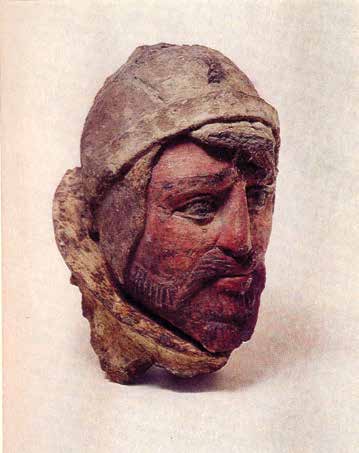
is the warrior in a helmet with armor in the shape of a tall expanding bell-shaped collar that protects the neck (Fig. 4). The image is vaguely reminiscent of the Spanish Grandees in defensive armor with an expression of deep sadness on a narrow, lengthened face. It reminds one of the hero of Cervantes, if a literary anachronism is allowed. Actually, even if we have a lot of written sources about these knights of Europe, we know almost nothing, except fragments of classical authors (Strabo, Pompeius, Trogus). So, who are the armored knights from Khalchayan and other archaeological objects found on the territory of Central Asia?
In previous works, I identified defeated heavily armed soldiers with the nomadic tribe Sakaraukes and lightly armed cavalry with images of Yuezhi. (Bernard 1987Paris. Bernard, P. (1985). Les Monnaies Hors Tresors. Question d’Histoire Greco-Bactrienne. Fouillesd’AiKhanoum. IV, Memoirs de la Delegation Archeologique Francaise en Afghanistan.T.XXVIII. Paris. Bernard, Р. (1987). Les nomads conquerants de l’Empire greco-bactrien.; Abdullaev 1995aAbdullaev K. (1992). K voprosu o voinstve Sredney Azii v ellinisticheskuyu epohu. Srednyaya Aziya i mirovaya tsivilizatsiya. Tezisy mezhdunarodnoy konferentsii. Tashkent. Abdullaev K. (1995a). Armor of Ancient Bactria. In the Land of the Griphon. Papers on Central Asian Archaeology in Antiquity. A.; Abdullaev, 1995bAbdullaev K. (1992). K voprosu o voinstve Sredney Azii v ellinisticheskuyu epohu. Srednyaya Aziya i mirovaya tsivilizatsiya. Tezisy mezhdunarodnoy konferentsii. Tashkent. Abdullaev K. (1995a). Armor of Ancient Bactria. In the Land of the Griphon. Papers on Central Asian Archaeology in Antiquity. A.; Abdullayev, 1997Abdullayev (1997). The source article does not provide a separate full bibliographic entry for this citation.; Abdullaev, 2005Invernizzi ed. Firenze: 151-161. Abdullaev, K. (2005). New Finds of Pre-Kushan and Early Kushan Plastic Art in Northern Bactria and the Khalchayan Reliefs. Parthica. 6.; Abdullaev, 2007Abdullaev (2007). The source article does not provide a separate full bibliographic entry for this citation.).
The expressive and eloquent material from Central Asia demonstrates the high level of military affairs of the region in ancient times. The Greco- Bactrian state’s relations with the surrounding peoples, particularly nomads, were frequently hostile. Later, the Greco-Bactrian state collapsed under the onslaught of the same nomadic tribes.
The discovery of Ai Khanum, an ancient Greek city far in Asia, and the study of its arsenal has become one of the breakthroughs in the field of military affairs of the Hellenistic era (Bernard, 1980: 452Moskva: 68-86. Bernard, P. (1980). Campagne des fouilles 1978 a Ai Khanoum Afganistan.). [2] The finding of a specific armor in the arsenal indicates the presence of cataphracts in the Greco-Bactrian army as a fighting unit. It is dated quite accurately to 150 BC, confirmed by archaeological context. Meanwhile, 145 BC for Ai Khanum is considered as a period of raids by nomads (Bernard, 1980: 456Moskva: 68-86. Bernard, P. (1980). Campagne des fouilles 1978 a Ai Khanoum Afganistan.).
While the Ai Khanum archeological site shows some of the earliest evidence of cataphracts in
Bactria, the origin of this type of weapon is still open. We do not have sufficient grounds to believe that cataphracts occurred on the territory of Bactria, even though this is the second monument that gives a reason for this assumption. In my opinion, it is most likely that cataphracts as a category of heavy cavalry were created in the milieu of professional armies. It is hard to say who (what ethnisity) properly was the creator. It is very possible that it is somewhat of a phenomenon of convergence. We could advance the supposition that different ethnic communities might realize this idea. I think that cataphracts came from the East, and perhaps Central Asia. Considering the similarities between the vambraces (plate
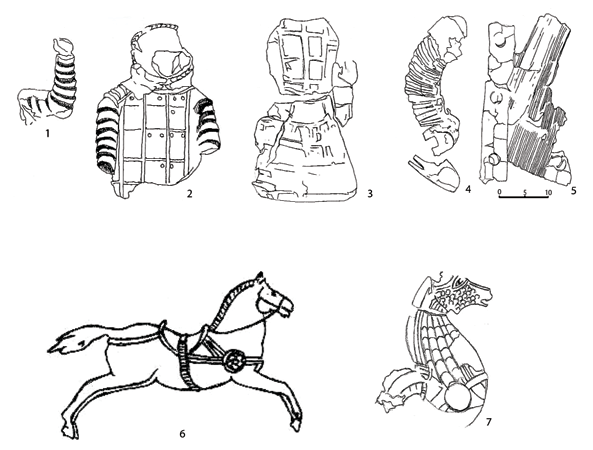
armor covering the arms) found in Ai Khanum and the vambraces represented on Khalchayan clay sculptures (Fig. 5. Pl. II, 4), cataphracts can be viewed as the outcome of the interaction of military organizations and military hardware of various nationalities involved in the orbit of ancient world military events. (Pugachenkova, 1971Dvadtsatyi noinulinski kurgan. Novosibirsk. Pugachenkova, G. A. (1971). Skul’ptura Khalchayana. Moskva. Pugachenkova, G. A. (1987). Obraz kanguytsa v sogdiyskom iskusstve. Iz hudozhestvennoy sokrovishnitsy Srednego Vostoka. Tashkent, 47-59. Pugachenkova, G. A. (1989). Drevnosti Miankalya. Tashkent, “Fan”. Pugachenkova, G. A., Rtveladze E.V. Eds. (1978). Dal’verzintepe – kushanskiy gorod na yuge Uzbekistana. Tashkent. Rudenko, S.I. (1960). Kultura naseleniya Tsentralnogo Altaya v skifskoe vremya. Moskva- Leningrad. Rudenko, S.I. (1961). Kultura Hunnov i Noinulinskie kurgany. Moskva- Leningrad. Rudenko, S.I. (1962). Sibirskaya kollektsiya Petra I. Svod arheologicheskih istochnikov. Steblin-Kamenski, I.M. (1981). Baktriyski yazyk. Osnovy iranskogo yazykoznaniya. Moskva, 314-345. Strabo Geography (1928). Volume V: Books 10-12. Translated by Horace Leonard Jones. Loeb Classical Library 211. Cambridge, MA: Harvard University Press. Suleymanov, R. Iskhakov, M., Turebekov, M., Nefedov N. (1976).). It should be noted that these two archaeological sites are located in Bactria. The Khalchayan was located in northern Bactria in the middle of the Surkandarya oasis in late 2 BC (Yuezhi migration period), and Ai Khanum was located at the confluence of the Kokcha and Amudarya (Oxus) rivers.
In addition, the torso of a warrior with a breastplate covered in “cuirass armor” and divided by rectangular
embossed lines that support a sizable metal or leather plate catches the eye in Khalchayan reliefs. The ocher yellow color that the armor has been painted with is most likely for the gilt. Three rows of plates of larger sizes are arranged in the lower part under the waist belt (Pl. II, 3). Thus, we can say that the warrior’s torso was protected by an armored layer, fixed separately.
One gets the impression that the bracers were also fixed separately and attached by a special loop or lacing. The shoulder protector can be judged by the best-preserved sculpture, which shows the shape of the armor (Fig. 5. Pl. II, 2). And one of the most remarkable details is its high bell-shaped collar (Fig. 4).
The discoveries made in Sogdia’s territory and in Bactria’s neighboring north attest to the cervical armor’s existence and widespread use. At the same time, they show that this portion of the Bactrian protective armor, created to guard one of the body’s most anatomically vulnerable areas, is a natural component of Central Asian armor. This relates to the discovery of bone plates in the Orlat necropolis (region of Samarkand) with engravings of combat scenes. (Pugachenkova, 1989: 122-154, fig.70, 71Dvadtsatyi noinulinski kurgan. Novosibirsk. Pugachenkova, G. A. (1971). Skul’ptura Khalchayana. Moskva. Pugachenkova, G. A. (1987). Obraz kanguytsa v sogdiyskom iskusstve. Iz hudozhestvennoy sokrovishnitsy Srednego Vostoka. Tashkent, 47-59. Pugachenkova, G. A. (1989). Drevnosti Miankalya. Tashkent, “Fan”. Pugachenkova, G. A., Rtveladze E.V. Eds. (1978). Dal’verzintepe – kushanskiy gorod na yuge Uzbekistana. Tashkent. Rudenko, S.I. (1960). Kultura naseleniya Tsentralnogo Altaya v skifskoe vremya. Moskva- Leningrad. Rudenko, S.I. (1961). Kultura Hunnov i Noinulinskie kurgany. Moskva- Leningrad. Rudenko, S.I. (1962). Sibirskaya kollektsiya Petra I. Svod arheologicheskih istochnikov. Steblin-Kamenski, I.M. (1981). Baktriyski yazyk. Osnovy iranskogo yazykoznaniya. Moskva, 314-345. Strabo Geography (1928). Volume V: Books 10-12. Translated by Horace Leonard Jones. Loeb Classical Library 211. Cambridge, MA: Harvard University Press. Suleymanov, R. Iskhakov, M., Turebekov, M., Nefedov N. (1976).; Pugachenkova, 1987: 56- 65, figs. 57, 59Dvadtsatyi noinulinski kurgan. Novosibirsk. Pugachenkova, G. A. (1971). Skul’ptura Khalchayana. Moskva. Pugachenkova, G. A. (1987). Obraz kanguytsa v sogdiyskom iskusstve. Iz hudozhestvennoy sokrovishnitsy Srednego Vostoka. Tashkent, 47-59. Pugachenkova, G. A. (1989). Drevnosti Miankalya. Tashkent, “Fan”. Pugachenkova, G. A., Rtveladze E.V. Eds. (1978). Dal’verzintepe – kushanskiy gorod na yuge Uzbekistana. Tashkent. Rudenko, S.I. (1960). Kultura naseleniya Tsentralnogo Altaya v skifskoe vremya. Moskva- Leningrad. Rudenko, S.I. (1961). Kultura Hunnov i Noinulinskie kurgany. Moskva- Leningrad. Rudenko, S.I. (1962). Sibirskaya kollektsiya Petra I. Svod arheologicheskih istochnikov. Steblin-Kamenski, I.M. (1981). Baktriyski yazyk. Osnovy iranskogo yazykoznaniya. Moskva, 314-345. Strabo Geography (1928). Volume V: Books 10-12. Translated by Horace Leonard Jones. Loeb Classical Library 211. Cambridge, MA: Harvard University Press. Suleymanov, R. Iskhakov, M., Turebekov, M., Nefedov N. (1976).; Abdullaev, 1995b: 151-161Abdullaev K. (1992). K voprosu o voinstve Sredney Azii v ellinisticheskuyu epohu. Srednyaya Aziya i mirovaya tsivilizatsiya. Tezisy mezhdunarodnoy konferentsii. Tashkent. Abdullaev K. (1995a). Armor of Ancient Bactria. In the Land of the Griphon. Papers on Central Asian Archaeology in Antiquity. A.; Ilyasov, Rusanov, 1997Zeymalya. Dushanbe, “Donish”. Ilyasov, J.Ya., Rusanov, D.V. (1997/1998). A Study on the Bone Plates from Orlat. Silk Road Art and Archaeology 5. Kamakura: 107-159. Itina, M. A. (1992). Rannie saki Priaral’ya [The early Sakas of the Aral sea region]: Stepnaya polosa Aziatskoi chasti SSSR v skifo-sarmatskoe vremya [Archaeology of the USSR. Steppes band of the Asian part of the USSR in the Scythian-Sarmatian time]. Moscow, Nauka: 31-46 (in Russ.) Kulture and Art of Ancient Uzbekistan. (1991). Exhibition catalogue./1998Zeymalya. Dushanbe, “Donish”. Ilyasov, J.Ya., Rusanov, D.V. (1997/1998). A Study on the Bone Plates from Orlat. Silk Road Art and Archaeology 5. Kamakura: 107-159. Itina, M. A. (1992). Rannie saki Priaral’ya [The early Sakas of the Aral sea region]: Stepnaya polosa Aziatskoi chasti SSSR v skifo-sarmatskoe vremya [Archaeology of the USSR. Steppes band of the Asian part of the USSR in the Scythian-Sarmatian time]. Moscow, Nauka: 31-46 (in Russ.) Kulture and Art of Ancient Uzbekistan. (1991). Exhibition catalogue.: 107- 159). Analysis of the armor on these images gives
grounds to clarify some of the design features of plate armor. A notable feature of this armor is the plate’s form-fitting upper body, high armored collar, firmly tightened waist, and an incredibly wide hem, descending well below the knees, which allowed them to protect part of the horse’s croup (Fig. 6). The connection points may be the most vulnerable, which may be why one of the riders impales his opponent exactly at on those points.
Rivets, another kind of fastening, are shown as dots in the middle of the plate. Judging by the pattern and location of plates, we can say that the armored jacket, bracers, and greaves were separate parts that
could be collected and connected through special hardware (hinges, hooks). One of these hooks was a discovery in burial no1 in Orlat necropolis and represents an iron buckle with a long tongue at the end of which there was an opening for fixing (Pugachenkova, 1989Dvadtsatyi noinulinski kurgan. Novosibirsk. Pugachenkova, G. A. (1971). Skul’ptura Khalchayana. Moskva. Pugachenkova, G. A. (1987). Obraz kanguytsa v sogdiyskom iskusstve. Iz hudozhestvennoy sokrovishnitsy Srednego Vostoka. Tashkent, 47-59. Pugachenkova, G. A. (1989). Drevnosti Miankalya. Tashkent, “Fan”. Pugachenkova, G. A., Rtveladze E.V. Eds. (1978). Dal’verzintepe – kushanskiy gorod na yuge Uzbekistana. Tashkent. Rudenko, S.I. (1960). Kultura naseleniya Tsentralnogo Altaya v skifskoe vremya. Moskva- Leningrad. Rudenko, S.I. (1961). Kultura Hunnov i Noinulinskie kurgany. Moskva- Leningrad. Rudenko, S.I. (1962). Sibirskaya kollektsiya Petra I. Svod arheologicheskih istochnikov. Steblin-Kamenski, I.M. (1981). Baktriyski yazyk. Osnovy iranskogo yazykoznaniya. Moskva, 314-345. Strabo Geography (1928). Volume V: Books 10-12. Translated by Horace Leonard Jones. Loeb Classical Library 211. Cambridge, MA: Harvard University Press. Suleymanov, R. Iskhakov, M., Turebekov, M., Nefedov N. (1976).).
A completely original type of helmet was found in the Khalchayan archaeological site. It was represented in Khalchayan sculpture on two images: the head of an elderly bearded warrior with a broad face and a second personage with a slightly elongated face and a beard. The helmet is preserved better on this fragment, including a part of the neck protector/collar (Fig. 4). The helmet consists of a crown with a base in a broad band and a tight-fitting head with a small segmental visor. Under the helmet on his head, the warrior wore, very likely, a balaclava. A liner that is covering the ears absorbed the impact shocks during the battle,. This type of helmet, until recently, was not recorded on the monuments of fine art, and it is undeniable that they belong to the nomadic warfare culture.
Armor images on the coin findings
The images on coins are one of the important categories of sources on this issue. As a genre of official art, usually with a portrait of the ruler, the coins convey the character’s attire in a realistic manner with details.
The closest analogy to early Saka coins is imprinted with the image of a heavily armed rider. These are coins of Vanones, Azes, and Azilises (Fig. 7), and on certain types of Vanones’ coins, the horse is depicted in a protective armor. The bump on the horse’s body surface suggests that the protective apparel is not only for the rider but also for the horse. We can attribute the images on the coins as a representation of cataphracts (Mitchiner, 1975a: types 681, 744-751, 769London. Mitchiner, М. (1975b). Indo-Greek and Indo-Scythian Coinage. Vol. 5.).
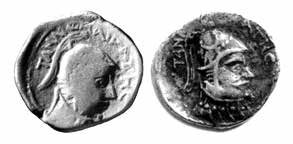
Iconographic analysis of the coins localized to the northwest of Balkh (ancient Bactres) provides interesting information concerning the helmet’s design. The representation of a ruler on these coins gives an analogy not only for the helmet and neck armor but also to the physical appearance of the personages. Representing the portrait, namely on the obverse of the coins, proves that the nobles and even royal warriors used this kind of armor. These silver coins are close in weight to the Attic standard (closer to 4 grams). An elderly and Caucasoid type personage is depicted in the profile to the right (Fig. 8). He
has a wedge-shaped beard, mustache, protruding nose straight, wide shaped eyes, and the long form of the eyebrows. Its look as a whole reminds one of the images of the Khalchayan findings. The Crown of the hat is decordated with pearls, and on the side, there is a symbol in the shape of a crescent with horns facing upwards and knobs on the ends and resting on a vertical rod. A high collar protects the neck of the personage. It is shown in the shape of elongated plates, on the center of which passes a horizontal row of rounded knobs, which may be rivets. The collar has a small extension in the upper part and, in its configuration, resembles the collars of knights of Orlat’s necropolis, in particular the vertical stripes. From the top of the helmet falls a plume.
There is inscription on obvers of the coins in Greek letter. The name of the ruler TANΛΙCΜΙAΔΑΤΗC was carved on the coins circularly. The name is Iranian and has a composite form, with the last two words serving derivatives interpretation: ΜΙAΔΑΤΗC means “given by Mah (Moon-God in Iranian pantheon)”. ΤΑΝ means “body”, and ΛΙS probably means fortress, temple. In this case, the name of the whole can be translated as “strong body (the body as a fortress) given by (God) Mah”,However, it is important to specify that this definition is hypothetical and requires a special philological analysis.
Mitchiner’s historical interpretation of these coins seems very convincing. He associates them with the mint of Tanlismaidates, one of the kings of the Sakaraukes tribe. Chronologically, it is the same period as the time of the reign of Parthian king Orodes I (about 89-77 BC.). This implies that Tanlismaidates coins could be of local issue (Alexandria Areia-Herat) and minted under the suzerainty of Orodes. (Mitchiner, 1975b: 407London. Mitchiner, М. (1975b). Indo-Greek and Indo-Scythian Coinage. Vol. 5.).
Thus, analyzing the coins with the image of a knight in armor, we have identified one more point
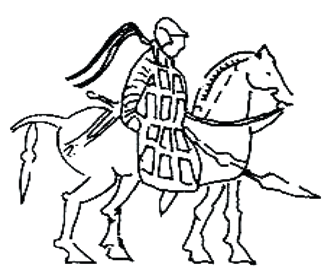
on the way of knights (cataphracts) on the Silk Road with direction to the Indian subcontinent. But can we say that Tanlismaidates’ coins show us an equestrian warrior, considering that it shows only a bust on a coin? Probably, yes, given that we see a lot in common with the characters of Khalchayan’s sculptures and images on Orlat plates. In all probability, we can add to the circle of such images the fragment of the mural of Dalverzintepa (Belyaeva, 1978: 33-47; Abdullaev, 1995a: 154-155Abdullaev K. (1992). K voprosu o voinstve Sredney Azii v ellinisticheskuyu epohu. Srednyaya Aziya i mirovaya tsivilizatsiya. Tezisy mezhdunarodnoy konferentsii. Tashkent. Abdullaev K. (1995a). Armor of Ancient Bactria. In the Land of the Griphon. Papers on Central Asian Archaeology in Antiquity. A.), which bears a representation of a warrior in a helmet with a high armored collar (Fig. 9) and the head of a horse also protected by plates. These fragments represent a similar image of a heavily armed rider.
Represented Battle Scenes
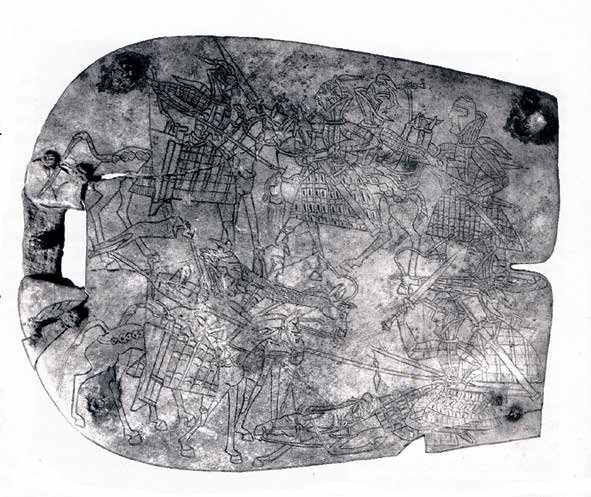
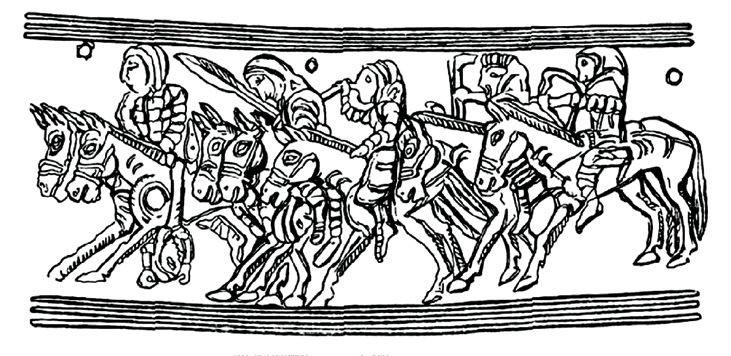
Concerning the topic of battle in the nomad milieu in antiquity, it would be logical to mention a wellknown work here. It is a gold plate from the Siberian collection of Peter I the Great (Fig. 10), which was published several times and represents a composition with heavily armored riders (Artamonov, 1973: 154, Fig. 192; Rudenko, 1960: 298, 153; Rudenko, 1962: Fig. 29). Rudenko interprets the plot as the return of five riders with the corpses of two of their dead comrades or leaders after the fight. Ahead is a rider with a horse through the saddle of which a hanging corpse of a slain warrior’s head hangs. One of the riders holds a sword. Meanwhile, the other rider holds the horse’s reins and the corpse of the dead comrade. The procession closed with two riders, one of which held a battle axe and the other a bow. On
the heads of the riders, there are helmets of the type found in the third barrow in Altai. The horses have cropped manes and saddles, but without the stirrups.
Without going into detail on the riders’ armor, which have a lot in common with the compositions of Khalchayan and Orlat, the semantic meaning of the plot should be emphasized.
Compositionally, the scene can be divided into three parts. First, the left part is represented by one rider, keeping parallel on a galloping horse, lifting the dead warrior. The middle part consists of three riders, the closest of which is shown with a raised right hand, compressing a spear with which he strikes a mortal blow from above into the back of the enemy. The spear pierces the horseman through and comes out of his chest. A wide spearhead in the shape of an elongated leaf is shown up at an angle that does not correspond to the physical reality. However, this is conventionality
justified because to continue the line of the spear in the “right direction” would hide the spear behind the animal’s head, making the action incomprehensible. Another warrior testifies to the inclined posture of the latter, almost dying. The last two figures are also shown in a combat position. The rider shown drawing the bow is closest to the viewer (the last on the right in the composition). Next to him in the background is a rider with a battle axe in his raised hand.
If you follow these chronological calculations, the Sakaraukes historically preceded Yuezhi and are in some sense “followers” and “heirs” of the Greco-Bactrian cultural complex.
All of the above clarifies the meaning of the overall composition and interprets it not as a “The scene of the warriors’ return from the campaign” but as the scene of persecution of one group of riders by the other. The similarity between characters can be interpreted as that they were from related tribes. The battle scene is reminiscent of the persecution we have already seen in the sculptural complex of Khalchayan, where opponents differed from each other not only by weapons but also by appearances. Regarding the battle-equipped riders, the composition of the bone plate of Orlat is similar to the scene on the Siberian collection’s gold plate.
Most likely, these scenes have an epic character and may present an important event in the history of the peoples of Central Asia. We have several historical episodes that appear in written sources, telling about civil wars of related tribes, including the confrontation of Sakaraukes and Tochari (Pompeius Trogus, XLII), the confederation of five Yabgu (principalities) of Ta Yuezhi under the leadership of Kujula Kadphises,
military clashes with Wusun and Yuezhi, and the war between Xiongnu and Yuezhi. All of these historical events could be represented in the works of fine arts. All these peoples had a similar lifestyle according to Chinese chronicles and Western literal history (Abdullaev, 2005: 27-30Invernizzi ed. Firenze: 151-161. Abdullaev, K. (2005). New Finds of Pre-Kushan and Early Kushan Plastic Art in Northern Bactria and the Khalchayan Reliefs. Parthica. 6.; Abdullaev, 2007Abdullaev (2007). The source article does not provide a separate full bibliographic entry for this citation.; Abdullaev, 2007: 73-98Abdullaev (2007). The source article does not provide a separate full bibliographic entry for this citation.).
To these well-known works of ancient art, we could add the remarkable find of a carpet by Russian archaeologists from Novosibirsk in Mongolia (Polosmak, 2010London. Polosmak, N.V. (2010). My vypili Somu, my stali bessmertnymi. Nauka iz pervykh ruk, 3(33), Moskva: 50-59. Polosmak et al. Polosmak N.V., Bogdanov E.S., Tseveedorzh, D. (2011).). The remnants of carpet fabric contain a battle scene with a murdered body, and some of the warriors are shown in plate-shaped armor. The physical appearances of the personages are a lot like the heroes of Khalchayan.
It should be noted that the image of the warrior in armor that we studied above is reflected in popular artifacts as terra cotta sculptures. I give here only one example coming from layers of the post-Greco- Bactrian period of the Kampyrtepa site in Southern Uzbekistan. Amongst Greek depictures from the archaeological complex of Kampyrtepa present some samples of terra cotta of nomadic appearance. It particularly concerns a bearded figure sitting on an omphalos shape throne (Abdullaev, 2007: 90, fig, 10Abdullaev (2007). The source article does not provide a separate full bibliographic entry for this citation.).
In the nomadic world in which, according to Strabo, the main male occupation was military, there is, very likely, a layer of professional warrior knights who acted either as a mercenary force or raided the nearby towns and villages for plunder or receiving tributes. For example, according to the Strabo, the Sacae led a similar way of life, “who raided like the Cimmerians”. They captured Bactriana and part of Armenia during one of these raids, leaving the name Sacasene behind (Strabo, XI, VIII, 3-4). The image of the knight, clad in metal armor, is demonstrated on coins of Vanones, Azes, Azileses and other kings of Central Asian origin who later came to India (Mitchiner, 1976London. Mitchiner, М. (1976). Indo-Greek and Indo-Scythian coinage. Vol. 6.).
Conclusion
Concluding this limited survey of selected images mainly from the archaeological layers, one can summarize nomad knights on the Central Asian sector of the Silk Road. The starting point for us is the Sogdian complex, including the Orlat necropolis, demonstrating excellent images of the knights on the engraved composition on the bone plates. Besides Orlat burials, the Sogdian region possesses several other monuments that illustrate the image of a professional warrior, including early Sogdian coins. The series of coins with the portrait image of a ruler on the obverse and the figure of an archer on the reverse are also close to the representations of Orlat compositions.
It should be emphasized that the legend is somewhat distorted, but the Greek letters on the coins are readable. The caucasoid physical type on these coins is reminiscent of the Khalchayan cycle of portraits, namely the group of warriors in armor. One of the distinguishing features of these portraits is a long whisker, which is typical for the early Sogdian coins. The other common sign on the reverse of Sogdian coins represents an archer in high collar protector shown on Khalchayan reliefs and Orlat plates (Abdullaev, 1995a: Figs. 7,8Abdullaev K. (1992). K voprosu o voinstve Sredney Azii v ellinisticheskuyu epohu. Srednyaya Aziya i mirovaya tsivilizatsiya. Tezisy mezhdunarodnoy konferentsii. Tashkent. Abdullaev K. (1995a). Armor of Ancient Bactria. In the Land of the Griphon. Papers on Central Asian Archaeology in Antiquity. A.). Finally, the asymmetrical bow configuration represented on the Sogdian coins is clearly close to the form of bows in the Orlat composition.
Thus, relating Sogdia with Northern Bactria, namely with Khalchayan, we can identify the movement of cataphracts - the Central Asian knights. Analysis of the coins of the ruler Tanlismaidates, located on the left bank of the Amudarya-Oxus area, allows us to associate it with the same circle of knightly aristocracy, reflected in the monuments of Sogdia (Orlat, Sogdian coins) and Northern Bactria (Khalchayan). Tanlismaidates’ coins give a reliable date chronologically (2nd century BC - 1st century BC).
It makes sense to associate cataphracts with the Saka tribes , who, in according to Strabo, “moved
from the area on the other side of Iaksartes” and were among those who overthrew the Greco- Bactrian state (Strabo, XI, VIII, 2; Bernard, 1987Paris. Bernard, P. (1985). Les Monnaies Hors Tresors. Question d’Histoire Greco-Bactrienne. Fouillesd’AiKhanoum. IV, Memoirs de la Delegation Archeologique Francaise en Afghanistan.T.XXVIII. Paris. Bernard, Р. (1987). Les nomads conquerants de l’Empire greco-bactrien.; Bernard, Abdullaev, 1997Bernard & Abdullaev (1997). The source article does not provide a separate full bibliographic entry for this citation.; Abdullaev, 2007Abdullaev (2007). The source article does not provide a separate full bibliographic entry for this citation.).
The discovery of iron armor plate fragments in a circular grave at the Chirik-Rabat archaeological site, which is associated with the Chirik-Rabat culture of the lower Syrdarya, is noteworthy in this context. The building’s excavation yielded material that was dated to the late 4th or early 3rd centuries BC (Tolstov, 1962: 148, Figs. 82, a, bTome VIII. Moskva. Tolstov, S.P. (1948). Drevniy Khorezm. Moskva. Tolstov, S.P. (1962). Po drevnim del’tam Oksa i Yaksarta. Moskva. Treasures of Ancient Bactria. (2002). Miho Museum. Trever, K.V., Yakubovskiy, A.Yu., Voronets, M.E. (1947). Istoriya narodov Uzbekistana.Tom 2. Tashkent, Akademiya nauk Uzbekskoy Sovetskoy Sotsialisticheskoy respubliki. Wang Renxiang. (2012). Shan Zi Yue Shu: Ancient Belt hooks and Buckles. Shanghai: Shanghai Ancient Book Publishing House.; Itina, 1992Itina (1992). The source article does not provide a separate full bibliographic entry for this citation.).
If you follow these chronological calculations, the Sakaraukes historically preceded Yuezhi and are in some sense “followers” and “heirs” of the Greco-Bactrian cultural complex. The director of excavations, Belyaeva, claimed that mural fragments found in Dalverzintepa that depicted a warrior with a helmet, an armored collar, and a horse head in protective armor belonged to the Pre-Kushan period. (Belyaeva, 1978: 38). Leaving the question of the absolute chronology of Sakaraukes open, as a working hypothesis, we accept 129 BC as the terminus ante quem (the latest possible date) when the Chinese diplomat Zhang Qian found Yuezhi remnants on the banks of the river Guyshuy (Oxus-Amudarya). They settled north of the river and their power extended to the territory of the left bank. In this case, the terminus post quem, respectively, refers to 145 BC, when one of the mainstays of the Greek government, a city known to us under the name of Ai Khanum, collapsed.
Thus, the chronological period is limited from 145 to 129 years BC in all the evidence, which can be underlined from the widespread notion of the “Saka-Yuezhi period” in the history of Central Asia.
Based largely on stratified works of art, I have tried to show the movement of nomads from the East to the West. Of course, the conclusions are hypothetical and require additional material. It is hoped that the systematic archaeological research throughout the Silk Road will give researchers new material for resolving disputes.