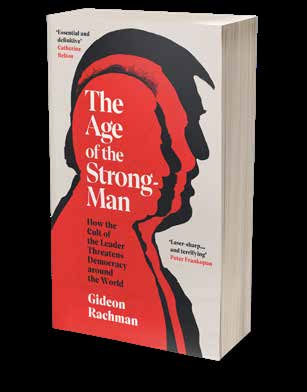
After easternisation - war and Peace in the Asian Century (2016) comes the next extensive political analysis by Gideon Rachman, chief foreign affairs columnist for Financial Times and, for ten years, a prominent commentator on the political and geostrategic aspects of globalization. In
Easternisation, Rachman gave a poignant portrayal of China’s growing economic, political and military power as Asia’s unchallenged hegemon. He clearly indicated a power and culture shift from the transatlantic to the Indo-pacific hemisphere. In The Age of the Strongman, Rachman describes
another kind of power shift, the potentially dangerous and conflictive metamorphosis in global political culture from relative to absolute leadership. Rather alarmingly, Rachman writes (p. 2): “The rise of strongmen leaders across the world has fundamentally changed world politics. We are now in the midst of the most sustained global assault on liberal democratic values since the 1930s.” Although The Age of the Strongman was written and published some weeks before the outbreak of the war in Ukraine, it perfectly fits into the actual political frame of “might is right” and the enforcement of so-called legitimate national interests through sheer violence. If this primitive approach to solving antagonistic interests should prevail and become an example to others, be it individuals, nations, and their political elites alike, any conflict led by any means becomes imaginable and possible. The destructive potential is already at hand.
Whether it is called authoritarianism, national populism, or neo-feudalism, what Rachman calls “the politics of strongmen” all lead towards the same end, a concentration, if not monopolization, of enormous wealth and power in the hands of very few individuals.
In his essay, Rachman describes a traditional concept of power rather than an
entirely new political style. Whether it is called authoritarianism, national populism, or neo-feudalism, what Rachman calls “the politics of strongmen” all lead towards the same end, a concentration, if not monopolization, of enormous wealth and power in the hands of very few individuals. The “iron law of oligarchy” has described this accumulation of influence within organizations, or even whole nations, since its introduction by German sociologist Robert Michels in 1911 (Zur Soziologie des Parteiwesens in der modernen Demokratie) and is not an entirely new historical phenomenon. Modern history in the 20th century gave many and often cruel, if not criminal, examples of ruthless rulers that considered themselves grand national leaders.
Today, the political and societal consequences of “the age of strongmen” might differ. The strongman, as seen by Rachman, is not necessarily an autocrat, “führer”, tyrant, “generalissimo”, or “caudillo”. It is a politician who, even if he has gained power through a democratic election, defies the concept of a pluralistic society. As a populist, the strongman depends on the acclaim of political majorities; as a nationalist, he tends toward an aggressive foreign policy; as a traditionalist, he alludes to an imperial grandeur that belongs to the past. In an often complex – at least ambiguous – geopolitical constellation, strongmen offer quick solutions instead of complicated procedures, crystal clear certainties instead of painful doubts, and hard decisions instead of elaborated and unsatisfying compromises.
Rachman gives some examples: annexation of the Crimean peninsula in 2014;
Brexit in 2016; the storm on the White House at the end of Trump’s presidency in 2020; and Chinese expansionism since Xi Jinping’s rise to power in 2012. Rachman’s list of strongman politicians is much longer, including, among others, Orbán (Hungaria), Erdogan (Turkey), Modi (India), Netanyahu (Israel), Mohammed bin Salman (Saudi-Arabia), Duterte (Philippines), and Bolsonaro (Brazil). Arguably, the common denominator of all these politicians is hard to find. What can be said about Boris Johnson that is equally true for Putin or Abiy Ahmed of Ethiopia?
“The global battle of ideas is waged not just by politicians but also by intellectuals”
The “charismatic new leader” (p. 173), as described by Rachman, was already identified by Max Weber a hundred years ago in his famous essay on the legitimization of political power (Wirtschaft und Gesellschaft, 1919Wirtschaft und Gesellschaft (1919). The source article does not provide a separate full bibliographic entry for this citation.). Weber was the first to introduce the religious idea of charisma in the field of worldly power. Rachman simply stands on the shoulders of giants; his ideas derive from the tradition of deep political analysis from Alexis de Tocqueville to Ernest Gellner and Isaiah Berlin. The concepts of nationalism and authoritarian rule of power go, at least in modern times, hand in hand. Strongmen, as portrayed by Rachmann, are political newcomers that find growing pleasure in exceeding personal and institutional power.
That is nothing truly astonishing, as this phenomenon was already perceived and extensively described by such different writers as Tacitus, Montesquieu, and Shakespeare, only to name the most prominent exegetes of worldly power. Obviously, power in itself is a mighty temptation, but to refer to this idea is necessarily a truism. Seen from an intellectual viewpoint, “The Age of the Strongman” lacks originality and does not have much to add to the concept of power as the “ultimate aphrodisiac” (Kissinger).
Rachman is at his strongest when he combines personal insights, anecdotal details, and general reflections: “The global battle of ideas is waged not just by politicians but also by intellectuals” (p. 197). Technological progress (including military means of mass destruction) is not matched by moral progress of any kind. The strongman bears the same moral danger as any other human being, although his impact on the world is arguably bigger. Rachman’s book reminds us of the unlimited possibilities and, at the same time, the moral restrictions of power. Rule of law is by far the better idea than the exertion of brutal force. Again, to quote Kissinger (Reflections on Diplomacy, 2019Reflections on Diplomacy (2019). The source article does not provide a separate full bibliographic entry for this citation.): “If you don’t know what to do in a situation, support the weaker against the stronger because you don’t want to encourage aggression.” But this step demands strength – and a strong man and a strong will, too. Even such an eminent commentator and sharp analyst of contemporary global politics as Gideon Rachman could not solve the dilemma of the powerful.