Introduction
The neoliberal international order dictated to the world by the Atlantic System has come to an end. The world is now in search of a new and more egalitarian international order based on mutual benefit and respect for national sovereignty. The last three decades have not only witnessed a shift of the center of weight of production from the West to the East, but also the rise of a Developing World in Eurasia accompanied by struggles in the economic as well as political and armed spheres. The once “Oppressed Nations” are now in the process of constructing a developing alternative to the Atlantic System in all spheres of life. The economic struggle is led by the People’s Republic of China, while an armed struggle is continuing in West Asia with Syria, Turkey, Russia and Iran at the forefront, and all this is reflected politically in the increasing centrifugal forces against the Atlantic System in Europe as well.
The Nation-States are the Main Building Blocks of the Developing World
The construction of an alternative system representing the common future of humanity requires a thoughtful design of international interaction, which enables each country to benefit effectively from international cooperation. The specific conditions and development strategies of the “nation-states”, which form the main building blocks of the Developing World in our era, serve as the primary inputs of this interaction design.
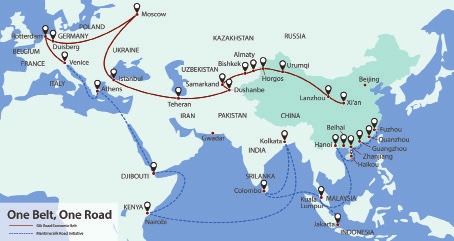
The ancient continental as well as maritime Silk Road connecting the East with the West was an Asian project, just like the current Belt and Road Initiative. The centralized and durable feudal empires of the East contributed to the culture of that era with elements reflecting a publicist spirit within their own historical contexts. This spirit, which infused the peoples living on those lands with a sense of dignity and justice-based trust, constitutes an inseparable part of today’s cultures as well. This publicist heritage contributed to the economic and cultural prosperity of contemporary Asia. All this historical accumulation makes the ancient Silk Road a source of inspiration for today’s Belt and Road Initiative.
The Developed World of the Atlantic System is much more monolithic than is the Developing World of Eurasia. The Eurasian countries span over a very broad spectrum concerning both the levels of economic development and historical and cultural accumulation. That is why there is no ready-made, one-size-fits-all recipe for economic development among the priorities and strategies faced by Eurasian countries. That is precisely why each country is to find “its own way” reflecting its own concrete conditions. Hence, the key to the success of the Belt and Road Initiative lies in the ability to harmonize the priorities and strategies of different countries. Only in this way can the economic and social outcomes achieved be broadly accepted by the societies in those countries.
“Inclusiveness” Requires a New Kind of “Openness”
Markets are myopic in the sense that they can only internalize short-term interests of the parties involved. Development strategies, however, are to be farsighted. Thus, their implementation cannot be left entirely to the workings of the market. On the other hand, the current level of the production forces renders the usage of markets indispensable. Hence, the gist of economic development lies in aligning the workings of the markets with strategic development goals. Strategic goals should naturally take into account the limitations the market forces impose upon them. In the last analysis, however, it is the market forces that are to be made subject to the strategic development goals rather than vice versa.
Economic growth is merely a quantitative component of economic development. Two countries may have similar growth rates with quite different impacts upon their productive powers. It is the qualitative content of growth that is decisive in the medium and long run. A sustainable economic development involves a continual adjustment and readjustment process between the production forces and the relations of production. Thus, an optimal route of development cannot be achieved on an economic stage, which is degraded into a playground of market forces.
Optimal routes of development of different countries are to be diversified. For example, the economy should reach a certain threshold to settle on a sustainable growth path. Complete exposure to market forces renders a country’s passive recipient’s position in sectors below that threshold permanent. No matter how intensive it might be, international interaction alone cannot bring about a leap beyond that threshold by itself. In agricultural and industrial sectors of strategic importance for either national security or economic and social development, the formation of special protection, incentive design and support policies will be needed.
Under the “globalization” model dictated to the world by the Atlantic System, “openness” was understood entirely as giving way to the “free circulation” of capital and goods under the rule of market forces. Nation-states of the Developing World were regarded as obstacles before this free circulation, and the whole effort was focused on the liquidation of the nation-states in order to open up the way to transnational monopolies.
“Openness” is one of the most crucial notions that has to be “redefined” for the success of the Belt and Road Initiative. To strengthen interaction and cooperation, countries should, of course, be “open” to cooperation. Under the Belt and Road Initiative, to the contrary of the Atlantic approach, “openness” is to be brought about by “voluntary participation” based on “mutual gain”. Being “openminded” rather than promoting “openness” will naturally help “open up” the way to more interaction and cooperation. However, it is not just the wishes, but the means that bring about the consequences. Thus, the success of the Belt and Road Initiative strongly depends upon the introduction of effective means to align openness with the development strategies of the countries involved, thereby increasing their willingness to interact. The new kind of globalization aims at globalizing cooperation, and not to create a single global market in the absence of national borders.
Finance is the lifeblood of production. In other words, finance is there to serve the needs of production. Thus, the way it circulates should accord with a smooth and qualitatively well-balanced growth in production. In case finance starts to dominate and shape production, however, it becomes a parasitic activity not promoting production, but forming an obstacle to improving production.
One of the major reasons why the center of production shifted from the West to the East within the last three decades was, in fact, that the domination of finance capital - as the main source of profits under the capitalist system - over production of goods and services became stronger than ever in the West, while finance was treated just as the lifeblood of production in the East. In the West, the shaping of the relationship between finance and production was entirely left to market forces, while in the East the state authority entered the scene as a strategic planner along with designing the means needed to implement the plans. While in the West the state had been turned into an apparatus serving the interests of finance capital, the broader national interests played a relatively more weighted role in the East.
For the Belt and Road Initiative to “include” all the countries along the Belt and the Road in an effective and voluntary way, “openness” to market forces should be harnessed. Market forces are blind to the needs of relatively underdeveloped countries; they are oriented by “profit maximization” only. If the interaction between the countries along the Belt and Road were left to the market calculations of private companies, the development goals of weaker nations would be sidelined. It is only through interaction between states and state interference by participation, orientation and regulation that the workings of the market can be aligned with the countries’ strategic goals.
It is also true that the optimal level of openness of an economy with respect to strategic development objectives will rise as the economy develops further and differences between developmental levels diminish. Then the formula will become more and more that “the more open an economy becomes, the more will it benefit from international interaction”. But what the Belt and Road Initiative promises to humanity is something that has to be constructed step by step and cannot be reached immediately in one shot.
The Creation of and the Need for Peace and Stability
It is not only that the Belt and Road Initiative will contribute to peace and stability, but the very construction of the Initiative itself also requires a peaceful and stable environment. The geographical overlap between the routes of the Belt and Road and the hotspots of terrorism is no coincidence. One of the regions where terrorism is mostly condensed is West Asia, particularly the region around Syria. Turkey has been leading an armed struggle simultaneously against various terrorist organizations such as the PKK/YPG and ISIS, all rooted in the Atlantic System. It is engaged in close cooperation with Russia and Iran regarding the Syrian Issue, which played a key role in restoring peace and stability in the region. The security of this region directly affects the main route of the contemporary Silk Road extending to the Mediterranean and Europe.
The reestablishment of peace and stability in West Asia will greatly facilitate the success of the Belt and Road Initiative. The construction of peace and stability in Eurasia and the Belt and Road Initiative are complementary in that one provides safety and the other prosperity to the ground on which the Eurasian economy as a whole can flourish further.
The 21st century terrorism is not an individualistic phenomenon with purely local origins as in the 19th century; it enjoys open or covert backing by global hegemonic powers. Therefore, combating terrorism cannot be won within national borders alone. Terrorism targeting Syria means terrorism against Turkey, Russia, Iran, and China as well. This formula applies to all countries along the Belt and Road. Defeating terrorism requires a common will and collective effort ranging from diplomatic and political to armed forms of struggle.
A Vision to Construct the Common Future of Humanity All Together
The coexistence of different cultures is widely regarded as a source of richness – a vision that can hardly be denied. In case these cultures continue to exist without touching each other, however, the richness they reflect cannot exceed the richness of an exhibition in a museum. The yardstick of social richness in history of civilizations has always been the ability to create a more advanced common culture by interaction.
It is “peace of mind” under which such an interaction will induce the richest flow of ideas and values. In an environment where people feel secure and free from future anxiety, creative thought and cultural interaction reach their peak. The Belt and Road Initiative will not only contribute to peace and stability in general, but it will also pave a ground on which peace of mind prevails.
The digitalization of technologies along with the scientific and technological advancements in artificial intelligence opens up entirely new horizons for humanity. The central question now is whether the possibilities stemming from this progress will be shared collectively or lead to concentrating power further in the hands of the largest monopolies history has ever witnessed. The only way to prevent this technological surge from turning into a destructive force is to expand the number of countries capable of developing these advanced technologies, turning them into common human wealth.
Capitalist relations of production had been born under the feudal system by themselves. They were not designed by anyone. Thus, everything that has been written about capitalism, be it by classical or neoclassical economists or by Marxists, was written by observing an already existing system that had reached a certain maturity level. The findings about capitalism were discoveries, rather than inventions. Socialism, on the other hand, was put forth by Marx and Engels in the 19th century when it was not yet an existing phenomenon. Socialist relations of production do not get born by themselves under the capitalist system; they have to be consciously designed, and the economic and social means to implement and further develop them have to be created. On the economic plane, this amounts to a continual adjustment and readjustment process between the productive forces and the relations of production in each country.
This means that any attempt to go beyond the capitalist system has to rely on science and a sound philosophy to be successful. Although the Belt and Road Initiative is mainly a project on the economic plane, it will undoubtedly be helpful in paving a ground, on which a Eurasian Alternative to the Atlantic System can be constructed. The full success of this historical attempt requires scientists to engage in permanent and close international cooperation focused on drawing continual lessons from this huge social and economic experiment to shed light on its roadmap.