An Introduction to the Unique Geopolitics of the Islands Sea and the Karaman Sea
States are as strong as their power at sea. History has never given land empires a chance in the struggle between land empires and sea empires. Therefore, the race for power takes place in the seas. The Islands Sea and the Karaman Sea, which constitutes the critical legs of this power race, are also a vital struggle area between Türkiye and Greece. Since it is not applicable in semi-enclosed seas, Greece, with its imposing attitude over the 1982 Law of the Sea Convention (UNCLOS), to which Türkiye is not a party, has now brought the tensions to an uncontrollable point. In this complicated process, Greece also put the European Union (EU) in a difficult position, which it forced to support itself. Türkiye, which lost its enthusiasm and interest in EU membership due to the losses caused by unlimited abuse, is a state that the EU has difficulty managing in terms of its market size.
The volume of trade ships entering and leaving the Mediterranean waters through the Strait of Gibraltar, the Suez Canal and the Turkish Straits is one-third of the world’s maritime trade today. On the transit route of 30% of the world’s oil transportation, the Mediterranean is also a basin where 31% of the world’s tourism activities occur (Ruffie, Gros, & Tourret, October 2018).
Due to the excessive demands of Greece and the Southern Cyprus Administration (GCA) in the Islands Sea and the Karaman Sea, located in the east of this critical maritime geography, wide areas of discussion have emerged in terms of maritime jurisdiction areas. In recent years, especially in the Karaman Sea, the struggle for attractive areas of interest over energy has begun, but it should not be forgotten that the wars in these seas were always fought for the dominance of trade routes. Beyond the heap on world maritime trade, the Karaman Sea is a sea route where 35% of the European Union’s (EU) natural gas requirement and 50% of its oil requirement are met (Tziarras, 2019Tziarras (2019). The source article does not provide a separate full bibliographic entry for this citation.). To summarize, this waterway, which is almost an artery for Europe, is a geography where Europe, which requires energy flow continuity, has to risk war if necessary.
The equitable sharing of the Islands Sea that resembles a ball of straits with a land surface of 23,000 square kilometers, which is the sum of thousands of islands, and a sea surface area of 214,000 square kilometers, has not yet been completed between Türkiye and Greece. With a situation similar to a spontaneous and unsigned "modus vivendi", that is, a temporary peace is maintained over six nautical miles of mutual territorial waters, which both sides are not satisfied with, even though it is not signed.
The Geopolitical Break in the Defense Industry in the Islands Sea and Karaman Sea Caused by the Unstoppable Rise of “Türkiye”
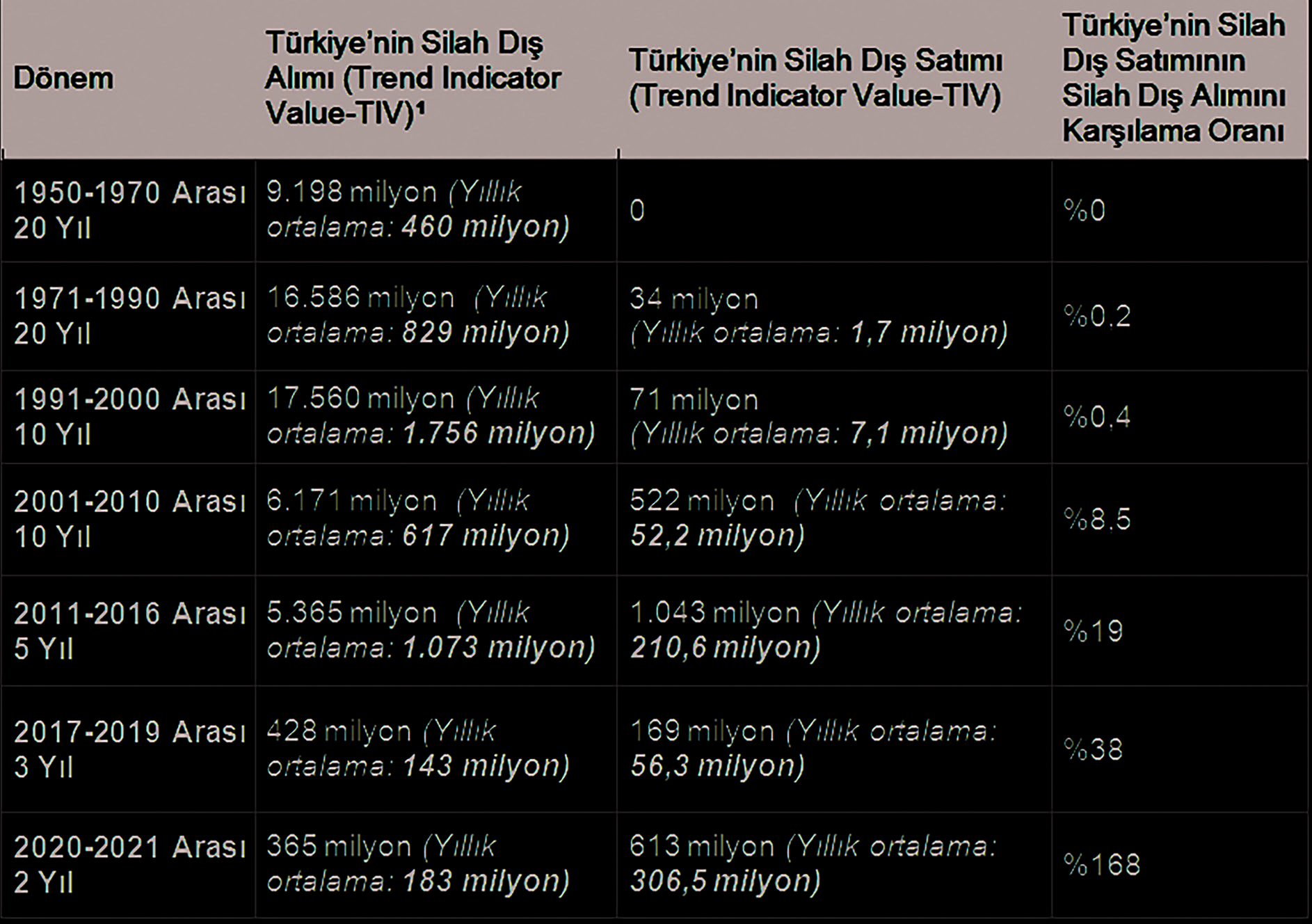
Instead of forcing its limits in the armament equation, a state’s consent to the limitations set by the imperialists means it renounces its geopolitical power. Türkiye, which has attached itself to NATO, has experienced exactly this and has broken away from its geopolitical reality. In the recent period when Türkiye was trying to break away from NATO, as it produced domestic and national weapons by pushing its borders, it became independent and realized its real geopolitical power. If we put the subject on the table from an analytical point of view, Table 1, which takes a picture of Türkiye’s arms imports and sales between 1950-2021, mirrors
us to understand Türkiye’s relationship with imperialism.
Between 1950 and 2000, Türkiye spent an average of 850 million TIVs of its national income annually to purchase weapons from abroad and could sell only 173 thousand TIVs annually in the same period. Türkiye, which had no weapons to sell, spent huge sums of money buying weapons from the imperialists. Several major factors forced Türkiye to purchase arms between the years 1950-2000: Soviet Russia, which was made hostile and provoked through the North Atlantic Alliance (NATO); Greece, which is armed and encouraged to pursue a re-expansionist policy to maintain imperialist-controlled tensions over the Islands Sea, Karaman Sea and Cyprus; and the PKK and FETO terrorist organizations, which are kept alive with unimaginable secret or direct global support and used to wear down Türkiye. The West, led by the USA, set up a fertile environment for arms sales and left Türkiye no choice but to buy the older generation weapons of the imperialists at inflated prices until the 2000s.
When we examine Table 2, in the first 21 years of these 51 years, Türkiye was 80-85% dependent on the USA. In the next 30 years, despite efforts to diversify the states on which it was dependent on purchasing weapons, it could only reduce its dependence on the USA to the band of 42-70%. Source: Export Values, 2022.
away from Atatürk’s philosophy of fighting against imperialism and was made to believe that it became westernized with NATO, was transformed into one of the world’s leading arms buyers in the half-century between 1950-2000, without being able to sell weapons. Between 1991 and 2000, when the need to fight the Kardak Crisis and the PKK reached the highest level, Türkiye broke a record and reached an annual average of 1.756 billion TIVs in arms imports, and 66 percent of this import came from the USA. The remaining 34 percent is made from other Western states, primarily Germany. For imperialism, this was gratifying. Türkiye had been made dependent on Western weapons for 50 years; therefore - on its own initiative - Türkiye fell into geopolitical blindness. Since it could not realize its real geopolitical power, it started to perceive imperialist impositions as a necessity of its foreign policy.
Nevertheless, between 2001 and 2010, a national upheaval in Türkiye affected the arms imports and sales. In the ten years from 2001 to 2010, when US imperialism first felt that Türkiye would take a hit over the arms market, Türkiye’s imports fell sharply from $1.756 billion to $617 million annually (Table 1). The difference was met through the national defense industry instead of purchasing weapons from abroad. Additionally, Türkiye has gained a state identity that has started to sell high-tech weapons by selling weapons abroad for 52.2 million TIVs annually. The USA wanted to intervene in this situation without delay. As a matter of fact, with the 2007-2008 Ergenekon, 2008-2009 Poyrazköy / Assassination of Admirals / Cage Action Plan, 2010-2011 Sledgehammer, 2012-2013 Espionage and Prostitution conspiracy cases, many officers who were determined to fight imperialism and worked hard to break Türkiye’s dependence on the West for weapons were arrested in the Turkish Armed Forces.
The Fethullahist Terrorist Organization (FETO), which greatly increased its effectiveness in the Turkish Armed Forces along with many state institutions in the five years between 2011 and 2016, increased the TAF’s foreign arms purchases, which had fallen to 617 million TIVs annually, to 1.073 billion TIVs annually. They also pioneered the transfer of 61 percent of high defense spending to US arms companies. In this period, the national defense industry, which FETO slowed down, started to bear its first fruits by making an annual export of 210.6 million TIVs, thanks to the sales agreements of the previous period, despite the strong US-led impediments. While trying to regress the Turkish national defense industry using FETO’s elements within the state, there was an unsuccessful coup attempt by the US-backed FETO on 15 July 2016, and then, all state institutions, particularly the Turkish Armed Forces, began the process of clearing FETO quickly.
In the 2017-2019 period, which is the first three years after the liquidation of FETO, Türkiye’s average annual defense expenditure fell from $1,073 million to $143 million, a sharp decline compared to the 2011-2016 period controlled by FETO. On the other hand, because FETO, which controlled the previous period, undermined arms After the US-backed failed coup attempt on 15 July 2016, all state institutions, particularly the Turkish Armed Forces, began the process of clearing FETO quickly. sales agreements, arms sales abroad decreased from an annual average of 210.6 million TIVs to an annual average of 56.3 million TIVs in the 2017-2019 period. Nevertheless, we should say that during the 2017-2019 period, which was the period of overcoming the trauma of FETO, defense expenditures were made using domestic rather than foreign resources. From 2017 through 2019, the share of the USA in defense imports decreased to 35% in 2017, 25% in 2018 and 17% in 2019 (Table 2).
In the period between 2020-2021, when the trauma of FETO was overcome, a first in Türkiye’s history was experienced. In these two years, annual defense imports averaged 183 million TIVs, while annual defense exports climbed to an annual average of 306.5 million TIVs. To summarize, for the first time, export exceeded imports. Moreover, the overshoot rate was 68%. In 2020 and 2021, a large part of the defense needs of the TAF was met by the national defense industry, and the financing of a small part that could not be met was easily made through foreign sales2. Preliminary performance evaluations for 2022 show that the Turkish defense industry is in a much brighter year than 2020 to 2021.
As can be seen in Tables 1 and 2, the share of the USA in Türkiye’s arms imports, which has decreased to a very low level of 183 million TIVs annually in the last two years, fell to 16% in 2020 and 9% in 20213. It has gone down to a low level, which is unbelievable for the USA. To make an analogy, "The bird escaped from the cage and came back as an eagle." Alternatively, as a more accurate analogy, "The USA could not prevent the bird in its cage from escaping, and this bird began to fly high as an eagle." This phenomenon, which seems irreversible, is one of the important signs that Türkiye intends to break the submissive ties it has established with the West in the past and that it wants to approach Asia to integrate without compromising its geopolitical freedom.
F-16 Block 70 and modernization kits, which are the last arms sales that the Turkish Armed Forces can make to Türkiye through the field of "fighter aircraft", where progress is relatively slow compared to other fields, is the last trump card that the USA can use to control Türkiye through the defense industry. The USA, after using this trump card, calculates that Türkiye’s war power will be destroyed by a war that may arise from the tensions over the Islands Sea and Karaman Sea, and thus it will be made dependent on itself as in the old days.
At this point, in a parenthesis, we should say that with the two seismic surveys and four drilling vessels that the Turkish Petroleum Corporation added to its inventory between 2012 and 2022, Türkiye has broken its dependence on imperialism in energy exploration and extraction capabilities, just like in the defense industry.
Having recovered from its dependence on U.S. weapons, Türkiye has also begun to embrace its geopolitical power in the defense of the “Blue Homeland”4. Acting in accordance with this purpose, Türkiye has made great progress in the critical “Turkish Fighter (TF) Project”, which it plans to start mass production as of 2030.5 The engines to be used in the prototypes of the TF were quickly presented to the Turkish defense industry by the USA and the UK. This initiative can be perceived as the sabotage of the Turkish defense industry, which has made a leap. Turkish national capabilities should be challenged for 100 percent locality in national fighter jet mass production; For advanced fighter jet requirements expected to be felt by the 2030s, Russian and Chinese options should be considered as a priority. In fact, in order to facilitate the development of fast-growing Turkish national defense industry, the issue of whether to buy F-16/F-35 or aircraft engines from the United States, which has declared Türkiye an enemy with CAATSA6 sanctions, should be carefully considered. Türkiye’s option of a trade retaliation that “prohibits the purchase of military equipment from the United States” is an issue worth discussing. The prototype of the Turkish Fighter developed by TAI was shared for the first time on 23 November 2022. Turkish Fighter is planned to leave the hangar next year. (Turkish Defence News, 2022Turkish Defence News (2022). The source article does not provide a separate full bibliographic entry for this citation.)
Turkish-Greek Relations in the Islands Sea and the Karaman Sea That Cannot Establish Their Balance
Shortly after the Turks dominated Anatolia, the Catholic world, which conquered and settled the Sea of Islands and Karaman, prospered between the 11th and 14th centuries by plundering the coasts where Muslim Turks and Orthodox Greeks lived together. The Greeks, who could not resist Catholic plunder because they were quite regressive in seafaring, came under the protection of the Turks, who responded to Catholic plunder by becoming sailors, who became stronger as they became sailors, and who drove Catholics from the "Blue Homeland" to the Western Mediterranean at the cost of hundreds of thousands of martyrs.
The Greeks, who were Ottoman nationals from the 14th century onwards, used the Turks as a defensive wall against the predatory West until the beginning of the 19th century. This great mistake of the Ottoman State, which did not go out to the oceans and closed itself to the Mediterranean and Red Sea basins, resulted in the confrontation of imperialism and its buffers, which carried the power they gained from the oceans to the Mediterranean, with the attacks of the Turkish "Blue Homeland" since the 18th century.
After the Napoleonic attacks on Egypt, the Ottoman Empire abolished the maritime trade privileges it had granted to France and gave the privilege of maritime trade in Ottoman waters to the Greeks. Thanks to this last-minute privilege granted by the Ottoman Empire, the Greeks quickly became sailors instead of defending the Turkish "Blue Homeland" against imperialism together with the Turks. Since their rebellion in 1821, they have turned into a hybrid state supported by imperialism and have begun to seize the Turkish "Blue Homeland" piece by piece through massacres and wars. Tens of thousands of Istanbul and Izmir boatmen, who could not remain insensitive to the massacres of Turks and Jews in Tripoli7, the entire Peloponnese and the Sea of Islands in 1821 and 1822, had enlisted themselves as galleonists8 in the Ottoman Navy, which was trying to suppress the Greek rebellion.
With a resolution taken by the Greek Parliament on 24 February 1994, the Greeks declared 19 May 1919 as the (so-called) "Pontic Genocide Remembrance Day" with the claim that "the Pontic Greeks living on the Black Sea coast during the First World War and the War of Independence were subjected to systematic genocide by the Ottoman Turks". It is time to confront the Greeks, who formalized this baseless claim to distort history with real history. Türkiye should erect a huge "Commemoration Monument of the Turks Massacred by the Greeks" on one of the "Islands, Islets and Rocks Whose Sovereignty Has Not Been Transferred by Treaties" (EGEAYDAAK) with a ceremony on 6 April and organize commemorative events in front of this monument on 6 April every year.
The Ottoman State, which had to accept the independence of Greece in 1830, tried to gain time with variable balance policies through the conflicts of interest of the imperialists among themselves. The Ottoman State, which was lost in the balance games, could not prepare a qualified naval force due to foreign dependence and a debt spiral. It was eroded between Tsarist Russia and Greece, the buffers of imperialism, and first reduced to the status of a semicolony. At the end of World War I, it lost its entire "Blue Homeland", including the Turkish Straits.
After the War of Independence was won on land, the Turkish Grand National Assembly (TBMM), which went to Lausanne without a navy9, was forced to leave most of the Boğazönü Islands and Saruhan Islands, which were on the Blue Homeland and were subject to Greek occupation, on the condition that they would be demilitarized in the 1923 Lausanne Peace Treaty. In addition, the Italian-occupied Menteşe Islands in Lausanne were left to the Italians. Italy, one of the losers of World War II, signed the Paris Peace Treaty of 1947 and left the Menteşe Islands to Greece instead of Türkiye – on the condition of demilitarization – in violation of the Lausanne Peace Treaty of 1923. While Türkiye should be the aggrieved party due to the loss of the vast majority of the Aegean Islands with the Lausanne Peace Treaty of 1923, on the contrary, Greece adopted an attitude that did not recognize Lausanne against Türkiye.
Türkiye accepted the "real" situation in Lausanne and pursued a policy based on "good neighborliness", but Greece, despite its unjust and extreme gains even in Lausanne, has not given up on its "expansionist ideals" (Megali Idea). Greece, which has been displaying piecemeal behavior since 193610 to recognize the Lausanne Peace Treaty of 1923, a peace treaty that determines the conditions that ended the Turkish-Greek War, openly challenges Türkiye with this attitude.11 Türkiye, on the other hand, despite having lost land, is in favor of preserving the Lausanne balance and sharing the seas peacefully and fairly within the framework of this balance.
The first wave, in which Greece unilaterally increased its territorial waters from 3 nautical miles to 6 nautical miles in 1936, has now turned into a tsunami threatening the entire Turkish "Blue Homeland". Türkiye, which does not want to be under this tsunami, is kept under control with artificial imperial tensions that smell of the "Megali Idea" and inconclusive diplomatic struggles that have been going on for years in vain. When we look at the examples in human history, it is impossible to avoid wars that come to the door at stages when diplomacy cannot give results. To put it in its most succinct form, the Lausanne Treaty of 1923, which was based on "3 nautical miles of territorial waters", "the demilitarization of the Boğazönü, Saruhan and Menteşe Islands", and "the acceptance of the belonging of formations with a very small surface area that are not handed over by name" to Türkiye, is the brake on a possible Turkish-Greek war. It is understood that Greece, which has exhausted all its diplomatic opportunities to erode these main factors that are the conditions of Lausanne’s peace, is not yet aware that happy peace days can end by attacking the Turkish "Blue Homeland" for 201 years, ignoring Lausanne for 86 years and challenging Türkiye militarily for 67 years.
The US’s military presence in Greece. (BRIQ , 2022BRIQ (2022). The source article does not provide a separate full bibliographic entry for this citation.)
The main reason underlying this lack of vision in Greece stems from the belief that Türkiye’s "defensive" stance, which it had taken up until 2005 due to the fear of not being able to cope with imperialism, continues. Indeed, Türkiye, which did not gain power at sea until 1952, had to act with a defense strategy based on its coasts. From its entry into NATO in 1952 until the early 2000s, it accepted being an ideal and easy-to-control proxy of US imperialism. Starting from the beginning of the 21st century, Türkiye, which started to develop its domestic and national defense industry by jumping over the resistance mechanisms of US imperialism, let down its guard for a short time with the dream of becoming an EU member until 2004. However, after 2005 it started to focus on an independent defense industry infrastructure again, realizing that the EU deceived it.
Greece, which has started to see Türkiye as an effective power in Libya in recent years12 and has almost zeroed its dependence on the West in defense expenditures, has realized that it cannot solve the crisis alone. With the thought that the USA and EU13 will not allow a stronger Turkish presence in the Karaman Sea, Greece’s behavior against Lausanne and illegal sea area demands continue in line with the suggestions of the West. Greece is a state stuck between the imperialist interests of the USA and the EU, the ambition of the "Megali Idea" 14 that it cannot give up, and the Turkish defense capabilities that have become independent.
Aside from finding a solution, Greece’s capacity to cope with this trauma is an issue worth examining realistically and impartially if the 67-year tense period, in which the problems deepened, turns into
Greece’s Capacity to Face Military Tensions That Might Evolve and Turn into a War
Territorial waters, the exclusive economic zone (EEZ), strict demilitarization issues in some islands, and Cyprus issues in the Islands Sea and Karaman Sea, which is the subject of many academic studies, are the main tension issues. At this point, it would be useful to evaluate the capacity of Greece to face a Turkish-Greek War, which may be caused by increasing these tensions, by making comparisons.
According to "Global Fire Power", which presents a comparison model of the armed forces in the world using more than 50 parameters, in 2022, the Turkish Armed Forces are 2.3 times stronger than the Greek Armed Forces (Comparison of Greece and Türkiye Military Strengths, 2022Comparison of Greece and Türkiye Military Strengths (2022). The source article does not provide a separate full bibliographic entry for this citation.). If qualitative scoring such as the level of operational readiness training could be made, it would be possible to see that the superiority of the Turkish Armed Forces over the Greek Armed Forces reached up to 5 times.
When we examine the arms purchases made by Türkiye and Greece from abroad in the last five years, although Türkiye meets most of its defense needs from domestic production, according to Greece, which does not have a defense industry, it spent 4.75 times (approximately five times) more than abroad. Türkiye, which has reduced its purchase of weapons from the USA, has brought Italy, Spain and Russia to the fore in the list of countries from which it purchases weapons and defense materials. Greece continued its dependence on the USA and France to purchase weapons and defense materials.
According to "Global Fire Power", which presents a comparison model of the armed forces in the world using more than 50 parameters, the Turkish Armed Forces are 2.3 times stronger than the Greek Armed Forces. The fact that warplanes are the largest purchases of defense materials by both Türkiye and Greece shows that warplanes are the most sensitive and deficient area of defense of both states. The fact that so many current examinations of the F-16, Rafale and F-35 aircraft are so intense these days is mainly due to this sensitivity.
When we look at Table 3 regarding Turkish and Greek armament performance, Greece does not have the potential to enter an arms race with Türkiye. This is because almost all categorical ratios on armament seem to be between 2.73 and 41.73 times in favor of Türkiye. To continue the tension policies of Greece, which cannot give up on its ideals, it is to seek the help of imperialism to be even more buffered and hybridized.15 Naturally, such a quest also puts the exploitation mechanisms in Greece into action – ruthlessly. Greece has had difficulty finding a budget for defense expenditures in the last five years. The increase in the Turkish-Greek tension, even turning it into a war, forced the Greek people to purchase more American and French weapons. The imperialist pressures of the USA and France, which target Greece rather than Türkiye, will cause the Greek people to pay more taxes for their defense expenditures for the next five years.
Possible Effects of USA and Israel on Turkish-Greek Tension
At the peak of imperialism, the USA was based in Alexandroupoli, thinking that Türkiye might want to seize Western Thrace due to the settled Source: Export Values, 2022.
War. It also adopted a radical base policy under the guise of reinforcement of the weak Greek Armed Forces. However, when the world is moving towards multipolarity, it is highly unlikely that the USA, which does not want to wear out its armed forces, will be directly involved in a Turkish-Greek War. Instead, the United States, Britain and France plan to establish a high-level military presence in Cypriot waters, forcing Türkiye to shift some of its power to Greece in the Karaman Sea is an option with a higher probability.
By adjusting its presence in the Karaman Sea to the level of tension, the United States can continue to control maritime trade routes through the "surprise effect", which is the most important weapon of war.
On the other hand, the escalation of the tensions between Türkiye and Greece are the facts that will trigger the arms needs of both Greece and Türkiye. The USA offered to Greece, which has economic difficulties, to sell 4 Multi-Purpose Surface Warships (MMSC), a modernization package for Hydra (MEKO-200 HN) class frigates16 and 20 F-35 fighter jets. It also offered to sell 40 F-16 Block 70 and 79 F-16 Block 40/50 modernization kits to Türkiye at the same time (M5 Dergi, 2022M5 Dergi (2022). The source article does not provide a separate full bibliographic entry for this citation.) (SavunmaSanayiST, 2022SavunmaSanayiST (2022). The source article does not provide a separate full bibliographic entry for this citation.). Imperialism always benefits from tensions, so it is necessary to look for imperialism in the background of all tensions.
Possible Effects of France on Turkish-Greek Tension
Recently, in parallel with the discovery of new energy sources in the Karaman Sea, economicbased cooperation models of some countries in the region have been tried to be developed. For these economic-based cooperation models to be functional, they must have a strong image and even present a strong image with military demonstrations attended by many states. In this atmosphere, some weak military demonstrations, contributed by the USA, some EU countries, Israel and Egypt, which feared the Turkish geopolitical dominance in the Karaman Sea, became an annual routine. On the other hand, while these weak military exercises could not create a serious psychological impact on public opinion in Türkiye, which was declared a rival, it gave morale to the Greek and Greek Cypriot public. With this motivation, Greece and the Greek Cypriot Administration, determined to maintain tensions over geopolitics and geoenergy, act with the motive of armament by forcing their conditions. In these games played through the sale of weapons, apart from the USA, the world’s leading arms dealer, France, also plays the leading role.
France is more present in the Karaman Sea than before, with the belief that the USA has relatively withdrawn from the Mediterranean, thus creating a great power vacuum to be filled. The effort underlying the demonstration-based French military effort aims to establish a French hegemony under the name of "Pax Mediterranea" in this geography. However, this ambitious effort by France has not yielded any results so far (Jabbour, 2021Jabbour (2021). The source article does not provide a separate full bibliographic entry for this citation.).
In these games played through the sale of weapons, apart from the USA, the world’s leading arms dealer, France, also plays the leading role.
The last demonstration, which was held to keep the Turkish-Greek tensions fresh through the Greek public, triggering the arms sales, was held between 24 September and 1 October 2022, in the form of a Greek-French bilateral exercise under the name ARGO-22 (Athens News Agency, 2022Athens News Agency (2022). The source article does not provide a separate full bibliographic entry for this citation.), located in the north of the Islands Sea. It was exhibited in a small area between the islands of Bozbaba and İskiri.
The ARGO-22 Dual Exercise17, resembling tactical training rather than an exercise in its most minimal and most economical way (Özsaraç, Doğu Akdeniz’de Savaş Senaryoları, 2022Özsaraç, Doğu Akdeniz’de Savaş Senaryoları (2022). The source article does not provide a separate full bibliographic entry for this citation.), has achieved its purpose by causing a holiday joy in the Greek public and convinced the Greek citizens to pay high taxes for 24 Rafale fighter jets and 3 (+1 optional) prototypes FDI the Belharra type frigates that France wants to sell to
Possible Effects of Egypt on Turkish-Greek Tension
The former president of Egypt, Mohammed Morsi, abolished the natural gas delivery agreement between Egypt and Israel in April 2012 and annulled the EEZ agreement signed with the Greek Cypriot Administration in 2003 in March 2013. The choice of the Morsi administration was to establish the Levant Cooperation, of which Türkiye would be a part. However, General Sisi, who came to power with the coup, re-enforced the previous agreements. It should be considered that Egypt does not have a clear Karaman Sea policy and has become fragile with power changes. We should also note that with the onset of the General Sisi period, Egypt entered into a formidable armament effort.
Competing with Türkiye’s geopolitical power, extending to North Africa, even to the sub-Saharan SAHEL, and believing that it can balance it with its economic power, this time France, intends to use the Eastern Mediterranean Gas Forum as a carrot that can be extended to Türkiye because the carrot for entry into the European Union is not as effective as before.18 In addition, France is acting cautiously as it thinks that Türkiye will be the most important market for natural gas in the Karaman Sea (Segantini, 2022Segantini (2022). The source article does not provide a separate full bibliographic entry for this citation.).
As can be understood from the roles it wants to give Türkiye such as "balancing Russia and China in the Central Asian Turkic world", "assuming the security of the Black Sea", "supporting the stabilization of Libya", and "providing humanitarian aid to Syria", France is approaching Türkiye with an imperialist mentality that might bite (Segantini, 2022Segantini (2022). The source article does not provide a separate full bibliographic entry for this citation.). From the current policies of France, it is understood that Türkiye, which has successfully made its defense industry independent, cannot adequately perceive (or ignore) its new defense capabilities, act with the thought that this power fluctuation in the east of the Mediterranean is temporary, and underestimate the power of the Turkish Armed Forces with arrogance. However, compared to the French Army, the fourth strongest armed force in the world, the Turkish Armed Forces is only 34.57% underpowered in quantity. Moreover, Türkiye is completely independent of France in terms of defense materials, as it does not use the weapons of the French, who are among the leading arms dealers in the world. To summarize, France does not have an armed force that can crush Türkiye.
To summarize, Egypt is a silent giant in the Karaman Sea, which does not show its teeth for now, but cannot resist the wishes of the West today. The Turkish Armed Forces are quantitatively weaker than the Egyptian Armed Forces by 4.7% (Global Firepower, 2022Global Firepower (2022). The source article does not provide a separate full bibliographic entry for this citation.). The main reason that Egypt, which does not have a national defense industry, has the strongest armed forces in the Karaman Sea is because of the excessive purchase of weapons since 2015. As seen in Table 4, this excess is four times that of Türkiye. It is understood that the aim of these astronomical military expenditures of Egypt, which used most of it for the navy and air force, was to balance Türkiye in the Karaman Sea. Egypt has started to make its impact felt in the region with the defense expenditures it has made for the last seven years and has not slowed down.
Both Türkiye and Egypt have to extend a hand of friendship to each other. It is especially worth noting that Egypt needs Turkish friendship because Egypt’s dependence on the West in defense evokes Türkiye’s situation in the 1990s. Egypt, located on one of the busiest waterways in the world, will want to meet its defense needs with domestic and national resources, as Türkiye did, as soon as it realizes that being connected to the West is a weakness. The day Egypt decides to seek its interests in Asia instead of the West, Türkiye will be a model country. Source: Export Values, 2022.
Egypt, which has participated in many exercises with Greece and the Greek Cypriot Administration (GCA) in recent years, is a powerful state that should be considered in a possible Turkish-Greek War. In addition, it should not be forgotten that in the event of such a war, even if Greece does not participate in the war on its side, if the Suez Canal is closed to Turkish merchant ships, it may have a dangerous effect against Türkiye. This geopolitical power is not to be taken lightly.
International Court of Justice (ICJ)
It is not only Türkiye and Greece that have maritime jurisdiction disputes worldwide. About 180 of 420 disputes have been brought to the International Court of Justice in the Hague. It should be accepted that it is an ideal solution for Türkiye and Greece to bring all their disputes to the International Court of Justice in the Hague. However, based on the previous decisions of the Court of Justice, Greece, which understands that the court will most likely make decisions in favor of Türkiye, does not want to take the disputes to the Hague. Waiting patiently for a period when the conjuncture will change in its favor legally, Greece is making efforts to postpone the option of the International Court of Justice as much as possible without neglecting to take measures per the existing case law. It would be incompatible with realism to think that Greece could abandon this asymmetrical behavior that avoids the application of international law.
Although the exclusive economic area in the Islands Sea is shown as 89,000 square kilometers in the current "Blue Homeland" maps, the fair situation for Türkiye is that an economic area equal to half of the sea and land total is requested from the International Court of Justice. If Greece continues to resist going to the International Court of Justice, Türkiye should begin to unilaterally and boldly implement the requirements of its interests. In other words, Türkiye must abandon its policy of silence to a situation similar to the current "modus vivendi". Adopt the option of unilaterally declaring an exclusive economic zone based on the westward extension of the midline to include a marine area of 118,500 square kilometers (half of the combined sea area and land area – about 55% of the sea) in the
1988 Athens Consensus
Greece always chooses the winter months to escalate tensions because tourism, which intensifies in the summer months, is vital for the country’s economy. Türkiye and Greece, with the Athens Agreement, signed on 27 May 1988, guaranteed each other not to conduct military exercises in the Islands (Agean) Sea between 1 July and 1 September. On 1 July 2006, this period was extended to cover the period from 15 June to 15 September. Türkiye has made a great contribution to Greek tourism by following this moratorium so far. However, it is illogical to prioritize Greek tourism revenue when so many problems have been waiting for a solution for 67 years. It is clear that it will be in favor of Türkiye to cancel this moratorium rather than pause military activities during the summer months and to carry the tensions experienced in the winter in the Islands Sea to the summer months.
1936 Montreux Straits Convention
The term of the Montreux Straits Convention, a 20year contract, expired on 9 November 1956. However, since none of the signatory states took a step towards annulment of the convention, it has remained valid until today. To 17% of all merchant ships in the world as DWT, Greeks, who own 30.25% of crude oil and petroleum products tankers, benefit from the special transit regime provided for merchant ships by the 1936 Montreux Convention. To summarize, the state that uses the Turkish Straits and the Sea of Marmara most, which is a Turkish inland sea, is Greece. For example, Greek-owned tankers carry most of the oil transported through the Turkish Straits. At least 49% of the oil that Greece uses in its own country has come through the Turkish Straits for the last 20 years. This rate was 91% in 2020 (IEA, 2022IEA (2022). The source article does not provide a separate full bibliographic entry for this citation.). To create a solution to Turkish-Greek tensions that favors Türkiye, the geopolitical power of the Turkish Straits, which has contributed to the prosperity of Greece for decades, should be activated. It is the right time to open the 1936 Montreux Convention for discussion.
Conclusion
Tensions in the Islands and Karaman Sea that are evolving into war have not been resolved through diplomacy to date. The easiest way to solve all the problems under discussion is for Türkiye and Greece to go to the International Court of Justice by mutual agreement and respect the court’s decision. If Greece, which has blocked this road until now, continues to flee from the International Court of Justice, Türkiye must operate unilateral decision mechanisms, considering war.
When considering the Islands Sea, the 1923 Lausanne Peace Treaty is a very strong text in international law, which cannot be violated unilaterally by both states. The clauses of peace treaties do not become obsolete until a new war. The only way to change, other than war, is by mutual consent. Atatürk’s Türkiye, which wanted to get rid of the restrictions of Lausanne regarding the Turkish Straits, solved this problem with the conference held in Montreux in 1936 and convinced all the signatory states of Lausanne, including Greece, to a new convention. There is only one peaceful option for Greece, which wants to get rid of the provisions of Lausanne’s "3 nautical miles territorial waters", "demilitarization of islands far from the Greek mainland but very close to the Turkish mainland", and "return to Türkiye of formations whose sovereignty has not been transferred to Greece" to request "a conference". Any situation to the contrary means risking a war.
Therefore, after Greece was suggested to apply for a conference to the signatory states of the Treaty of Lausanne for its demands beyond Lausanne, with full consideration of the balance of Lausanne, a law should be outlined which: - Does not recognize the territorial waters and airspace of Greece greater than 3 nautical miles - Protects the Islands, Islets and Rocks (EGEAYDAAK) whose sovereignty has not been transferred by treaties, by name and practices, - Takes into account the imbalances caused by the large number of islands in the Islands Sea, together with 3 miles of territorial waters, unilaterally declaring and implementing the exclusive economic zone (EEZ) so that at least 55% of the entire remaining sea area belongs to Türkiye. This should be discussed in the Grand National Assembly of Türkiye and, if necessary, submitted to a public vote.
For the Karaman Sea, the Grand National Assembly of Türkiye should discuss a law that provides a conference invitation to the 10 riparian states, ignoring the demands of Greece and the Greek Cypriot Administration in case of failure of the conference solution, and declaring and applying the borders of the exclusive economic zone (EEZ) in the Karaman Sea. If necessary, it should be submitted to a public vote.
In this process, with the cancellation of the 1988 Athens Agreement and the 1936 Montreux Convention, the issues of whether to continue the voluntary contributions made through the Turkish geography to the tourism and maritime trade areas, which are the most important income items of Greece, should be opened to a comprehensive discussion by the public.
Thanks to the development of its national defense industry, Turkish dependence on weapons from the imperialist states trying to interfere with our geopolitical power in the Karaman Sea has largely disappeared. This momentum should not be missed, and a trade embargo should be applied to Western weapons, including purchases of warplanes and engines. Mandatory weapons requirements must be met through Asian options such as Russia, China, and Iran.19 Asia’s coping with imperialist pressures depends on Asian control of interconnected maritime trade routes, starting from the Kerch Strait in the Black Sea, through the Turkish Straits, the Suez Canal, the Babülmandep Strait, the Strait of Hormuz, the Strait of Malacca, and the Bering Strait. For this purpose, a new defense structure should be considered based on the control of these trade routes from the sea by the Asian states, which are not the buffer of the West. Of course, for a defense structure that will protect Asia from the seas against imperialism, Türkiye, Russia, China, Iran, and even Egypt must show their will together if they can break away from the West. It is possible for Asia to get rid of imperialism by giving a breath to the sea trade routes around it. The maritimization of Asia in cooperation and its giantization in the oceans should be prioritized. Otherwise, Western imperialism, which can directly or indirectly use its power in the seas, including the Karaman Sea, will not end its attempts to shape Asian maps with soft or hard power instruments through its theories of reshaping the world. Notes 1. TIV (Trend Indicator Value); Developed by the Stockholm International Peace International Research Institute for the purpose of comparing military capacity rather than financial value, under the name of “trend indicator value”. It is a standard international valuation unit applied in the analysis of arms sales.
2. Zachary Paikin and Caroline Rose believe that Türkiye, the third most arms importing state in the world in the 1990s, has succeeded in being 14th in world arms exports today despite limited economic conditions. They point out that although it was once the most popular customer in the arms market, it has reduced its arms imports by 59% from 2011 to the present (Paikin & Rose, 2021Paikin & Rose (2021). The source article does not provide a separate full bibliographic entry for this citation.).
3. The remaining 91% of arms and defense equipment purchases were from Italy and Russia (Export Values, 2022Export Values (2022). The source article does not provide a separate full bibliographic entry for this citation.).
4. Many Greek academics believe that a group of high-ranking soldiers have been putting forward and developing the "Blue Homeland" doctrine since 2006, provoking the Turkish government and Turkish public opinion and persuading them to act outside the basic principles of international law in the Eastern Mediterranean (Grigoriadis, 2021Grigoriadis (2021). The source article does not provide a separate full bibliographic entry for this citation.).
5. The first prototype of the Turkish Fighter (TF), which continues its production activities within the body of TAI, is planned to exit the hangar on 18 March 2023 with the engines running and start ground tests. By the end of 2026, 3 TF Block 0 prototypes will be produced and the first flights will be made. It is aimed to deliver TF Block I fighter jets to the Turkish Air Force by 2029. 10 F-110 engines are to be procured from the United States for the prototypes of these aircraft. For the Block I aircraft, Rolls- Royce engines are to be purchased from the UK and then the domestic engines developed by the Kale Group will be used (Milli Muharip Uçak’ın Motoru Türkiye’de, 2022Milli Muharip Uçak’ın Motoru Türkiye’de (2022). The source article does not provide a separate full bibliographic entry for this citation.).
6. Due to Türkiye’s purchase of the S-400 air defense system from Russia, the USA has included Türkiye as of 6 April 2021 in the scope of the "Combating Adversaries of the United States through Sanctions Act (CAATSA)" to impose sanctions on China, Russia, Iran and North Korea (ABD’nin Türkiye’ye yönelik CAATSA yaptırımları yürürlüğe girdi, 2021ABD’nin Türkiye’ye yönelik CAATSA yaptırımları yürürlüğe girdi (2021). The source article does not provide a separate full bibliographic entry for this citation.).
7. The genocide of Turks and Jews in the Peloponnese from 1821 to 1822 is a lesser-known issue to the Turkish public because of a lack of academic interest (Örenç, 2020Örenç (2020). The source article does not provide a separate full bibliographic entry for this citation.).
8. The massacres suffering the Turks spread starting from Tripolis on 6 April 1821 and were not limited to the Peloponnese, but took place in Samos, Chios and Ipsara Islands, and even on the coasts of Anatolia (Büyüktuğrul, 1982Büyüktuğrul (1982). The source article does not provide a separate full bibliographic entry for this citation.; Tezel, 1973Tezel (1973). The source article does not provide a separate full bibliographic entry for this citation.; Özsaraç & Özyiğit, Osmanlı’nın Kalbi, Tersane-i Amire/Tersane, 2022Özsaraç & Özyiğit, Osmanlı’nın Kalbi, Tersane-i Amire/Tersane (2022). The source article does not provide a separate full bibliographic entry for this citation.).
9. During the Lausanne negotiations, the Ottoman Navy, which was weak, backward in technology, neglected and worn out due to war wounds, was interned in the docks and piers of the "Tersâne-i Âmire" in the Golden Horn under the control of the Allied Powers who had been occupying Istanbul since 1918. Two gunboats with very low firepower, named Preveza and Isareis, which escaped to support the logistical transportation of the War of Independence over the Black Sea and came under the command of the Government of the Turkish Grand National Assembly, could not cross the Turkish Straits controlled by the Allied Navy under the conditions of 1923. Even if they passed, it would be impossible for them to overcome the powerful Greek Navy (Özsaraç & Özyiğit, Osmanlı’nın Kalbi, Tersane-i Amire/Tersane, 2022Özsaraç & Özyiğit, Osmanlı’nın Kalbi, Tersane-i Amire/Tersane (2022). The source article does not provide a separate full bibliographic entry for this citation.)
10. Following the Montreux Convention on the Straits, the Greek Parliament unilaterally increased the width of the territorial waters from 3 nautical miles to 6 nautical miles with Law No. 230 adopted on 17 September 1936. Along with the relatively friendly environment in bilateral relations, Türkiye did not object to this initiative of Greece due to the increasing threat of Italy in the Mediterranean. Although the Italian presence in the Islands Sea ended in 1947, Türkiye remained silent on this unilateral application of Greek territorial waters. After a while, it made a very serious mistake and increased the width of the territorial waters of Türkiye to 6 nautical miles with the law numbered 476 dated 15 May 1964. Moreover, with the Territorial Waters Law No. 2674 dated 20 May 1982, the width of the territorial waters of 6 nautical miles in the Islands Sea has been confirmed. Although Türkiye has made a double mistake, they are not incorrigible mistakes.
11. Greek scholars claim that the Turkish-Greek problems started in the 1970s (Grigoriadis, 2021Grigoriadis (2021). The source article does not provide a separate full bibliographic entry for this citation.)
12. In 2020, the world’s first large-scale unmanned aerial vehicle battle between Bayraktar TB2, a SİHA (Armed Unmanned Aerial Vehicle) used by Turkish operators, and Chinese-made Wing Loong II drones used by United Arab Emirates citizen (UAE) operators, resulted in victory (Defense World, 2022Defense World (2022). The source article does not provide a separate full bibliographic entry for this citation.)
13. In the language of literature used by the EU, it has become quite common to refer to Russia as the "enemy" and Türkiye as the "enemy’s partner" (Tanchum, 2022Tanchum (2022). The source article does not provide a separate full bibliographic entry for this citation.)
14. Greece’s ambition to snatch economic space through Crete and Rhodes has reached insanity with a map ordered for a fee from University of Seville professors Juan Luis Suarez de Vivero and Juan Carlos Mateos. On this map, Greece is trying to use the island of Meis, which is 330 nautical miles (580 kilometers) away from its mainland, but only 1.25 nautical miles (2 kilometers) from the shores of Kaş and on which only 500 Greeks live, as leverage. This attempt to steal a sea area of 40,000 square kilometers from the Blue Homeland was another issue that brought the tension to a peak.
15. It can also be called a "proxy", an increasingly commonly used term recently.
16. The $6.9 billion MMSC shipbuilding project and the $2.5 billion Hydra-class ship modernization project were presented to the US Congress as a package by the US Department of State on 10 December 2021 (Azman, 2021Azman (2021). The source article does not provide a separate full bibliographic entry for this citation.)
17. Although it was stated in the press that the entire Greek Navy would participate, one frigate, 2 LST (tank landing craft), one submarine, a small number of aircraft/helicopters from Greece and the FS Tonnerre helicopter amphibious ship from France participated in the ARGO-22 exercise on land for six days. It spent only one day at sea (News Beezer, 2022News Beezer (2022). The source article does not provide a separate full bibliographic entry for this citation.)
18. Among the academics who produce ideas within the EU, Türkiye has exhibited independent and problematic policies in the Mediterranean as it has stopped giving its attention to EU membership as before. Evaluations are made as it tries to get out of the deadlock it entered because it pushes its military limits excessively (Uzgel)
19. For example, it can be considered under a name such as the Asian Seas Collective Defense Organization (ASCDO) References ABD’nin Türkiye’ye yönelik CAATSA yaptırımları yürürlüğe girdi.
(2021, April 6). Retrieved from BBC News: https://www.bbc.com/ turkce/haberler-dunya-56644932 Athens News Agency. (2022, 3 October). Greece, France Successfully Complete Joint Military Exercise "Argo 22". Retrieved from TNH: https://www.thenationalherald.com/greece-france-succes sfully-complete-joint-military-exercise-argo-22/ Aydınlık. (2021, September 23). Türkiye, Yunanistan ile moratoryu mu iptal etmeli. Retrieved from Hayatın İçinden: https://www.ay dinlik.com.tr/haber/Türkiye-yunanistan-ile-moratoryumu-ip tal-etmeli-258384 Aydınlık. (2022, August 2). Em. Deniz Kurmay Albay Halil Özsaraç: Deniz ticaretine devlet el atmalı. Retrieved from Gündem: https:// www.aydinlik.com.tr/haber/em-deniz-albay-halil-ozsarac la-turk-denizciligini-ve-ticaretteki-yerini-enine-boyuna-konus tuk-deniz-tasimaciliginda-tarihi-firsat-kaciyor-330143 Azman, K. (2021, Decembe 2021). ABD’den Yunanistan’a 9,4 milyar dolarlık savaş gemisi satış ve modernizasyon paketine onay. Ret rieved from Haberler: https://www.defenceturk.net/abdden-yu nanistana-94-milyar-dolarlik-savas-gemisi-satis-ve-moderni zasyon-paketine-onay Büyüktuğrul, A. (1982). Osmanlı Deniz Harp Tarihi ve Cumhuriyet Donanması. İstanbul: Deniz Basımevi. Comparison of Greece and Türkiye Military Strengths (2022Comparison of Greece and Türkiye Military Strengths (2022). The source article does not provide a separate full bibliographic entry for this citation.). (2022, 15 October). Retrieved from Global Firepower: https://www.glo balfirepower.com/countries-comparison-detail.php?country1=g reece&country2=turkey Comparison of Greece and Türkiye Military Strengths. (2022, 15 October). Retrieved from Global Firepower: https://www.global firepower.com/countries-comparison-detail.php?country1=gree ce&country2=turkey Defense World. (2022). Libyan War Claimed 25 Large Military Dro nes in 2020. Retrieved 12 October, 2022, from https://www.defen seworld.net/2020/07/02/libyan-war-claimed-25-large-militar y-drones-in-2020.html Export Values. (2022, 10 14). Retrieved from Stockholm International Peace Research Institute: https://armstrade.sipri.org/armstrade/ html/export_values.php Global Firepower. (2022, 16 October). 2022 Military Strength Ran king. Retrieved from GFP: https://www.globalfirepower.com/ countries-listing.php Grigoriadis, I. N. (2021). The Eastern Mediterranean as an Emerging Crisis Zone: Greece and Cyprus in a Volatile Regional Environ ment. Konrad Adenauer Stiftung. IEA. (2022, February). Russian supplies to global energy markets.
Retrieved from Reports: https://www.iea.org/reports/russi an-supplies-to-global-energy-markets Jabbour, J. (2021). France vs. Türkiye in the EastMed A Geopolitical Rivalry between a ’Keeper’ of the Old Order and a Challenging Emergent Power. Briefings De L’ifri, 1. M5 Dergi. (2022, August 7). F-16 Block 70 tedariğinde Lockheed Martin ile OFFSET anlaşması imzalanacak. Retrieved from Öne Çıkan: https://m5dergi.com/savunma-haberleri/f-16-blo ck-70-tedariginde-lockheed-martin-ile-offset-anlasmasi-imzala nacak/ MarineTraffic. (2020). Density Maps. Retrieved from https://www.
marinetraffic.com/blog/singapore-top-shipping-centre-for-eigh th-year-running/ Milli Muharip Uçak’ın Motoru Türkiye’de. (2022, June 2). Retrieved from SavunmaSanayiST: https://www.savunmasanayist.com/mil li-muharip-ucakin-motoru-Türkiyede/ News Beezer. (2022, 30 September). Exercise "Argo 22": Greek and French Marines land – Impressive videos from Newsbomb.gr – Newsbomb – News. Retrieved from Politics: https://newsbeezer.com/ greeceeng/exercise-argo-22-greek-and-french-marines-land-im pressive-videos-from-newsbomb-gr-newsbomb-news/ Örenç, A. F. (2020). Balkanlarda İlk Dram, Unuttuğumuz Mora Türk leri ve Eyaletten Bağımsızlığa Yunanistan. İstanbul: Babıali Kültür Yayıncılığı. Özsaraç, H. (2020). Donanmanın Tarihsel Serüveni. İstanbul: Doruk Yayınları. Özsaraç, H. (2022, October 5). Doğu Akdeniz’de Savaş Senaryoları.
Teori Dergisi Doğu Akdeniz’de Savaş Senaryoları Çalıştayı. Ret rieved from https://www.youtube.com/watch?v=_6lNqDJfHOQ Özsaraç, H., & Özyiğit, E. (2022). Osmanlı’nın Kalbi, Tersane-i Ami re/Tersane. İstanbul: Wizart Edutainment. Paikin, Z., & Rose, C. (2021, May). Türkiye and the Eastern Mediter ranean Geopolitical Europe’s pathway to strategic autonomy?
CEPS Policy Insights, 2-3. Papantoniou, S. (2021, May 20). Pontic Greek genocide remembe red. Retrieved from kathimerini: https://www.ekathimerini.com/ news/1161412/pontic-greek-genocide-remembered/ Ruffie, N., Gros, P., & Tourret, V. (2018 October). Strategies de securi te en Mediterranee. Fondation pour la rechreche strategique. SavunmaSanayiST. (2022, October 11). ABD Senatosu Türkiye’ye F-16 Blok 70 Satışını Kısıtlayan Eklemeleri Çıkarttı. Retrieved from Haberler: https://www.savunmasanayist.com/abd-senatos u-Türkiyeye-f-16-blok-70-satisini-kisitlayan-eklemeleri-cikartti/ Segantini, L. (2022, June). Engaging Türkiye In The Eastern Mediter ranean During A Time of Crisis. MESinsights, 13(3), 1-4. Tanchum, M. (2022, 3 October). What are the main risks that the conflicts in the Eastern Mediterranean pose for the EU and wider Europe. Retrieved from Assets: https://www.cats-network.eu/ assets/cats/networkperspectives/CATS_Network_Perspectives_ Eastern_Mediterranean.pdf Tarakçı, N. (2014). Mesele Mısır ve Suriye Değil: Doğu Akdeniz.
http://www.tasam.org/tr-TR/Icerik/5077/mesele_misir_ve_suri ye_degil_dogu_akdeniz_ adresinden alındı Tezel, H. (1973). Anadolu Türklerinin Deniz Tarihi. İstanbul: Deniz Basımevi. Turkish Defence News. (2022). Retrieved from https://www.savun masanayist.com/milli-muharip-ucakin-prototipi-ilk-kez-gorun tulendi/ Tziarras, Z. (2019). The New Geopolitics of the Eastern Mediterra nean: Trilateral Partnerships and Regional Security. Re-Imaging The Eastern Mediterranean Series: PCC Report 3/2019. Retrieved from Re-Imaging the Eastern Mediterranean Series: PCC. Uzgel, İ. (n.d.). Peace and Security, Türkiye And The Mediterranean Imbroglio, The story of An Aspiring Regional Power. (F. E. Stif tung, Ed.) Retrieved from Files: https://library.fes.de/pdf-files/ bueros/beirut/17494.pdf Yıldız, E. (2020, September). The Conflict Between Greece and Tur key In The Mediterranean Seas (International Maritime Law Study). Jurnal Hukum Unissula, 36(2), 126-138. Yunanistan 20 adet F-35 uçağı satın almak için talep mektubu gön derdi. (2022, June 30). Retrieved from Euronews: https://tr.euro news.com/2022/06/30/yunanistan-20-adet-f-35-ucagi-satin-al mak-icin-talep-mektubu-gonderdi