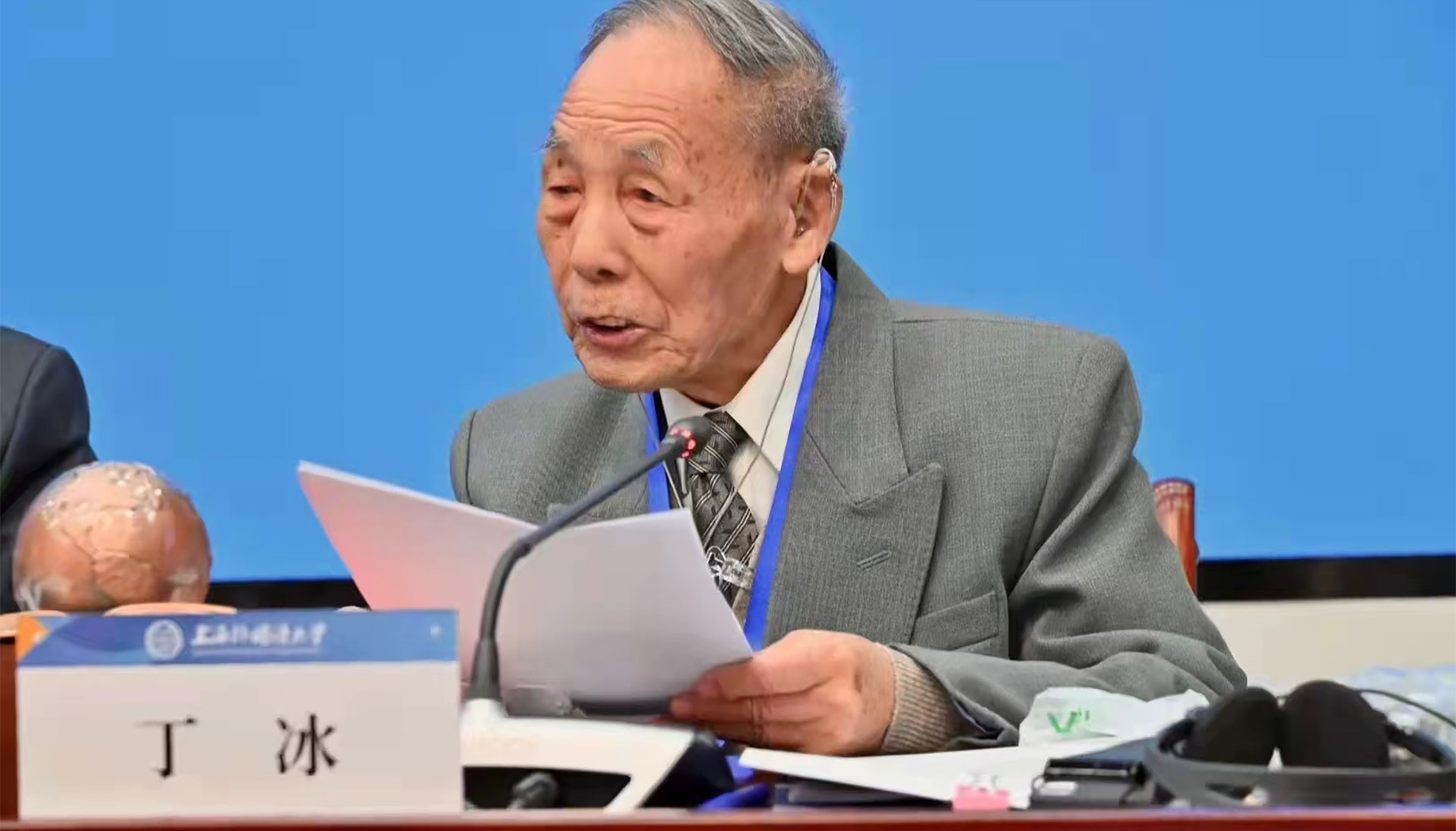
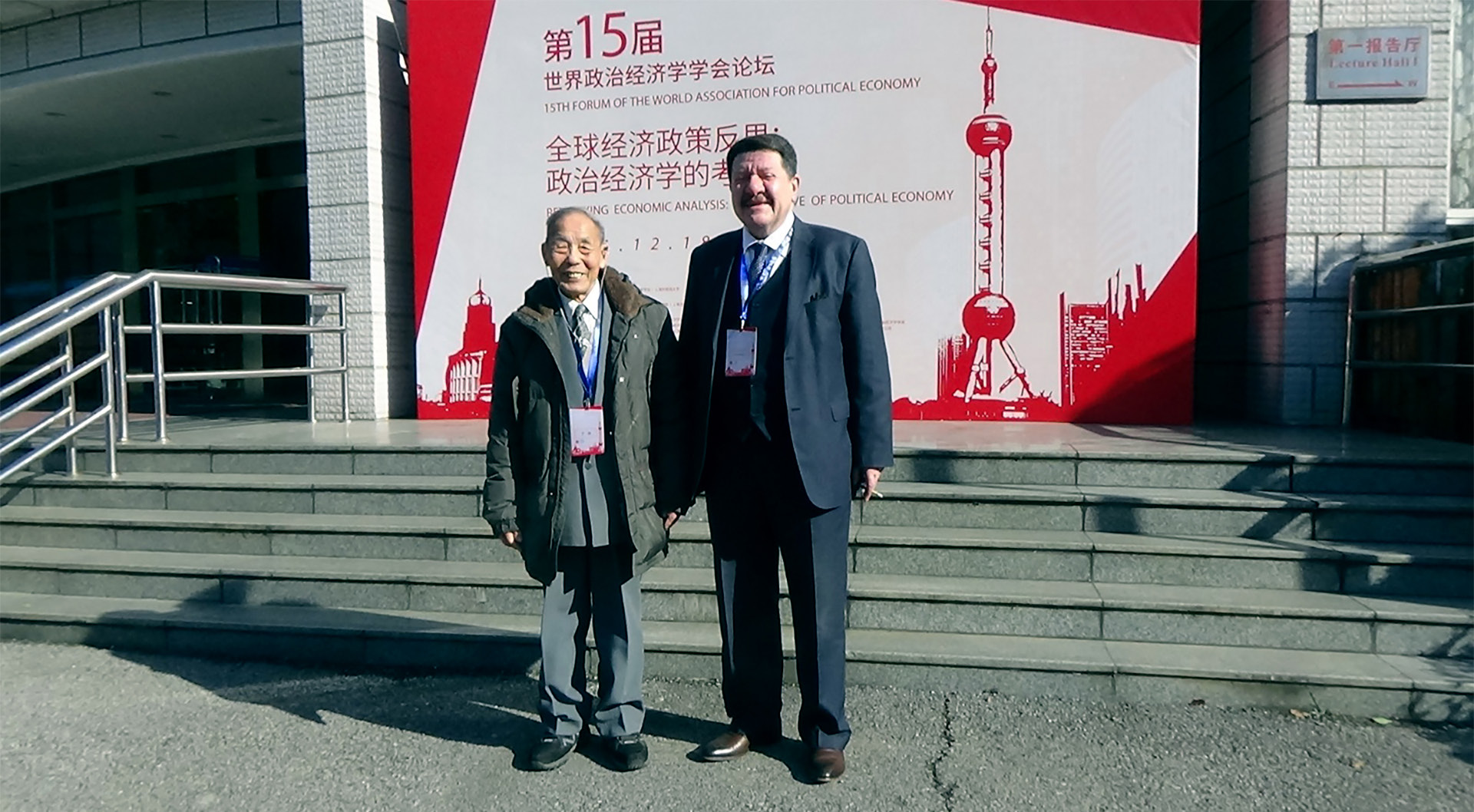
We present to your attention the award acceptance speech of Prof. Ding Bing, professor at Capital University of Economics and Business and General Counsel of China Society of Foreign Economics, at the Plenary Session I (Opening & Awarding Ceremony) of the Fifteenth Forum of World Association of Political Economy (WAPE), held at the Shanghai International Studies University, China, December 18-19, 2021.
I am a professor at Capital University of Economics and Business and also the General Counsel of the China Society of Foreign Economics. Many important domestic magazines have praised me as a prominent “Contemporary Marxist Economist”.
At today’s conference, let me first thank the “World Association for Political Economy” for awarding me with the “World Marxist Economics Prize” in 2020. I am deeply aware that this is not only a personal encouragement, but also a strong incentive for me to actively devote myself to this glorious cause pursued by the World Association for Political Economy, observing and studying the economies of all countries in the world with the support of modern Marxist economy theory, revealing their development laws and operating mechanisms, and exploring the promotion of economic civilization, social progress, and the construction of a community with a shared future for mankind. It’s a great honor.
I was born in April 1930 and began to engage in education in 1954. In 1956, I entered Sichuan University, a central university specializing in economics. In 1959, when I was a student, as one of the editors-in-chief, I co-authored the “Lecture Notes on the History of Foreign National Economies”, the first “economic history of the world” work of modern China guided by Marxism. In the same year, this book was published by the high-er education press and was selected as teaching material by some colleges and universities. After graduating from Sichuan University in July 1961, I was assigned to teach at Beijing Capital University of Economics and Business. Since then, I have successively published a series of treatises, including 15 individual independent monographs, co-au-thorship, being chief editor and deputy chief ed-itor, a total of 104 works, as well as 260 important academic papers and translations. Among them, about 4 million words were written by me.
Among my independent monographs, there are two books: “A Brief History of Marxist Political Economy” (1983) and “Contemporary Western Economic Schools” (1993), which have won the second prize of academic excellence at the provincial and municipal levels in Sichuan and Beijing. “Principles of Contemporary Western Economics” (1988) won the Beijing Municipal Excellent Textbook Award in 2006 and the first prize of excellent textbook award of Capital University of Economics and Trade in 2000. It has been revised and released in the 7th Edition (September 2019). The cumulative number of prints is about three hundred thousand, one of the works with the longest distribution duration and the largest number of similar works in China. The book “Modern Western Economic Theory” edited and published by me in 1995, was also highly praised by Professor Chen Daisun, who is recognized as the leader of economics in China, and believed that it broke new grounds in China’s foreign economic research. Therefore, it has aroused strong repercussions, praise and sensational effect in social science and education. In 1996 and 1998, it successively won the first prize of excellent achievements in Social Sciences at the municipal level in Beijing and the economics prize of excellent achievements in Humanities and So-cial Sciences research in colleges and universities of the ministry of education.
My main academic thoughts and distinctive opinions can be summarized into the following six aspects:
The first is on Western economics:
Guided by Marxism, I have evaluated the theoretical system of Western economics comprehensively and systematically, adhering to the viewpoint of “One Divides into Two” to carry out the analysis scientifically. I have evaluated the “Economic Man” hypothesis, which makes the core of western economics, and pointed out that although it has its relative rationality, it is actually a crude theory defending the eternal capitalist system. Moreover, I have analyzed and criticized the wrong approach of mentioning Marxist economics and Western economics in the same breath, which marginalizes Marxist economics.
Secondly, adhering to the “Four Cardinal Principles” and the general principles and policies of reform and opening up:
I do oppose neoliberalism, democratic social-ism, and other ideological trends that interfere with it.
At the same time, it should be emphasized that “adhering to the dominant position of public ownership is the lifeline of adhering to socialism with Chinese characteristics”.
Regarding property rights, I exposed and criticized some people who try to carry out privatization policy in China in the name of “reform”, relying on some wrong views such as Western Coase Theorem and the so-called “Inefficiency of State-owned Enterprises”.
The third is on “New Economy”:
In the 1990s, with the rapid development of new global high-technology, the academic circles put forward the concept of “New Economy”.
I published the article “A Brief Discussion on the Impact of The New Economy on Western Economic Theory and Economic System”, which took the lead in defining the new economy as an economy based on information technology, driven by intellectual factors and network being the basic production tool. Its essence digitalized and intellectualized the economies. If we deeply analyze this development pattern, the conclusion would be: “The emergence and development of the New Economy further prove Marx’s assertion that mankind will eventually replace capitalism by communism”.
The fourth is from our studies on the 2008 in-ternational financial crisis:
We have clearly pointed out that the world overproduction crisis is the inevitable result of the long-term implementation of financial liberalization policy by western developed countries after the 1970s and 1980s and the rampant development of financial innovation and financial derivatives. In the investigative process, we have found that this overproduction crisis is different from the previous one. That is, it did not only stay as a domestic crisis but also shifted transnationally. That is a remarkable feature of the overproduction crisis.
The fifth is based on research on the development strategy, the “Go Out policy”:
After the international financial crisis in 2008, the US government put forward conservative ideas such as “Pivot to Asia” and “United States first”. Under the US government’s attempts on restraining China’s peaceful rise, I promptly published “Break through the tight encirclement and create a vast new world” and a series of papers, firmly supporting and praising Chairman Xi Jinping’s foreign strategic foresight. “Belt and Road” is a new form of economic globalization based on equality, sharing, mutual benefit, cooperation, and co-construction. First of all, it is strictly differentiated from traditional economic globalization based on negative factors such as exploitation, discrimination, and hegemony, which are often led by the US-centered economic globalization. Therefore, many countries, especially the developing countries, have welcomed it and have formed unstoppable cooperation to change the destructive, old way of economic globalization. “Belt and Road” will also create an important economic foundation and diplomatic line, taking us one step closer to the realization of worldwide unity, a Community of Common Destiny for All Mankind.
Sixthly, we should be confident about the fu-ture:
Considering China’s institutional advantages, the advantages of late technological development, independence and hard work, it is predicted that China’s GDP will surpass the United States by 2028. This also refutes the traditional view of some scholars that the growth rate of a country’s economy will slow down due to its size and population. In addition, we are now in a favorable situation within the fifth long wave rising period of the world economic cycle. Therefore, as long as we unite as one and work hard, if nothing goes wrong, by the middle of this century, the realization of the Chinese Dream, the great rejuvenation of the Chinese nation will be a long-term success. To truly achieve this goal, four main issues need special attention at present:
First, we must bear in mind that we must ad-here to the dominant position of the public economy. Second, we must pay attention to the hidden danger of government debts. Third, we should carefully prepare ourselves to use artificial intelligence (AI) technology wisely. It is suggested to shorten the working hours to 4 working days a week on the premise of adhering to the dominant position of the public economy. Fourth, we should be highly vigilant against falling into the “Thucydides Trap”.
Thank you!