INTRODUCTION
While entering the presidential elections of the Turkish Republic of Northern Cyprus (TRNC) held in October 2020, my main goals in my presidential candidacy declaration titled "A New Era, A New Vision" are; the TRNC should be kept alive and glorified, the Turkish Cypriot People should live in prosperity and security, our relations with the Motherland Türkiye should be developed in a healthy way, our State should take the place it deserves in the world and the possible solution in Cyprus should be based on the existence of two separate sovereign equal states. I explained this vision to our people and asked for their support. Our people have shown their support for this vision-based solution by electing me as the President of their own free will.
I sincerely believe that our solution proposal, based on the confirmation of our sovereign equality and equal international status, which I put forward before and during the Presidential elections, and which envisages institutional cooperation between the parties, is just and necessary not only in the Island but also in the Eastern Mediterranean region, considering the latest developments in the broader region and beyond. I firmly believe this will be understood by everyone that it is the only key to lasting and sustainable peace in Cyprus.
The details of the Cyprus issue are not very well known except for experts working on this issue, but it is a vital issue for the whole Turkish World. The honorable struggle of the Turkish Cypriot people for centuries is not just a struggle for existence. It also includes many global and local struggles. It is not correct to see this struggle only as a Turkish-Greek struggle. This struggle is also the struggle for the existence of Turkishness on the island, the heroic struggle of an oppressed people, who are numerically a minority, against the aggressive majority, the struggle to protect our culture, religion, and identity, a struggle for a civilizational conflict, and in a way, the domination of the West, over the East which has been going on for centuries in different dimensions.
Deriving from these points, in this article I will try to explain the political future of the TRNC and its vital importance for the Turkish World in light of the latest developments in the Eastern Mediterranean, through three main interrelated topics: Cyprus negotiation process and a solution based on the existence of two sovereign equal states, TRNC’s political future in the Eastern Mediterranean, its importance for Türkiye and the necessity of recognizing the TRNC.
The details of the Cyprus issue are not very well known except for experts working on this issue, but it is a vital subject for the Turkish World. The honorable struggle of the Turkish Cypriot people for centuries is not just a struggle for existence. It also includes many global and local struggles. It is not correct to see this struggle only as a Turkish-Greek struggle. This struggle, at the same time, is the struggle for the existence of Turkishness on the island, the heroic struggle of an oppressed people, who are numerically a minority, against the aggressive majority, a struggle for a civilizational conflict, and in a way, it is the question of the West’s domination over the East, which has been going on for centuries in different dimensions. Turkish Cypriots defended their destinies by giving great struggles on the island, gained their freedom as a result of the 1974 Cyprus Peace Operation, and the Turkish Republic of Northern Cyprus, which we established in 1983, became the second Turkish state in the Turkish World to gain its independence other than the Republic of Türkiye. Cyprus is of great importance in terms of the security of the Republic of Türkiye, the continental shelf, the Exclusive Economic Zone, the control of the airspace, and the strategic defense depth of Türkiye. The TRNC is not simply a piece of land for Türkiye and the Turkish world. The point that the honorable struggle of the Turkish Cypriot people with their blood and life for more than half a century should reach, is an internationally recognized, sovereign, and independent state. A new era has begun, in which new decisions will be implemented and the equal sovereignty of the Turkish Cypriot People will be at the forefront.
The Cyprus Negotiation Process and the Solution Based on the Existence of Two Equal Sovereign States
The first point to be underlined regarding the Cyprus issue is the emphasis that the Republic of Cyprus, which was established on 16 August 1960, has a sui generis character, which is unique and has no other example, since it is not similar to the founding treaties of any other country. Contrary to many other states in the world, the Republic of Cyprus was founded on principles and regulations, based on the vested equality of the Turkish and Greek Cypriot peoples on the Island, where one side cannot establish superiority over the other. This point is very important and constitutes the essence of the Cyprus issue.
Archbishop Makarios, the Greek leader and the President of the Republic of Cyprus at that time, did not accept the political equality of the Turkish Cypriots since the establishment of the Republic, insisted at every opportunity that "Cyprus is a Hellenic island" and that "the Turkish minority cannot interfere with the political will of the Greek majority". According to Makarios, the establishment of the Republic of Cyprus was a stepping stone for the Greeks’ eternal political goal, enosis the annexation of Cyprus to Greece. It soon became clear that Makarios words were not just rhetoric. In the December 21 attacks, which went down in history as the "Bloody Christmas" attacks, the Greek army, equipped with heavy weapons, systematically attacked the Turks.
As a result of these attacks, more than a quarter of the Turkish Cypriot population was forced to leave their homes in mixed villages and migrate to villages and areas inhabited only by Turks. Turkish Cypriots were condemned to live in 39 isolated areas spread over the island, surrounded by Greek armed forces. The Greek-occupied government did not provide any services to the areas protected by the Turkish Cypriot mujahedeen, and thousands of Turkish Cypriots were deprived of their most basic needs. Moreover, dozens of Turks, who had to leave their regions to work and meet their other needs, were kidnapped and murdered by the Greeks. After 1963, the so-called Republic of Cyprus turned into a Hellenic state, in violation of the constitution and international treaties.
As a reflection of all these, the Cyprus negotiation processes, which started in 1968, have not reached a positive result until today due to the uncompromising and negative attitude of the Greek Cypriots. The main reason for the deadlock in Cyprus is the Greek side’s never-changing obsession with being the sole
administration and wealth with the Turkish Cypriots.
What the Greek side understands from a federal-based agreement is to patch the Turkish Cypriot people as a minority into the so-called Republic of Cyprus, which turned into a Hellenic state after Turkish Cypriot people were expelled by force from the Republic of which they were a founding partner. The Greek position is the removal of Türkiye’s guarantorship and thus by removing Turkish soldiers from Cyprus to reach its final political objectives. With the self-confidence of being an internationally recognized government on the island, the Greek Cypriot administration will never give up on this policy. The results of the 2004 Annan Plan Referendum and the collapse of the 2017 Crans-Montana talks despite all the concessions made by the Turkish side showed the whole world that a bi-zonal and bi-communal federal solution in Cyprus has now been exhausted.
All these facts show that the Turkish and Greek peoples of the island, who have a bloody past, different languages, religions, cultures, and lifestyles, cannot live together with a federal solution, and even if this is achieved with a forced treaty, this will not last long. Therefore, it has become evident which solution model cannot work in Cyprus. Until today, the solution in Cyprus has always been perceived by the international community as satisfying the wishes of the Greek side and the so-called "reunification" of the Island. However, the changing international and regional conjuncture shows that this perception is wrong day by day.
It is a necessity to go beyond stereotypes and established parameters in order to achieve consensus in Cyprus. A just, sustainable, and lasting solution in Cyprus can only be achieved by the reflection of the equality of the two sovereign peoples on the Island in their international status, which is recognized in accordance with international treaties. This can only be possible with the existing two-state reality and arrangements that will not impose the sovereignty of one side on the other.
After I was elected as President, I brought up our solution proposal which envisages institutional cooperation between two sovereign equal states, also supported by the most powerful country in the region, that is Motherland Türkiye. I have consistently emphasized that there will be no turning back from our proposed solution, and this is the only solution based on the realities of Cyprus that not only benefitted both Sides but also the regional countries.
In the informal Cyprus conference in 5+1 format, which was held in Geneva, Switzerland on 27-29 April 2021, under the leadership of United Nations (UN) Secretary-General Antonio Guterres, with the participation of the Turkish and Greek Cypriot Parties and the guarantor countries of Türkiye, Greece and the United Kingdom, I presented a 6-item proposal for a permanent solution in Cyprus to the United Nations and all the interested parties. With this proposal, for the first time, our solution proposal based on the sovereign equality and equal international status of the two Sides was put on the table.
The essence of the Turkish Cypriot proposal is the UN Secretary-General taking the initiative and passing a new UN resolution and reaffirming the recognition of the inherent sovereign equality and equal international status of the State of the Turkish Cypriot people, through which a cooperative relationship can be established between the two existing States on the Island. This would pave the way for results-oriented, time-framed negotiations toward a realistic and sustainable settlement. Such a cooperative relationship needs to be based on the following principles and arrangements: 1. The Secretary-General is to take an initiative so that the Security Council adopts a resolution in which the equal international status and sovereign equality of the two sides is secured. Such a resolution will form the new basis for the establishment of a cooperative relationship between the two existing States.
It is a necessity to go beyond stereotypes and established parameters in order to achieve consensus in Cyprus.
2. Once the equal international status and sovereign equality of the two sides is secured through the above-mentioned arrangement, they will enter into results-oriented, time-framed negotiations, on this new basis, under the auspices of the UN Secretary-General to establish a freely-reached and mutually acceptable cooperative agreement.
3. The negotiations will focus on the future relationship between the two independent States, property, security, and border adjustment, as well as relations with the EU.
4. The negotiations will be supported by Türkiye, Greece, and the UK, as well as, where appropriate, the EU as an observer.
5. In the context of any agreement the two States will mutually recognize each other; the three Guarantor States will support this.
6. Any agreement to be reached as a result of these negotiations will be submitted for approval in separate simultaneous referenda in the two States.
In Geneva, we both recorded these proposals in the official UN records and announced them to the whole world. In the closing speech of the informal conference, Secretary-General Antonio Guterres stated that a bi-regional and bi-zonal federal solution has now become a Greek thesis and that the Turkish side’s solution proposal passes through a new solution based on sovereign equality and equal international status. Therefore, our vision has also been announced by the highest UN representative.
At the meetings I held with Guterres in Brussels on June 25, 2021 and in New York on 25 September 2021, and at the informal tripartite meeting held in New York by Guterres on 27 September 2021 and in the presence of the President of the Greek Cypriot Administration Nikos Anastasiades, I once again expressed our views on the Cyprus issue and once more confirmed that the equality and international status of the Turkish Cypriot people is essential for the start of official negotiations.
If the Greek-Cypriot side can get rid of the obsession of being the sole ruler of the island and evaluate the Turkish side’s proposal with a pragmatic mentality, it will gain great benefits from such a solution. The only way for the Greek Cypriot side to normalize its relations with Türkiye and for all sides to benefit from the rich hydrocarbon resources around the island is to make an agreement with the Turkish Cypriot side. President Erdoğan welcomed President Ersin Tatar with an official ceremony. (October 26, 2020October 26 (2020). The source article does not provide a separate full bibliographic entry for this citation.) (Website of the Presidency of the Turkish Republic of Northern Cyprus, 2020Website of the Presidency of the Turkish Republic of Northern Cyprus (2020). The source article does not provide a separate full bibliographic entry for this citation.)
The Importance of the TRNC in the Eastern Mediterranean
Cyprus is the third largest island in the Mediterranean after Sicily and Sardinia. The island has a unique strategic and geographical location and importance in the Eastern Mediterranean. Due to this special location, the geo-strategic importance of Cyprus, which has been a center of attraction for many civilizations throughout history, has always remained constant. 68% of the world’s known oil reserves and 41% of natural gas reserves are located in the Middle East region, which is connected to the Mediterranean. 70% of Europe’s hydrocarbon consumption passes through the Eastern Mediterranean. Therefore, Cyprus Island is in a geography where energy resources in the Middle East, Caucasus, and Central Asia are open to the outside world. The importance of Cyprus has increased even more recently with the natural gas resources discovered in the Eastern
Cyprus also acts as a jumping-off point, supply facilities, and forward base for intervention in crisis areas in the Middle East. The island of Cyprus is a valuable base for military build-up, and air and naval forces. For this reason, the UK maintains its bases in Cyprus, despite closing many of its bases around the world. To summarize, Cyprus has often been described as a "submarine that never sinks", due to its proximity to the Middle East and the Suez Canal, its strategic location in the Mediterranean.
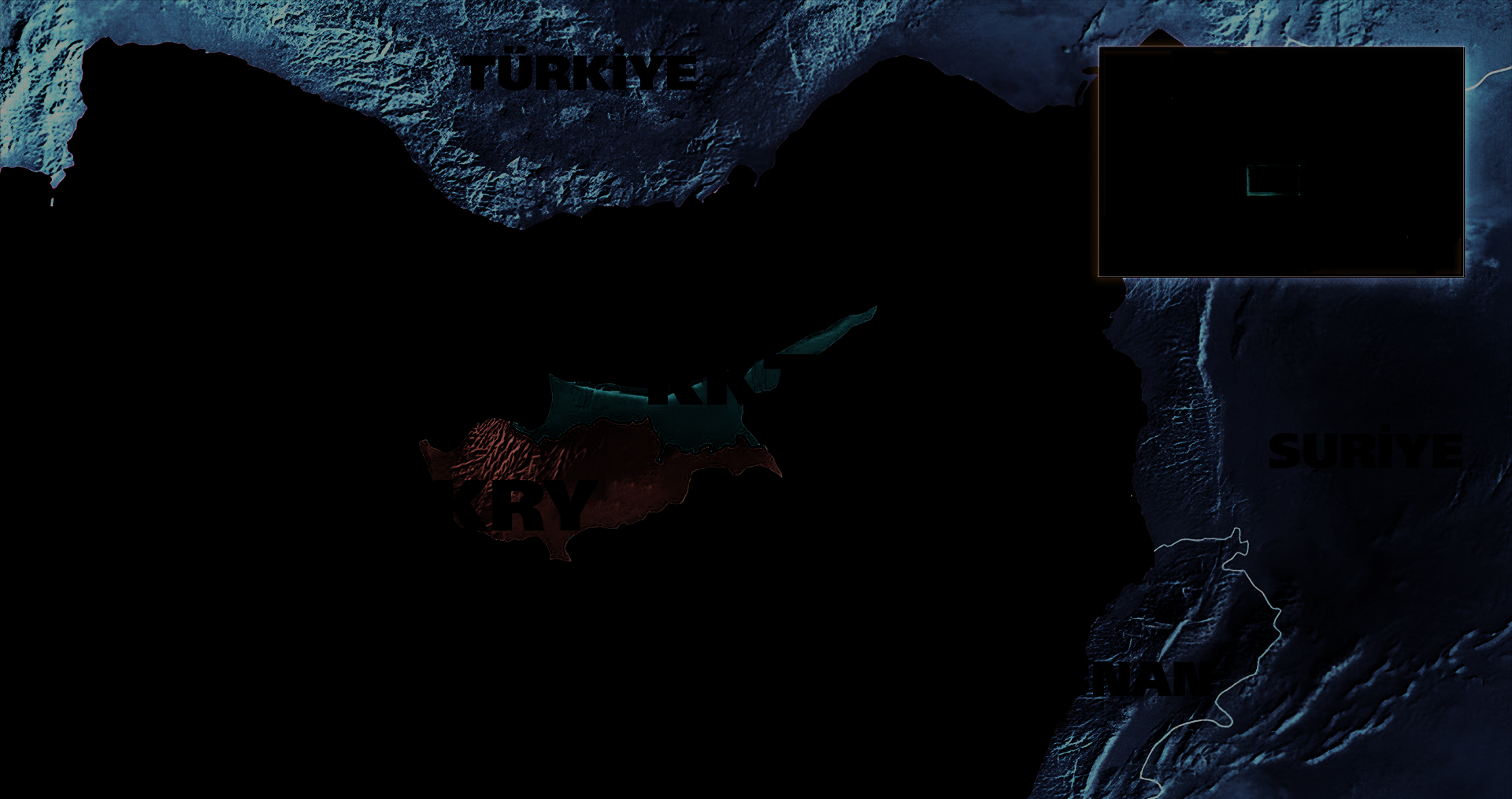
Cyprus also occupies a particularly important strategic position for the security of the Republic of Türkiye. Cyprus is only 40 nautical miles (70 km) from Türkiye. The island of Cyprus is of great importance for Türkiye in terms of providing a safe exit to the Mediterranean from the south, controlling the maritime transport lines in the region, controlling the territorial sea, continental shelf, Exclusive Economic Zone, airspace, and strategic defense depth of Türkiye.
The fact that Türkiye is surrounded by Greek islands in the Aegean Sea and all the islands except Gökçeada and Bozcaada have been lost to Greece further increases the importance of Cyprus for Türkiye. Greece, which currently controls about 44% of the Aegean Sea, will control about 72% of the Aegean Sea if it extends its continental shelf to 12 miles. If Cyprus comes under Greek-Cypriot sovereignty with a federal structure, both Türkiye’s security will be in danger and Turkish ships will become virtually unable to sail to the open seas.
Again in this context, strategic products, and oil imports will be of vital importance in case of any crisis or armed conflict in which Türkiye could be involved. If a single country controls the whole of Cyprus, as in the Aegean, Türkiye will have difficulty in ensuring the security of its supply routes.
An indispensable dimension of the importance of Cyprus for Türkiye stems from the Turks living on the island. The island remained under Turkish rule for approximately 350 years between 1571 and 1914. In this period, Turks brought to Cyprus from various parts of Anatolia formed the ancestors and origins of today’s Turkish Cypriots, and Cyprus became a Turkish homeland.
The necessity of Recognition of TRNC
In recent years, there have been critical developments in Cyprus and in the region. In this connection, the geopolitical situation in the Eastern Mediterranean has turned into a new struggle over hydrocarbon resources.
While Türkiye which has the longest seashore on the Eastern Mediterranean and is only 70 km far from Cyprus, is trying to be excluded from the political equation in the Eastern Mediterranean while some regional actors and global powers continue their efforts to establish dominance in the Eastern Mediterranean. This situation led to an intense and complex political struggle, as well as the intensification of tension and military activities in the region.
From the Turkish side’s point of view, the "Blue Homeland" lies at the heart of this struggle. Considering Türkiye’s homeland, the Blue Homeland corresponds to more than half of these lands. Blue Homeland is a challenge to the policies that try to isolate Türkiye and the TRNC from the seas. There is no difference between claiming any land in Türkiye and the TRNC and claiming a territory within the Blue Homeland.
Despite their limited population, land area, and military and economic power, Greece and the Greek Cypriot Administration (GCA) follow an expansionist policy in the Eastern Mediterranean by using the islands, which are their only trump card in the political sense. At every opportunity, they show their aim to shrink Turkish territorial waters by 3.5 times and reduce it to 41 thousand square kilometers and therefore, confine Türkiye to the Gulf of Antalya by ignoring the rights of Türkiye and the as envisaged in the Sevilla Map.
At this point, the importance of the TRNC emerges once again. The Blue Homeland doctrine can only survive if the TRNC exists. For Türkiye to defend its legal and political rights in the Eastern Mediterranean, recognition of the TRNC’s sovereignty over land, sea, and air is essential. Again, in this context, this is the only way to prevent the maximalist and expansionist steps that Greece and the Greek Cypriot Administration will take by ignoring Türkiye’s Exclusive Economic Zone.
As a result, the dissolution of the TRNC, which is the mainstay of Turkish sovereignty in the Eastern Mediterranean, will mean that Türkiye is isolated from the Eastern Mediterranean and imprisoned in the Gulf of Antalya. In other words, the recognition of the TRNC has now become a must for Türkiye. It has gained great importance to ensure the international recognition of the Turkish Cypriot State, which has maintained its existence effectively with its institutions since 1974, in order to protect the rights of Türkiye and the TRNC in the Eastern Mediterranean in an effective and de facto manner.
At this very point, the President of the Republic of Türkiye Recep Tayyip Erdogan, in his speech at the 77th UN General Assembly on September 20, 2022, in New York, called on all countries to "recognize the TRNC", while creating a new era for the TRNC, and on the way to recognition which was the first step taken. After this historic call, the inclusion of the call to "recognize the TRNC" in the declaration of the National Security Council of the Republic of Türkiye dated September 28, 2022, gave very important messages that irreversibly changed the paradigms in Cyprus politics. All these developments show that the elements put forward by Mr. Erdogan on behalf of the Republic of Türkiye are not a temporary position but a state decision.
The TRNC State, which meets all the conditions of being a state defined by international conventions, also has the capacity to establish relations with other countries. TRNC has representations in 20 different countries, including its Embassy in Ankara and Consulate Generals in Istanbul, Izmir, Antalya, Mersin, Trabzon, and Gaziantep. Although the international community does not officially recognize it, there is the TRNC reality on land, at sea, and in the air. Every country in the world, especially the Greek-Cypriot side, knows very well where the sovereignty of the TRNC begins and ends. There are two separate States on the island of Cyprus, which are different from each other and have been separated for half a century, with their own institutions, legislative, executive, and judicial organs.
The issue of how the future of the TRNC should be shaped is now one of the common issues that the Turkic World needs to solve. We believe that the closer, collaborative and intense relations Türkiye developed with the Turkic World in this period triggered important dynamics in every field, especially in the political and economic fields. The key to paving the way for our two-state solution proposal will undoubtedly be the further development of our existing relations with Motherland Türkiye and friendly and brotherly countries. It is of great importance that the Turkic World, which shares the same values as the TRNC, under the leadership of Türkiye, establish a strong coalition and actively implement the policy understanding for the recognition of the TRNC.
In this context, if the Organization of Turkish States was established under the leadership of the Republic of Türkiye, TRNC should naturally take its rightful place as the second Turkish State that gained its independence in the Turkic World. I have consistently expressed our wish and desire on this matter. We are so happy that The TRNC State meets all the conditions for being a state and has the capacity to establish relations with other countries. at the 9th Organization of the Turkic States Leaders’ Summit held in Samarkand, Uzbekistan, the observer membership of the TRNC was unanimously accepted. Our state gained this status for the first time in an international organization with its constitutional name, namely the Turkish Republic of Northern Cyprus. This milestone that will go down in the pages of history is an additional source of pride for us.
Again, as a start, the participation of Turkish Cypriot Youth in sports and cultural activities to be held in the Turkic World and increasing their visibility will act as a pioneer in eliminating this shame of humanity. The Organization of Turkic States can undoubtedly be the main part of the bridge we will build from the Eastern Mediterranean to Central Asia in order to strengthen the bonds of brotherhood between us, protect the Turkic World from common dangers, and support this rightful struggle of the TRNC in search of status.
Concentrating on initiatives for the recognition of the TRNC by the Turkish World will facilitate the establishment of a permanent and fair peace agreement between the parties. Increasing recognition and visibility will ease the pressures on the TRNC and Türkiye, change the ground of negotiations and meetings, and cause the Greek Cypriot Administration to adopt a more constructive and conciliatory attitude.
Conclusion
Turkish Cypriots defended their destinies by giving great struggles on the island, gained their freedom as a result of the 1974 Cyprus Peace Operation, and the Turkish Republic of Northern Cyprus, which we established in 1983, became the second Turkish state in the Turkic World to gain its independence after the Republic of Türkiye. Cyprus is of great importance in terms of the security of the Republic of Türkiye, the continental shelf, the Exclusive Economic Zone, the control of the airspace, and the strategic defense depth of Türkiye. In other words, Cyprus is not simply a piece of land for Türkiye and the Turkish world.
On the other hand, recent developments in the Mediterranean have increased the importance of the region. Especially the developments after Russia’s invasion of Ukraine showed once again the importance of trust and stability, especially in the Eastern Mediterranean. There is no doubt that there is a solution to all the problems experienced on the continental shelf and energy resources in the Eastern Mediterranean. For this, all neighboring countries should seek solutions in common sense by showing the necessary respect for each other’s rights.
In this context, a fair, realistic, practical, and sustainable agreement in Cyprus can only be reached with cooperation based on the existing realities on the Island, namely two separate Peoples and two separate States, and the sovereign equality of the two States and their equal international status. With this new solution proposal based on a "win-win" approach, both sides will gain many political and economic gains. This model will also not only ensure that the island is an island of peace, tranquility, and stability but also act as a catalyst for solving the problems in the Eastern Mediterranean and the region.
Although the international community does not officially recognize it, there is the TRNC reality on land, at sea, and in the air. According to international law, the TRNC has a legitimate state structure that meets all conditions. We see that the TRNC, which has full-fledged institutions and organizations, is in a much better situation than the well-known state, which deals with many socio-economic and political problems. In addition, when we see many people who want to become a state in the world but have not succeeded, we once again understand how important our state is and that we cannot take a step back. At this point, where the interests of Türkiye and the TRNC completely coincide, it is of great importance for the TRNC to be strengthened internally and externally.
As a final word, I would like to express that the honorable struggle of the Turkish Cypriot people with their blood and life for more than half a century should reach to the attainment of an internationally recognized, sovereign, and independent state. The fire of struggle has been started. A period has begun when new decisions will be implemented, the equal sovereignty of the Turkish Cypriot people will be at the forefront and the equal international status of the Turkish State in Cyprus will be established.